
AI memory vs shared context
ChatGPT custom instructions for a whole team
ChatGPT custom instructions and memory are per-account, so a team cannot share them natively. Here is how to give a whole team one shared context to read.
You cannot give a whole team one set of ChatGPT custom instructions, at least not natively. Custom instructions and memory in ChatGPT are tied to a personal account. Each person writes their own, ChatGPT learns about each person's work separately, and there is no built-in switch that publishes one set of instructions to everyone's ChatGPT. So "team custom instructions" is not really a ChatGPT feature. It is something you have to build around the tool.
Here is what the tool gives you, where it stops, and how to make a team actually share context.
What ChatGPT custom instructions do
Custom instructions are a per-account setting. You tell ChatGPT how you want it to respond and what it should know about you and your work, and it applies that across your chats. Memory is the companion feature: ChatGPT retains things from your conversations and carries them forward in your account.
Both are genuinely useful, and both are personal. They make your ChatGPT better for you. They do nothing for your teammate's ChatGPT, because that is a different account with its own instructions and its own memory. We go deeper on this split in ChatGPT memory vs team memory.
Where it stops for a team
Once more than one person is involved, the per-account design becomes the whole problem.
- No shared instructions. There is no native way to define one set of instructions the team's accounts all read. Everyone maintains their own, and they drift. The same per-account limit hits other assistants too, including GitHub Copilot custom instructions for teams.
- No shared memory. What ChatGPT learned about the project in your account is invisible to everyone else's. The knowledge does not pool.
- Pasted preambles rot. The common workaround, a block of "here is our project" text everyone pastes at the top of a chat, is out of date the moment a decision changes, and nobody re-pastes the new version everywhere.
- It does not reach your coding tools. A decision you reached in a ChatGPT planning session does not land in Cursor or Claude Code, which is exactly why sharing context between Cursor and ChatGPT needs a deliberate setup.
So you can get each person's ChatGPT tuned nicely, and still have a team where two people ask the same question and get answers grounded in different facts.
The fix: one shared source, read over a remote endpoint
For a team to share context through ChatGPT, the context cannot live in personal custom instructions. It has to live in one source every account reads.
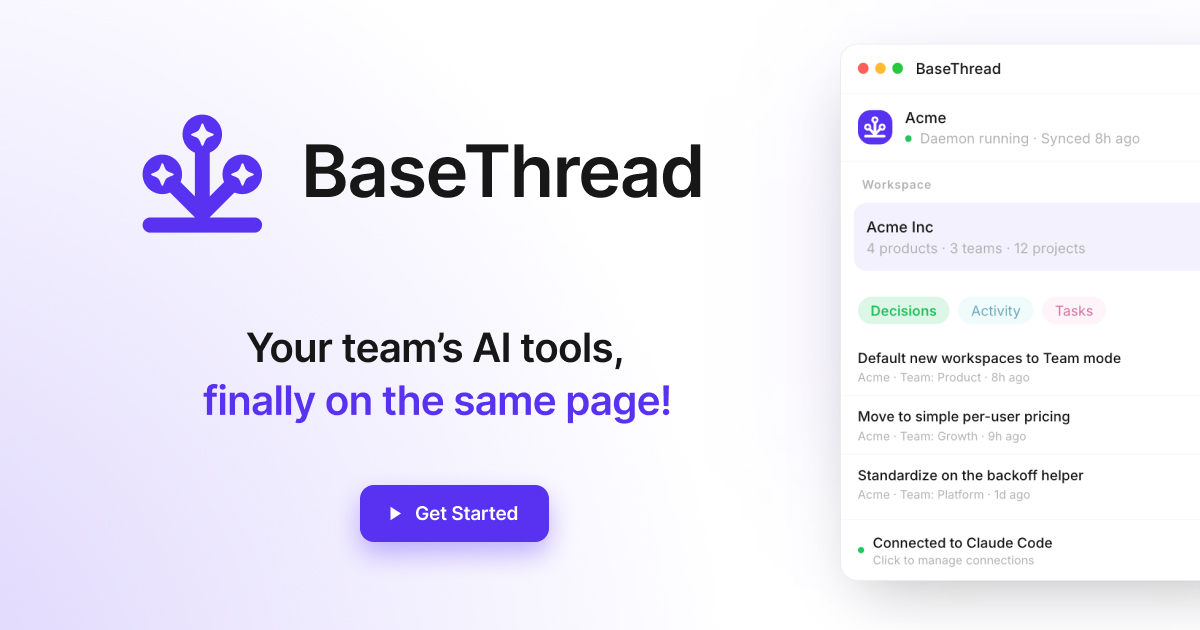
That is what a shared context layer does. BaseThread keeps a curated context graph for your team, curated, not scraped, organized into layers like Company, Products, Teams, Projects, and You, with three streams: Activity for what happened, Decisions for what you settled and why, and Tasks for what is next. ChatGPT reads it over MCP through the remote endpoint at mcp.basethread.ai, and your coding tools read the same source through the local Mac app. As work happens, tools write activity, decisions, and tasks back, so the source stays current.
In practice:
- The team curates the project, the decisions, and the conventions once, in one place.
- Each person's ChatGPT reads the relevant slice over the remote endpoint, so answers are grounded in the same facts instead of in each person's preamble.
- A decision logged from any tool is there for everyone's next chat, so the knowledge pools instead of staying stuck in one account.
- The same source feeds your editors, so a planning chat and the code agree.
Keep personal custom instructions for personal taste, how you like answers formatted, your role. Put the shared project truth in the layer. This is shared context for AI tools applied to the limits of per-account ChatGPT.
The quick test
Ask two teammates to pose the same project question to their own ChatGPT. If the answers disagree, you are running on per-account instructions, not shared context. One source removes the gap.
TL;DR
ChatGPT custom instructions and memory are per-account, so a team cannot share them natively. Pasted preambles drift and personal memory never pools into team knowledge. To give a whole team consistent context, keep the project, decisions, and conventions in one shared source every account reads over a remote MCP endpoint, and let tools write activity, decisions, and tasks back so it stays current. The same source feeds your coding tools too.
Give your whole team one shared context that ChatGPT and every coding tool reads.
Related reading
ChatGPT memory vs team memory: why per-user doesn't scale
ChatGPT memory vs team memory: ChatGPT memory is personal and single-tool. Here is why per-user memory never becomes team knowledge, and what does.
How to share context between Cursor and ChatGPT
Share context between Cursor and ChatGPT without copy-paste. Keep one source both tools read over MCP, so your project context follows you between them.
What is shared context for AI tools? (2026 guide)
Shared context for AI tools is the company, project, and decision background every AI reads automatically, so your whole team's tools stop guessing.
GitHub Copilot custom instructions for teams
Set up GitHub Copilot custom instructions for a team with copilot-instructions.md, see where repo-scoped instructions stop, and how to share context.
Frequently asked questions
Can a whole team share ChatGPT custom instructions?
Not natively. Custom instructions and memory in ChatGPT are tied to a personal account. Each person sets their own, and there is no built-in way to publish one set of instructions that everyone's ChatGPT reads. The closest workarounds are copy-paste or a pasted preamble, both of which drift.
Is ChatGPT memory shared across users?
No. ChatGPT memory is per-user. What ChatGPT learned about your work in your account is invisible to a teammate's account, and there is no shared team memory layer in the product itself.
How do I keep my team's ChatGPT answers consistent?
Put the facts the answers depend on in one shared source outside the account, and have everyone's ChatGPT read it over a remote MCP endpoint. Consistency then comes from the shared source, not from each person maintaining identical custom instructions.
Does this work for ChatGPT and coding tools together?
Yes. A shared context layer is read over MCP by ChatGPT through the remote endpoint and by editors like Cursor or Claude Code through a local bridge, so a planning chat and the editor work from the same facts.