
Shared context for AI tools
What is shared context for AI tools? (2026 guide)
Shared context for AI tools is the company, project, and decision background every AI reads automatically, so your whole team's tools stop guessing.
Every new AI session starts from zero. You open a fresh chat or a new tool and re-explain who you are, what you are building, and what the team already decided. It is a tax you pay over and over. At the team level it is worse: each person's AI works in isolation, with no idea what anyone else's tools just did or agreed.
The usual fixes do not hold. A rules file lives in one repo and one tool. A wiki is something people read, not something an AI tool reads on its own. Pasting the same context into every prompt drifts the moment someone changes it. The missing piece is a single place every tool can read, that stays current as the work moves. That is shared context.
Definition
Shared context for AI tools
Shared context is the company, product, project, and decision background your AI tools need to answer well, kept in one structured place that every tool reads automatically, and that every teammate shares. It is cross-tool, team-wide, and curated, not a single tool's private memory.
Why does every AI tool start from zero?
A model only knows what is in front of it. The model weights hold general knowledge; everything specific to your situation has to arrive as context at the start of the task. With no shared source, that context comes from whatever the person remembered to paste, which is usually thin and quickly stale.
The result is the pattern every team knows:
- The AI suggests an approach the team reversed two sprints ago, because nothing told it the decision was made.
- Two engineers' assistants make contradicting choices on the same service in the same week.
- A new hire's tools know nothing about the codebase, so the new hire becomes the slowest part of onboarding.
- A marketer's AI pitches a feature that slipped, because the roadmap lives somewhere the tool cannot see.
None of these are model failures. They are context failures. Anthropic now calls the discipline of getting the right information in front of a model context engineering, and they frame it plainly: the quality of an AI's output is mostly the quality of the context it was given. Shared context is context engineering done once, for the whole team, instead of ad hoc in every prompt.
What does shared context actually mean?
Shared context is the deliberate, structured background your tools read. In practice it has three parts.
The structure: what is true. Your company and how it works, the products you build, the teams and projects in flight, and, for individuals, your own role and preferences. Organized so a tool can read the slice that fits the task instead of the whole thing.
The record: what happened and what was settled. A running ledger of activity (what shipped, what changed) and decisions (what the team agreed, and why). This is the part a wiki and a rules file miss entirely: the living history that makes an answer fit reality instead of last quarter's plan.
The forward view: what is next. Tasks, who owns what, by when, so a tool answering "where does this stand" can see the open work, not just the past.
Put together, that is a context graph: the structure, the record, and the forward view, connected, so a question about a decision can surface the work and the people behind it. We go deeper on the record in what is an AI activity and decisions ledger.
How is shared context different from memory, RAG, a wiki, or a rules file?
This is where most confusion lives, because several adjacent things sound similar. The short version: each of the others gets one or two properties right and misses the rest.
| Approach | Cross-tool | Team-shared | Auto-updated | Curated structure |
|---|---|---|---|---|
| Built-in memory (ChatGPT, Claude, Cursor) | No, one tool | No, per user | Yes | No |
| A rules file (.cursorrules, CLAUDE.md) | No, one tool/repo | No, per file | No, hand-edited | Partly |
| A team wiki (Notion, Confluence) | No, humans read it | Yes | No | Yes |
| Memory APIs / RAG you build | Yes, if you build it | Depends | Depends | No, raw recall |
| Shared context (BaseThread) | Yes, every tool | Yes, whole team | Yes, AI-written | Yes |
A few honest distinctions:
- Memory is personal and single-tool. ChatGPT memory, Claude's memory, and Cursor memories each remember you, inside that tool. None of them give your teammate's Cursor the decision your Claude Code just logged. We cover this fully in AI memory vs shared context.
- A rules file is great until the team grows. A
CLAUDE.mdor.cursorrulesis a fine start for one repo and one tool, but it is static, hand-maintained, and per-tool. Keeping several of them in sync across a team becomes its own chore, see keeping CLAUDE.md and .cursorrules in sync. - A wiki is read by people, not tools. It is curated and team-shared, but your Cursor cannot read your Confluence at the start of a session, and nobody updates it the day a decision changes.
- Memory APIs and RAG are building blocks, not a product. They give an agent recall over documents, which is useful infrastructure, but there is no curation, no shared team layer, and no record of what the team decided.
Shared context is the combination the others miss: cross-tool, team-shared, auto-updated, and curated. See the full breakdown on the compare page.
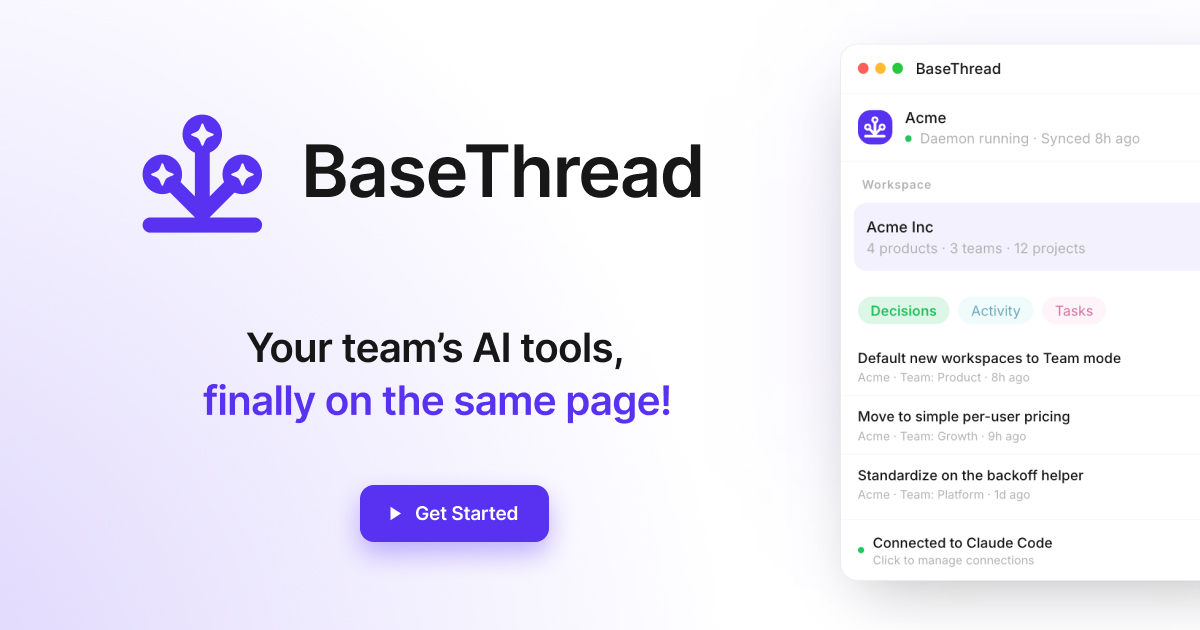
How does shared context reach your tools?
Through the Model Context Protocol (MCP), the open standard for connecting AI tools to outside context. MCP went from a late-2024 release to one of the fastest-adopted standards in AI tooling, with thousands of public servers and support across the major assistants.
With BaseThread the flow is a loop, not a one-time paste:
- Define once. Your team curates its context: the structure, plus the running activity, decisions, and tasks.
- Read everywhere. Every MCP-capable tool reads the relevant slice at the start of a session, locally through the desktop app or remotely over a hosted endpoint. Claude Code, Cursor, ChatGPT, Gemini CLI, Windsurf, and Copilot all read the same source.
- Write back. When a tool finishes work, its AI writes a structured summary of what shipped and what was decided back to the ledger, so the next session, and the next teammate, start already caught up.
Define once, read everywhere, written back automatically. That loop is the whole point, and it is what the how it works page walks through end to end. For the team-server side of this, see MCP for teams.
Why does this matter more for a team than for one person?
For an individual, shared context is convenience: your tools stop making you repeat yourself. Useful, but not the reason the category exists.
For a team it is coordination. The hard problem is not that one tool forgets you. It is that ten people's tools each hold a different, partial picture, and no two of them agree.
- One curated context graph means engineering, design, and product all work from the same decisions, not three private versions.
- An AI-written activity ledger means the team's tools brief each other, so work is not duplicated or contradicted across people.
- A decision logged once, by the AI that watched the conversation, reaches every other teammate's tools from then on.
Put together, that is what we mean by a second brain for your team's AI: one shared place that every tool reads from and contributes to. This is the part single-tool memory structurally cannot do, because it is per-user by design, and the reason we think of it as the team-context problem nobody has solved yet. It is also why the value lands hardest on cross-functional work, where a handoff between roles is exactly where context normally gets lost.
The quick test
If your AI tools each know you but none of them know what your team decided last week, you have memory, not shared context. The gap between those two is the whole job.
Explore shared context, topic by topic
This is the hub for the topic. The cluster goes deeper on each part:
- The bigger idea: a second brain for your team's AI, the umbrella this all rolls up to, and team second brain vs personal second brain.
- Memory vs context: AI memory vs shared context and why per-user memory doesn't compound into team knowledge.
- How tools read it: MCP for teams and how to set up a shared MCP context server.
- For engineers: a second brain for engineering teams and AGENTS.md vs CLAUDE.md vs .cursorrules.
- The problem it solves: the team-context problem nobody has solved and stop re-explaining your project to AI.
- How we compare: how BaseThread is different.
How do you start with shared context?
You do not need to move your team's whole brain in on day one. The fastest path to value:
- Write a little real context. A few lines on the company, the current project, and the conventions you actually follow beats a blank slate immediately.
- Connect one tool. Point Claude Code or Cursor at the shared context over MCP and watch the next answer fit your situation instead of guessing.
- Let the loop run. As your AI works, it writes activity and decisions back, and the context gets sharper on its own.
- Bring in the team. The moment a teammate reads the same context, you cross from convenience to coordination.
TL;DR
Shared context is the curated company, project, and decision background every AI tool reads automatically, and every teammate shares. Unlike per-tool memory, a static rules file, or a human-read wiki, it is cross-tool, team-wide, auto-updated, and structured. Tools read it over MCP at the start of a session and write activity and decisions back, so the whole team's AI stays current and gets sharper every day.
One context, read by every tool your team uses, defined once and written back automatically as you work.
Related reading
MCP for teams: one context layer across your AI tools
MCP for teams turns scattered docs and decisions into one context layer every AI tool reads, so Claude Code, Cursor, and ChatGPT share the same source.
AI memory vs shared context: the difference
AI memory vs shared context: memory is personal and locked to one tool, shared context is team-wide and read by every tool. Here is how to tell them apart.
The team-context problem nobody has solved yet
Every AI tool solves context for one person. The team-context problem, one shared, current context across every tool and teammate, is the gap nobody filled.
How to stop re-explaining your project to AI
Stop re-explaining your project to AI every session. Put your context in one place every tool reads automatically, so each chat starts already caught up.
Frequently asked questions
What is shared context for AI tools?
Shared context is the background your AI tools need to give good answers: your company, the product you are building, the project at hand, and the decisions you have already made, kept in one structured place that every tool reads automatically. It is different from a single tool's memory, which is personal and locked to that one tool. Shared context is read by Claude Code, Cursor, ChatGPT, and any other tool your team uses, and by every teammate, so the same facts reach everyone.
How is shared context different from AI memory?
Built-in AI memory (ChatGPT memory, Claude's memory, Cursor memories) is per-user and locked to one tool. It remembers your chats, not your team's decisions, and it does not travel to the other tools your team uses. Shared context is the opposite: team-wide, cross-tool, and deliberately curated, with an AI-written record of activity and decisions on top. Memory makes one tool remember you. Shared context makes every tool understand your team.
How do AI tools read shared context?
Over the Model Context Protocol (MCP), an open standard for connecting AI tools to outside context. A tool connects once, then reads the slice of context relevant to the task at the start of a session. With BaseThread the connection is one step, and the same shared context reaches every MCP-capable tool, locally through a desktop app or remotely over a hosted endpoint.