
Shared context for AI tools
A second brain for your team's AI
A second brain for your team's AI is one curated context every tool reads, so the whole team's assistants share the same memory instead of guessing alone.
People have used "second brain" for a decade to describe a personal system, a Notion vault, an Obsidian graph, a Roam database, where you offload what your own brain cannot hold. It is a good idea, with one limit: it is yours, and only you read it.
Now flip the audience. What if the second brain were not for you, but for your team's AI? One curated context that every assistant reads, so the whole team's tools share the same memory instead of each one guessing on its own. That is a different and, for a team, far more useful thing.
From a brain for you to a brain for the AI
A personal second brain is built for a human to read and maintain. You write notes, you link them, you come back later and re-read. The AI is not in the loop.
A second brain for your team's AI inverts that. It is built for tools to read, automatically, at the moment they start a task. No one re-reads it by hand. The assistant pulls the relevant slice when it needs it. The value is not better notes for people, it is shared memory for the machines doing the work.
Definition
A second brain for your team's AI
A single curated, structured context, the company, products, projects, decisions, and current work, that every AI tool on the team reads automatically. Instead of each assistant holding a private, partial picture, they all read from the same source, so the team's AI works from shared memory rather than guessing alone.
Why every team needs one now
Every new AI session starts from zero. Open a fresh chat, a new tool, and you re-explain who you are and what you are building. On a team it compounds: each person's assistant works in isolation, with no idea what anyone else's tools just did or decided.
The symptoms are familiar. One engineer's AI suggests an approach the team killed two sprints ago. Two assistants make contradicting calls on the same service in the same week. A new hire's tools know nothing, so onboarding stalls. None of these are model failures. They are missing-memory failures. Each assistant has, at best, a private second brain, and the privates never reconcile.
A shared second brain closes the gap. One source, read by every tool, so the answers agree. We make the broader case in per-user AI memory doesn't compound into team knowledge.
What goes in it
A second brain for the team's AI is not a flat pile of notes. It is structured so a tool can read the slice that fits the task. Three parts:
- The structure: what is true. The company and how it works, the products, the teams and projects in flight, and each person's own role. The stable picture an assistant needs to place an answer.
- The record: what happened. A running stream of activity and decisions, so a tool sees the events that changed the plan, not a frozen snapshot. This is the layer a wiki and a rules file miss entirely.
- The forward view: what is next. Tasks, owners, timing, so an assistant answering "where does this stand" sees the open work too.
Put together, that is a context graph: structure, record, and forward view, connected, so a question about a decision can surface the work and people behind it. It maps onto the shared context for AI tools idea directly.
How tools read it
A personal second brain is read by a person. A team's AI second brain is read by tools, over the Model Context Protocol (MCP), the open standard for connecting AI tools to outside context. A tool connects once, then reads the relevant slice at the start of a session.
This is the difference between a second brain that sits there and one that actually shapes answers. The assistant pulls the right context as work begins, instead of waiting for someone to paste it. And as tools work, they write activity, decisions, and tasks back and update the context itself, so the source stays current without manual upkeep. Your AI does not just read the brain, it writes it, focused on the area you are working in. The high-level structure stays curated by your team, the signal, not an auto-generated dump.
How BaseThread builds it
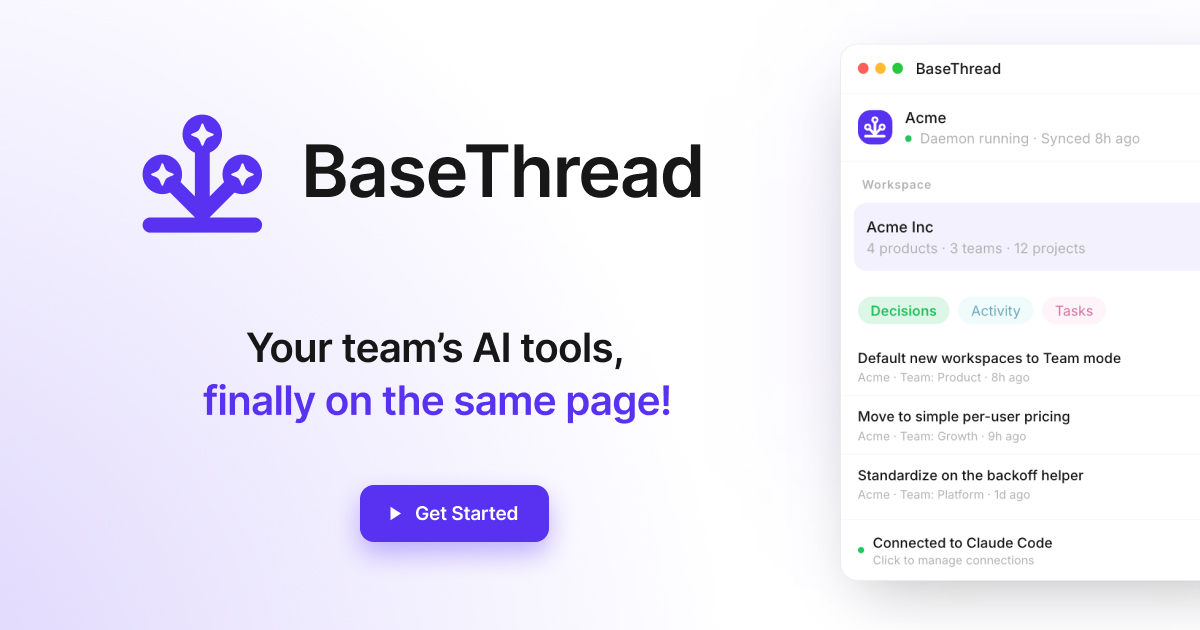
BaseThread is a second brain for your team's AI. Your team curates the context graph once, the company, products, teams, projects, and you, plus the live streams of activity, decisions, and tasks. Every AI tool reads the relevant slice over MCP, through a local Mac app that bridges your tools or a remote hosted endpoint, so Claude Code, Cursor, ChatGPT, and the rest all read the same source. As tools finish work, they write activity, decisions, and tasks back, keeping the brain current. Integrations distill context from tools you already use, like Notion and HubSpot, into the graph, the signal, not the raw data.
The structure is curated, not scraped. That is the difference between a shared brain your tools can trust and a landfill they have to dig through. For the why-curation argument, see context engineering for teams.
The quick test
If every teammate's AI knows that one person but none of them know what your team decided last week, you have a pile of private brains, not a shared one. The shared one is the job.
Explore the team second brain
This is the hub for the idea. From here, go deeper on the pieces:
- The distinction: team second brain vs personal second brain, why Notion and Obsidian are not it.
- For engineers: a second brain for engineering teams, past scattered CLAUDE.md and .cursorrules files.
- Build one: how to build a team second brain, step by step, starting small.
- The foundation: what is shared context for AI tools, the structure underneath it.
- Why personal memory is not enough: per-user AI memory doesn't compound into team knowledge.
- How tools read it: MCP for teams.
TL;DR
A second brain for your team's AI is one curated, structured context, the company, products, projects, decisions, and current work, that every tool reads automatically over MCP, instead of each assistant holding a private, partial picture. Unlike a personal second brain meant for humans to read, this is built for tools, and it stays current as they write activity, decisions, and tasks back. BaseThread builds exactly this: a curated context graph, read by every tool, kept current by the work.
One curated context, read by every tool your team uses and written by your AI as you work.
Related reading
What is shared context for AI tools? (2026 guide)
Shared context for AI tools is the company, project, and decision background every AI reads automatically, so your whole team's tools stop guessing.
AI memory vs shared context: the difference
AI memory vs shared context: memory is personal and locked to one tool, shared context is team-wide and read by every tool. Here is how to tell them apart.
What is context engineering for teams?
Context engineering is the discipline of getting the right information in front of a model. For teams it means doing it once, shared, so every tool answers well.
Per-user AI memory doesn't compound into team knowledge
Per-user AI memory can't add up to team knowledge. Here is the structural reason ten people's personal memories never become one shared team brain, and what does.
Frequently asked questions
What is a second brain for a team's AI?
It is one curated, structured context that every AI tool on the team reads: the company, products, projects, decisions, and current work, kept in a single place. Instead of each person's assistant holding a private, partial picture, every tool reads from the same source, so the team's AI works from shared memory rather than guessing alone.
How is this different from a personal second brain like Notion or Obsidian?
A personal second brain is something a human reads and maintains. A second brain for your team's AI is something tools read automatically, over a protocol, at the start of a task. The point is not a note-taking app for people; it is a shared context source that AI assistants pull from so their answers fit your team's reality.
Does the AI write into the second brain?
Yes. Your AI does not just read the shared context, it writes it: it logs activity, decisions, and tasks, and creates or updates context as work happens, so the source stays current on its own. You review what matters; the rest keeps the brain current automatically. The high-level structure stays curated by your team rather than generated blindly. The result is a living source that tools both read from and maintain.