
AI memory vs shared context
AI memory vs shared context: the difference
AI memory vs shared context: memory is personal and locked to one tool, shared context is team-wide and read by every tool. Here is how to tell them apart.
AI memory is suddenly everywhere. ChatGPT remembers your preferences across chats, Claude added memory, Cursor has memories. The pitch sounds like it solves the problem: your AI finally remembers.
It does, for one person, in one tool. The trap is assuming that solves the team problem too. It does not, and the reason is structural, not a missing feature. Memory and shared context are different things aimed at different problems, and teams that conflate them end up with tools that each know one person and none that know the team.
Definition
AI memory vs shared context
AI memory is personal and locked to a single tool: it remembers your chats, for you, inside that tool. Shared context is team-wide and cross-tool: a curated source plus an AI-written record of decisions and activity that every member's tools read. Memory makes one tool remember you. Shared context makes every tool understand your team.
What does "AI memory" mean today?
Two different things go by the name, so it helps to separate them.
Built-in memory. The memory features inside ChatGPT, Claude, and Cursor. These watch your conversations and quietly extract things worth remembering (your name, your stack, your preferences) so you stop repeating them. It is per-user and lives inside that one product.
Memory infrastructure. Developer tools like Mem0, Zep, and Letta that give agents you build a place to store and recall information, often as a vector store or a knowledge graph. This is plumbing for engineers building agents, not a product a team curates.
Both are genuinely useful. Neither is a team context layer, and built-in memory in particular has one hard limit that matters here.
What does shared context mean?
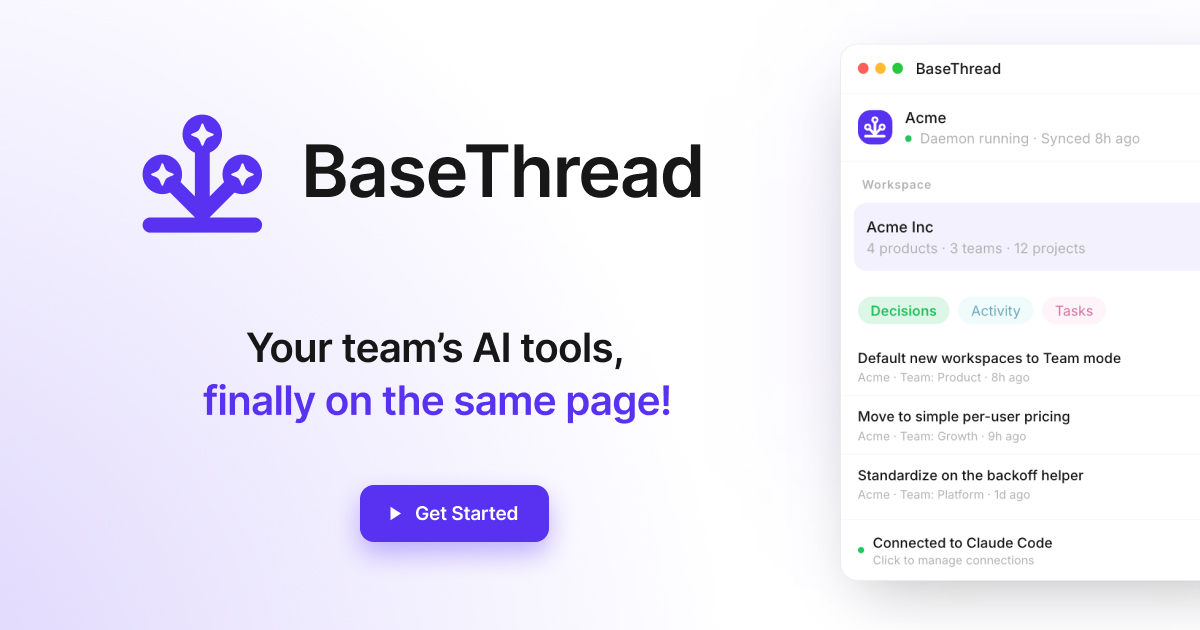
Shared context is the curated company, product, project, and decision background your tools read, plus an AI-written record of activity and decisions, kept in one place every teammate shares. The full picture is in what is shared context for AI tools; the short version is that it is cross-tool, team-wide, curated, and auto-updated.
The contrast with memory is sharpest across a few dimensions.
The differences that matter
| Dimension | AI memory | Shared context |
|---|---|---|
| Scope | One user | The whole team |
| Tools | One tool | Every tool |
| How it is built | Auto-extracted from your chats | Curated, plus AI-written from real work |
| What it captures | What you said | What shipped and what the team decided |
| Reaches teammates | No | Yes |
Read down that last row. Built-in memory does not reach teammates, by design. Your Claude's memory does not show up in a teammate's Cursor, and there is no mechanism to fold many people's personal memories into one team memory. That is why per-user memory cannot quietly become team knowledge, a point we make in full in per-user AI memory doesn't compound into team knowledge.
The "what it captures" row matters just as much. Memory captures the texture of your conversations. Shared context captures the decisions and the work, with the reasoning attached, which is what a teammate actually needs to stay aligned.
Why can't per-user memory become team knowledge?
Because the unit is wrong. Memory is built around an individual's sessions. To turn ten people's memories into team knowledge you would have to merge ten private, tool-specific stores into one, reconcile the contradictions, strip what is personal, and serve the result back to every tool. None of the built-in memory features do any of that, and it is not a roadmap gap, it is a different product.
A shared context layer starts from the team as the unit: one curated source, an AI-written ledger that many people's tools contribute to, and harmonization when those contributions overlap or conflict. It is, in effect, a second brain for your team's AI rather than a private memory per person. That is the team-context problem memory was never built to solve.
Where memory genuinely wins
Honest comparison cuts both ways. Built-in memory has real strengths shared context does not try to match:
- Zero setup. It is on by default in the tool you already use.
- Personal recall. It remembers your quirks and preferences inside that tool better than a team layer should bother to.
- Conversational continuity. It keeps a single long-running relationship with one assistant smooth.
If your only need is "I want ChatGPT to stop asking my name," memory is the right tool and you do not need anything else.
So do you need both?
Often, yes, and they do not conflict.
- Memory handles your personal recall inside a tool.
- Shared context handles what the team agreed and what is current, across every tool.
The test is simple: if every tool knows you but none of them know what your team decided last week, you have memory and you are missing shared context. The compare page lays out where each option fits, including the memory-infra tools, so you can see the boundaries clearly.
One line to remember it
Memory is about a person and a tool. Shared context is about a team and every tool. Different unit, different job.
TL;DR
AI memory (ChatGPT, Claude, Cursor, and infra like Mem0) is personal and locked to one tool: it remembers you, from your chats. Shared context is team-wide and cross-tool: a curated source plus an AI-written record of decisions and activity every tool reads. Per-user memory cannot become team knowledge because the unit is the individual, not the team. Most teams want both: memory for personal recall, shared context to keep everyone's tools aligned.
Get the one thing memory, wikis, and rules files each miss: one shared context every tool reads and keeps current.
Related reading
What is shared context for AI tools? (2026 guide)
Shared context for AI tools is the company, project, and decision background every AI reads automatically, so your whole team's tools stop guessing.
ChatGPT memory vs team memory: why per-user doesn't scale
ChatGPT memory vs team memory: ChatGPT memory is personal and single-tool. Here is why per-user memory never becomes team knowledge, and what does.
Per-user AI memory doesn't compound into team knowledge
Per-user AI memory can't add up to team knowledge. Here is the structural reason ten people's personal memories never become one shared team brain, and what does.
Claude Projects vs shared team context: where Projects stops
Claude Projects vs shared team context: Projects is great for organizing your work in Claude. Here is where it stops, and what a team needs beyond one tool.
Frequently asked questions
What is the difference between AI memory and shared context?
AI memory is personal and locked to one tool. ChatGPT memory, Claude's memory, and Cursor memories each remember you, inside that one tool, by extracting from your chats. Shared context is team-wide and cross-tool: a curated source plus an AI-written record of decisions and activity that every member's tools read. Memory makes one tool remember you. Shared context makes every tool understand your team.
Can AI memory be shared across a team?
Built-in AI memory is per-user by design, so it does not become team knowledge. Your Claude's memory does not reach a teammate's Cursor, and there is no mechanism for a team to build one common memory from individual ones. Sharing context across a team needs a deliberate shared layer, not the personal memory features built into each tool.
Do I need both AI memory and shared context?
They complement each other. Personal memory is convenient for your own recall inside one tool with zero setup. Shared context is what keeps a whole team's tools aligned on decisions and current work. If you only have memory, every tool knows you but none of them know what your team decided last week. Shared context fills that gap.