
Shared context for AI tools
The team-context problem nobody has solved yet
Every AI tool solves context for one person. The team-context problem, one shared, current context across every tool and teammate, is the gap nobody filled.
The AI tooling wave solved a remarkable amount in two years. What it mostly skipped is the team. Almost every context feature shipped since 2023 makes one tool understand one person better. Memory, projects, rules files, bigger windows: all single-player. The multiplayer problem, one shared context across a whole team's tools, is still open. It is worth naming clearly, because you cannot solve a problem you have not separated from its neighbors.
The problem, stated precisely
The team-context problem is this: a team uses many AI tools, across many people, and there is no single, current, shared context that all of them read, including the decisions the team has made. So every person's tools hold a different, partial picture, and no two agree.
It has three parts, and most tools nail one and miss the rest:
- Cross-tool. The same context has to reach Claude Code, Cursor, ChatGPT, and the rest, not live inside one of them.
- Team-wide. It has to be the same for ten people, not ten private versions.
- Decision-aware and current. It has to hold what the team decided and what just shipped, and stay that way without manual upkeep.
Why each existing solution stops short
Walk the field and the pattern is consistent:
- Built-in memory (ChatGPT, Claude, Cursor) is per-user and single-tool, so it cannot be cross-tool or team-wide. See AI memory vs shared context.
- Projects organize context inside one tool, not across the team's tools.
- Rules files (
CLAUDE.md,.cursorrules) are per-repo and per-tool, and hold rules, not decisions. - Wikis are team-shared but human-read, not something your tools read at session start, and not current.
- Memory APIs (Mem0, Zep) are infrastructure for agents you build, not a shared team layer.
- Bigger context windows add capacity, not sharing or currency, see why they won't fix team knowledge.
Each is good at what it does. None is aimed at all three parts of the team-context problem at once, because each was built for the single-player case.
Why it stayed unsolved
Because the unit is hard. Single-player context is tractable: one person, one tool, one session. Team context means merging many people's input into one trustworthy source, reconciling conflicts, scoping who sees what, and keeping it current as the work moves, across tools nobody controls together. That is genuinely harder, and it is why per-user memory cannot just compound into the team answer.
What solving it actually requires
- One curated, scoped source every tool reads over MCP, not a copy per person or per tool.
- An AI-written record of activity and decisions that many tools contribute to as work happens, which is why manual context-logging is dead and your AI should witness the work instead of relying on anyone to keep notes.
- Harmonization so overlapping contributions merge, superseded ones are marked, and conflicts surface instead of piling up.
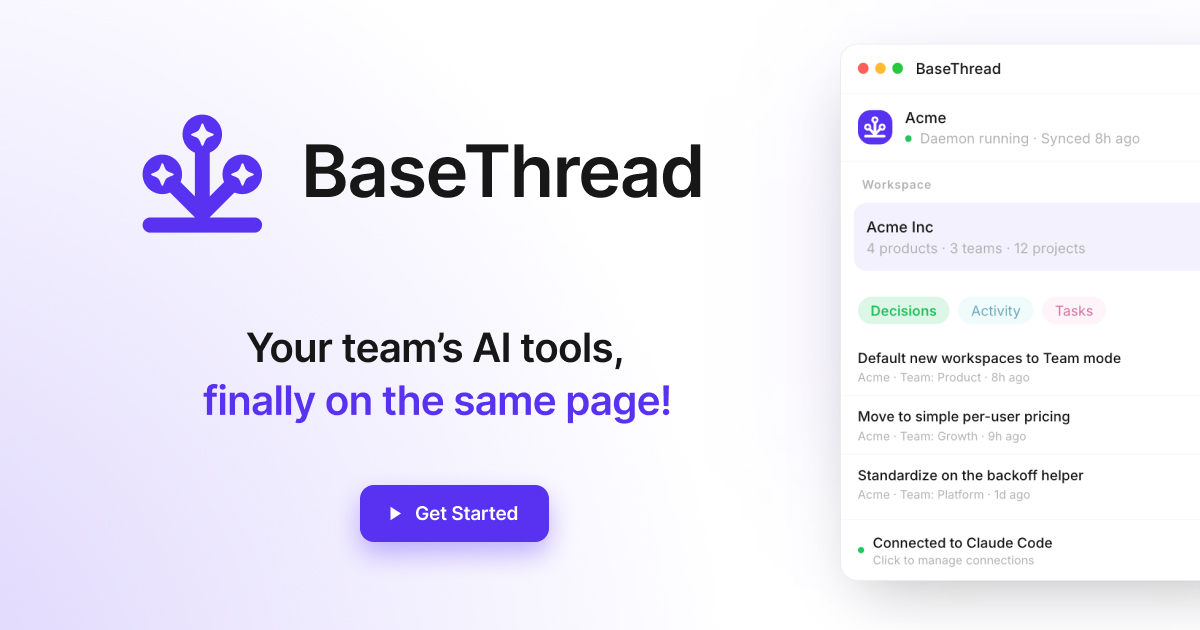
That combination is what shared context for AI tools is, and it is the specific thing BaseThread was built for. The compare page shows why the single-player tools, useful as they are, do not add up to it.
The framing
Most AI context tools answer "how does this tool understand me." The unsolved question is "how does every tool understand us." Different question, and the one teams actually feel.
TL;DR
Nearly every AI context feature since 2023 is single-player: it makes one tool understand one person. The team-context problem, one shared, current context across every tool and teammate, including the team's decisions, stayed open. Memory, projects, rules files, wikis, memory APIs, and bigger windows each solve one part and miss the rest. Solving it needs one curated, scoped source read over MCP, an AI-written decisions-and-activity record, and harmonization. That is what shared context is for.
One shared, current context across every tool and teammate, the multiplayer answer.
Related reading
What is shared context for AI tools? (2026 guide)
Shared context for AI tools is the company, project, and decision background every AI reads automatically, so your whole team's tools stop guessing.
AI memory vs shared context: the difference
AI memory vs shared context: memory is personal and locked to one tool, shared context is team-wide and read by every tool. Here is how to tell them apart.
Per-user AI memory doesn't compound into team knowledge
Per-user AI memory can't add up to team knowledge. Here is the structural reason ten people's personal memories never become one shared team brain, and what does.
How to build a team second brain (step by step)
A team second brain is one curated context every teammate's AI reads. Here is how to build one in five steps, starting small and letting your AI keep it current.
Frequently asked questions
What is the team-context problem?
It is the problem of giving a whole team's AI tools one shared, current context, across every tool and every person, including the decisions the team has made. Individual tools solve context for one person in one tool: memory, projects, rules files. None of them give ten people's different tools the same understanding. That cross-tool, team-wide, decision-aware gap is the team-context problem, and it is the one the AI tooling wave mostly skipped.