
Shared context for AI tools
A second brain for engineering teams
Scattered CLAUDE.md and .cursorrules files give each engineer's AI a private, partial brain. A second brain for the whole engineering team gives every tool one shared context to read and write.
Most engineering teams already have a second brain. It is just shattered into pieces. A CLAUDE.md here, a .cursorrules there, an AGENTS.md in another repo, plus whatever each engineer pasted into a chat this morning. Every AI tool has a private, partial brain, and none of them agree.
That works for a solo developer in one repo. It falls apart the moment a team shares a codebase, because the thing each tool needs most, what the team decided and why, lives nowhere a tool can read it.
The symptom every engineering team knows
You have seen the pattern:
- An engineer's AI suggests an approach the team rejected two sprints ago, because nothing told it the decision was made.
- Two engineers' assistants make contradicting choices on the same service in the same week.
- A new hire's tools know nothing about the architecture, so the new hire becomes the slowest part of onboarding.
- A
CLAUDE.mdand a.cursorrulesin the same repo drift out of sync, and now the two tools disagree by design.
None of these are model failures. They are missing-shared-memory failures. Each tool has, at best, a private second brain, and the privates never reconcile.
What a second brain for the engineering team is
It is one curated, structured context that every engineer's AI tools read automatically: the architecture and services, the conventions you actually follow, the decisions you have made, and the work in flight. Organized so a tool reads the slice that fits the task, not the whole thing.
Definition
A second brain for engineering teams
One curated, structured context, the architecture, conventions, decisions, and current work, that every engineer's AI tools read automatically over MCP and write back to as work ships. Instead of scattered per-tool rules files, every tool reads one source and keeps it current, so the team's AI stays consistent.
The key shift from a rules file: it is not static text you hand-edit. As tools work, they write activity and decisions back, so the brain stays current without anyone maintaining it. The high-level structure stays curated by the team, the signal, not an auto-generated dump.
Why a rules file is not enough
A CLAUDE.md or .cursorrules is a good start, and we are not telling you to delete it. But it has three limits a growing team hits fast.
| Rules files (CLAUDE.md, .cursorrules) | Team second brain | |
|---|---|---|
| Scope | One tool, one repo | Every tool, the whole team |
| Captures decisions over time | No, static text | Yes, an AI-written record |
| Stays in sync | No, hand-edited per file | Yes, one source |
| Kept current by | Whoever remembers to edit | Your AI, as work ships |
We go deeper on the file sprawl in keeping CLAUDE.md and .cursorrules in sync and on the formats themselves in AGENTS.md vs CLAUDE.md vs .cursorrules.
How engineering tools read it
Over the Model Context Protocol (MCP), the open standard for connecting AI tools to outside context. Claude Code, Cursor, Windsurf, and Copilot connect once, then read the relevant slice at the start of a task and write back what shipped and what was decided. The same shared context reaches every tool and every engineer. For the team-server side, see MCP for teams.
The quick test
If a new engineer's Cursor cannot tell you why your team chose the current database, the knowledge is in someone's head or a stale doc, not in a brain your tools can read. That gap is exactly the job.
Where it lands hardest
A second brain for the engineering team pays off most at the handoffs: onboarding a new hire whose tools are caught up on day one, and cross-team work where a decision made in one service needs to reach the AI of everyone touching it. This is the engineering case for a second brain for your team's AI, and it is what the engineering solution walks through.
TL;DR
Engineering teams already have a second brain, scattered across per-tool CLAUDE.md and .cursorrules files that drift and never share what the team decided. A second brain for the engineering team is one curated context every tool reads over MCP and writes back to as work ships: cross-tool, team-shared, and kept current by the AI itself. It fixes the contradictions, sync chores, and slow onboarding that scattered rules files cause. BaseThread builds exactly this.
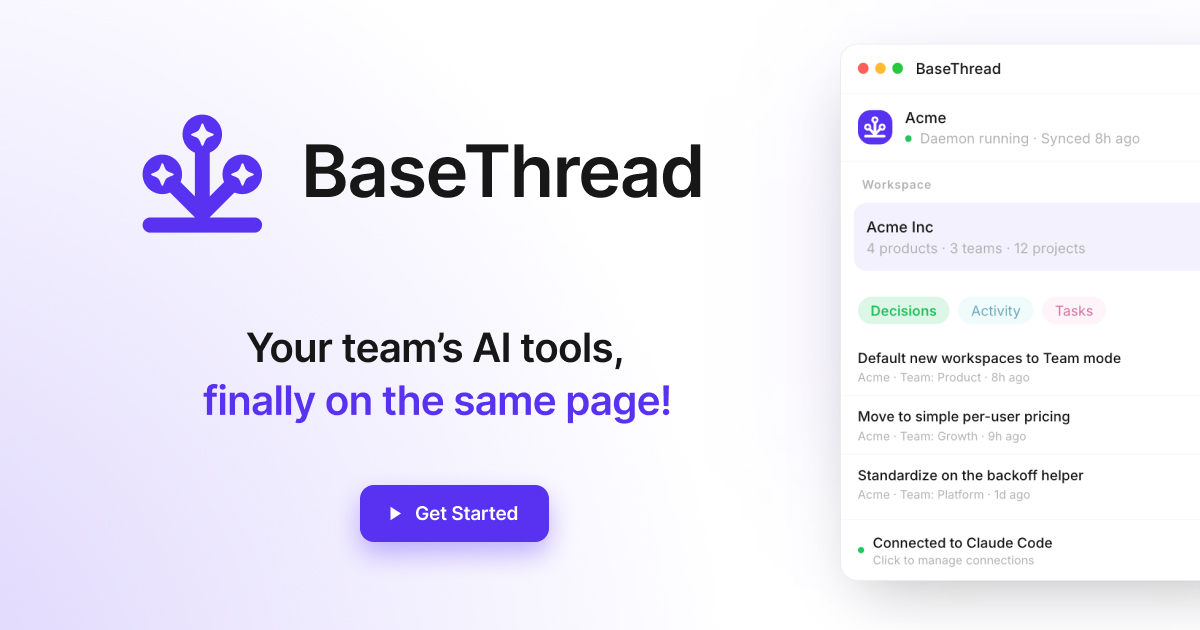
One shared context every engineer's AI tools read and write, instead of scattered rules files.
Related reading
A second brain for your team's AI
A second brain for your team's AI is one curated context every tool reads, so the whole team's assistants share the same memory instead of guessing alone.
How to keep CLAUDE.md and .cursorrules in sync
Keeping CLAUDE.md and .cursorrules in sync by hand drifts fast. Here is why, and how a shared context source keeps every tool's rules current across a team.
AGENTS.md vs CLAUDE.md vs .cursorrules: the landscape
AGENTS.md vs CLAUDE.md vs .cursorrules: what each context file is, how they differ, and the limit all three share once your team uses more than one tool.
MCP for teams: one context layer across your AI tools
MCP for teams turns scattered docs and decisions into one context layer every AI tool reads, so Claude Code, Cursor, and ChatGPT share the same source.
Frequently asked questions
What is a second brain for an engineering team?
It is one curated, structured context that every engineer's AI tools read automatically: the architecture, the services, the conventions, the decisions, and the work in flight. Instead of each engineer's Claude Code or Cursor holding a private, partial picture from its own rules file, every tool reads from the same source and writes back what shipped and what was decided, so the team's AI stays consistent.
Is this just a shared CLAUDE.md or .cursorrules file?
No. A rules file is per-tool, per-repo, static, and hand-edited. It is a fine start, but it does not travel across tools, does not capture the running record of decisions, and becomes a sync chore as the team grows. A second brain for the engineering team is cross-tool, team-shared, structured to your codebase and org, and kept current by the AI as work happens.
How do engineering tools read the second brain?
Over the Model Context Protocol (MCP). Claude Code, Cursor, Windsurf, Copilot, and other MCP-capable tools connect once, then read the relevant slice of context at the start of a task and write activity and decisions back when they finish. The same shared context reaches every tool and every engineer.