
MCP for teams
MCP for teams: one context layer across your AI tools
MCP for teams turns scattered docs and decisions into one context layer every AI tool reads, so Claude Code, Cursor, and ChatGPT share the same source.
The Model Context Protocol went from a late-2024 release to one of the fastest-adopted standards in AI tooling. Most teams meet it the same way: one developer wires up an MCP server for themselves, then another sets up their own, and the two drift apart within a week.
That is the limit worth naming. MCP solved how an AI tool connects to outside context. It did not, on its own, give a team one shared context to connect to. Connecting five people's tools to five different setups is not a team context layer. It is five silos with a nicer cable. MCP for teams closes that gap.
Definition
MCP for teams
MCP for teams is a single, shared context source that every member's AI tools read over the Model Context Protocol, instead of each person wiring up their own. One curated source, one connection step, the same context for Claude Code, Cursor, ChatGPT, and every MCP-capable tool, scoped by who should see what.
What is MCP, in one minute?
The Model Context Protocol is an open standard for connecting AI tools to outside context and tools. Think of it as a common port: instead of every tool inventing its own integration, an MCP-capable assistant can read from any MCP server through one protocol.
That is the plumbing. What flows through it is the interesting part, and for a team the answer should be one shared context, not many private ones. If you want the broader picture of what that context is, start with what is shared context for AI tools.
Why doesn't a per-developer MCP setup scale to a team?
A solo MCP setup is great. The trouble is that it does not add up across people:
- Everyone curates their own. Five people maintain five context sources, and they diverge the moment one of them changes.
- No shared decisions. Your MCP server knows what you told it. It has no idea what a teammate's AI decided yesterday.
- Onboarding restarts every time. A new hire wires up their own setup from scratch, so their tools start blind.
- No access control. A pile of files served over MCP has no notion of who should see the company strategy versus a single project.
- No write-back across people. When your AI finishes work, the summary stays with you. The next teammate's tools never learn from it.
These are the same context failures that hit AI tools generally, just multiplied by headcount. The fix is not a better personal server. It is a shared one.
What does "MCP for teams" actually mean?
A team context layer has four properties a personal MCP server lacks:
- One curated source. The team's structure (company, products, teams, projects, and each person's own area) lives once, in a deliberate shape, not scattered across machines.
- Read by every tool. Every MCP-capable tool reads the relevant slice at the start of a session, so Claude Code, Cursor, ChatGPT, Gemini CLI, Windsurf, and Copilot all work from the same facts.
- Scoped by role. Access control decides who reads what, so sharing the company context never means everyone can see every project. Scoping like this is also a large part of whether MCP is secure once a team points it at real company data.
- Written back automatically. When a tool finishes work, its AI logs what shipped and what was decided to a shared ledger, so the next session and the next teammate start caught up.
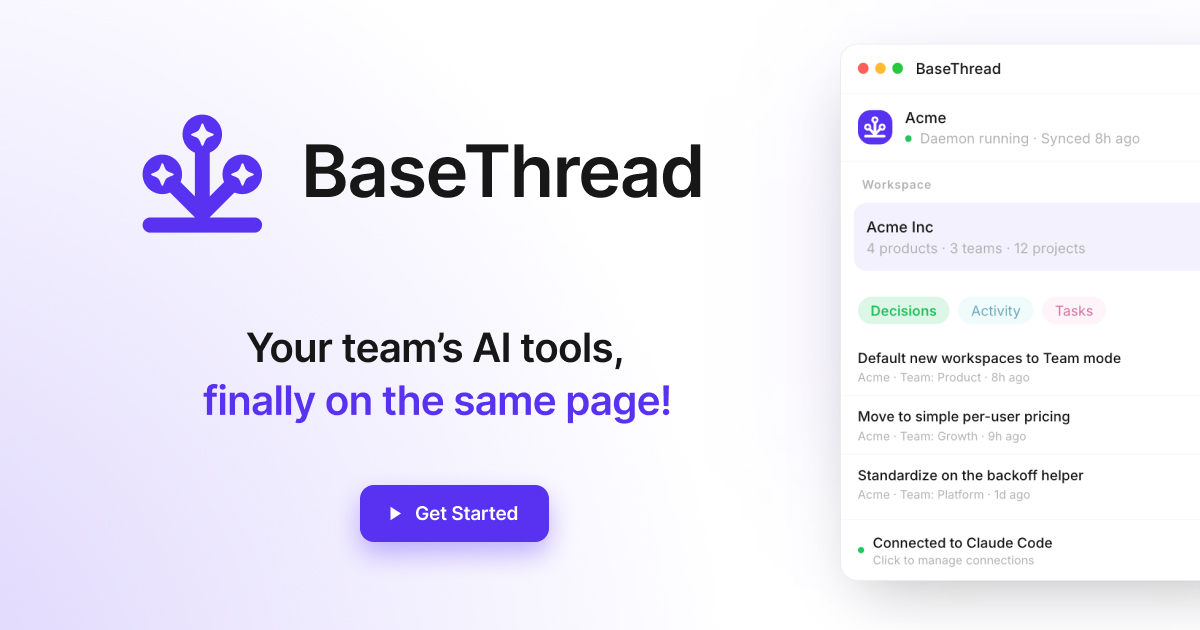
That is the difference between "I set up an MCP server" and "our team has a context layer." BaseThread is the second one, and the how it works page walks the loop end to end.
Local vs remote MCP for teams
Teams ask which to use. The honest answer is both, for different surfaces, reading the same shared context.
| Local MCP (desktop bridge) | Remote MCP (hosted endpoint) | |
|---|---|---|
| Setup | Install the app, one connect | Paste a URL, sign in |
| Works offline | Yes | No, needs the network |
| Best for | Desktop tools: Claude Code, Cursor, Windsurf | Web and hosted: ChatGPT, hosted agents |
| Reads the team's shared context | Yes | Yes |
The takeaway is the last row: whichever surface a teammate uses, they read the same curated context. We go deeper on the tradeoff in the dedicated piece on setting up a shared MCP context server for your team, and how BaseThread works over MCP shows which tools connect over which path.
What belongs in a team's MCP context?
A shared MCP layer is not a dumping ground for every document you own. It is curated, in three parts:
- Structure: what is true. The company and how it works, the products, the teams and projects, and each person's own area.
- The ledger: what happened and what was settled. Activity (what shipped, what changed) and decisions (what the team agreed, and why), written by each member's AI as work happens.
- Tasks: what is next. Who owns what, by when, so a tool answering "where does this stand" sees the open work.
Curation is the point. A focused, current context beats a giant pile of stale files, because the tool reads what fits the task, not everything you ever wrote.
The quick test
If two teammates would get different answers from their AI about the same decision, you have personal MCP setups, not a team context layer. The shared source is what makes the answers agree.
How do you set up a shared MCP context layer?
You do not need to move everything in on day one:
- Curate a little real context. A few lines on the company, the active project, and the conventions you follow beats an empty server immediately.
- Connect one tool over MCP. Point Claude Code or Cursor at the shared context, locally or over the remote endpoint, and watch the next answer fit your situation.
- Bring the team in. The moment a teammate reads the same source, you cross from a personal setup to a team layer.
- Let write-back run. As tools finish work, the ledger fills in on its own and the context gets sharper.
TL;DR
MCP standardized how AI tools connect to context, but most teams end up with one private server per person, which is five silos with a nicer cable. MCP for teams is a single curated source every member's tools read over MCP, scoped by role, with an AI-written ledger on top. Use a local bridge for desktop tools and a remote endpoint for web tools, both reading the same shared context, so the whole team's AI works from one source.
One curated context, read by every tool over MCP, written back as your team works.
Related reading
What is shared context for AI tools? (2026 guide)
Shared context for AI tools is the company, project, and decision background every AI reads automatically, so your whole team's tools stop guessing.
How to set up a shared MCP context server for your team
Set up a shared MCP context server your whole team's AI tools read: curate the context, choose local or remote, connect tools, scope access, and let it update.
Best MCP servers for engineering teams (2026)
The best MCP servers for engineering teams in 2026: GitHub, issue trackers, databases, observability, and a shared context server, with what each is good for.
RAG vs MCP: when to retrieve, when to share context
RAG retrieves chunks from documents; MCP connects tools to live context and actions. Here is the real difference, when to use each, and how they work together.
Frequently asked questions
What is an MCP server for team knowledge?
It is a single shared source of context that every team member's AI tools read over the Model Context Protocol, instead of each person wiring up their own. One curated source holds the team's structure, decisions, and activity, and Claude Code, Cursor, ChatGPT, and any other MCP-capable tool read the relevant slice at the start of a session, scoped by who should see what.
How does a team share one MCP server?
Two ways, and you can use both. A local bridge runs on each person's machine through a desktop app and serves desktop tools like Claude Code, Cursor, and Windsurf. A remote MCP endpoint is a hosted URL any tool can connect to, including ChatGPT and hosted agents. Both read the same shared context, so the team sees one source regardless of which tool or surface.
What is the difference between a local and a remote MCP server?
A local MCP server runs on your machine and works offline, which suits desktop coding tools. A remote MCP server is a hosted endpoint reachable from anywhere, which suits web tools and hosted agents. For a team, the point is that both connect to the same curated context, so it does not matter which surface a teammate uses.