
MCP for teams
RAG vs MCP: when to retrieve, when to share context
RAG retrieves chunks from documents; MCP connects tools to live context and actions. Here is the real difference, when to use each, and how they work together.
RAG and MCP get lumped together because both are about "giving the model more context," but they are not the same kind of thing, and treating them as competitors leads to muddled architectures. One is a retrieval technique. The other is a connection standard. Here is the clean way to hold them.
What each one is
RAG, retrieval-augmented generation, is a technique. You take a pile of documents, embed them into vectors, and at query time you retrieve the chunks most similar to the question and paste them into the prompt. The model then answers using those retrieved passages. RAG is fundamentally about search-by-similarity over a corpus.
MCP, the Model Context Protocol, is a standard for connecting AI tools to context and actions. A server exposes tools and resources with descriptions, and the model reads or calls them at runtime through one protocol. MCP is about a structured, reusable connection, not a retrieval method. If MCP is new to you, start with what is MCP.
So they answer different questions. RAG answers "which passages are relevant to this query." MCP answers "how does this AI tool reach context and actions in a standard way."
The differences that matter
| RAG | MCP | |
|---|---|---|
| What it is | A retrieval technique | A connection standard |
| Core operation | Embed, then fetch similar chunks | Expose tools and resources to the model |
| Best at | Finding passages in a big corpus | Structured access to context and actions |
| Can take actions | No, it retrieves text | Yes, tools let the model act |
| Cross-tool | No, built per app | Yes, any MCP client to any server |
| Relationship | Can run behind an MCP server | Can use RAG as one retrieval method |
That last row is the one to internalize. They are not rivals. An MCP server can use RAG internally for a search_docs tool, run the similarity search, and hand the model the result. RAG becomes one of the methods behind the connection MCP standardizes. It is a similar relationship to the one MCP has with APIs, which we cover in MCP vs API.
When to use which
Frame it by the job:
- Use RAG when the task is finding relevant passages across a large unstructured corpus by similarity. A big documentation set, a support archive, a research library. Retrieval is the right hammer for that nail.
- Use MCP when you want an AI tool to read structured, current context and call actions at runtime, and especially when many tools or many people need the same access. The win is the standard connection and the actions, not the retrieval.
- Use both when you have a large corpus and you want tools to reach it cleanly. MCP is the connection; RAG is one of the things behind it.
Where RAG quietly struggles
RAG is genuinely useful, but it has a failure mode worth naming for team context. Retrieval returns whatever is similar, which is not the same as whatever is true now. If your corpus holds a decision and its later reversal, similarity search can hand the model the stale version, and the model has no idea which one won.
RAG also has no notion of structure or ownership. It retrieves chunks, not "the current decision on this service" or "what this team is responsible for." For raw recall over documents that is fine. For a team that needs the model to know what was actually settled, raw retrieval over a stale pile is thin. We dig into this in what is shared context for AI tools.
How BaseThread fits
BaseThread is not a RAG product and it is not just an MCP cable. It is the curated context worth connecting, delivered over MCP.
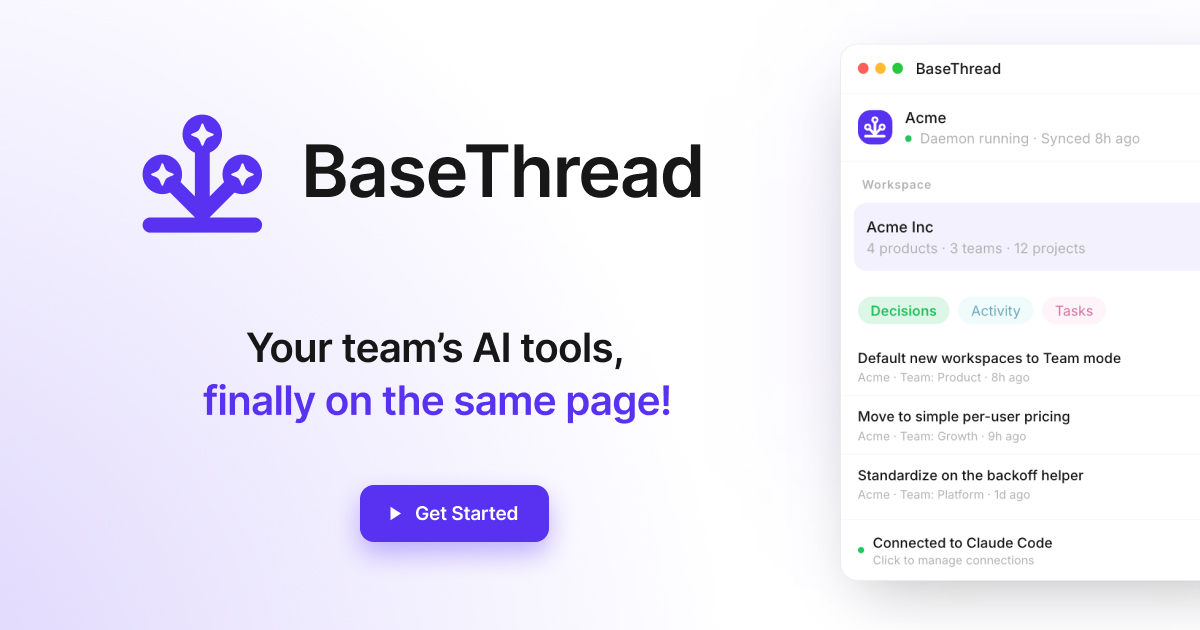
The context is a structured graph: your company, products, teams, projects, and your own area, plus a running record of activity, decisions, and tasks. Because it is curated and current, a tool often reads the relevant slice directly, no similarity search needed to find what is true. That sidesteps the stale-chunk problem RAG runs into. Integrations with tools like Notion and HubSpot distill the signal from connected systems into that context, so it stays the relevant part rather than a corpus to search. Every MCP-capable tool reads it, locally through a Mac bridge or remotely at mcp.basethread.ai, and writes activity, decisions, and tasks back as work happens. Retrieval can live behind that when a corpus is genuinely large; curation keeps it from being needed for the things that should just be true. See how it works.
The clean split
RAG finds passages that look relevant. MCP is the standard connection a tool uses to reach context and act. They stack, they do not compete. And neither one decides whether the context behind them is curated and current, which is the part that actually changes the answer.
TL;DR
RAG is a retrieval technique, embed documents and fetch similar chunks into the prompt, while MCP is a standard for connecting AI tools to context and actions at runtime. They are not competitors: an MCP server can use RAG as one retrieval method behind a tool. Use RAG to search a large corpus, MCP to give tools structured access across a team, often both. RAG returns what is similar, not what is true now; BaseThread delivers curated, current context over MCP so tools read what is settled, with retrieval available behind it when the corpus is large.
Structured, current context every tool reads over MCP, written back as your team works.
Related reading
What is MCP (Model Context Protocol)? A 2026 guide
MCP is an open standard that lets AI tools read outside context and call tools through one protocol. Here is what it is, how it works, and why it matters.
MCP vs API: what is actually different
MCP and APIs both connect software, but they solve different problems. Here is the real difference, when each one fits, and why MCP sits on top of APIs.
What is shared context for AI tools? (2026 guide)
Shared context for AI tools is the company, project, and decision background every AI reads automatically, so your whole team's tools stop guessing.
MCP for teams: one context layer across your AI tools
MCP for teams turns scattered docs and decisions into one context layer every AI tool reads, so Claude Code, Cursor, and ChatGPT share the same source.
Frequently asked questions
What is the difference between RAG and MCP?
RAG, retrieval-augmented generation, is a technique: you embed documents, retrieve the chunks most similar to a query, and stuff them into the prompt. MCP, the Model Context Protocol, is a standard for connecting AI tools to live context and actions through tools and resources the model uses at runtime. RAG is about pulling relevant text into a prompt; MCP is about giving a model a structured connection to data and actions.
Is MCP a replacement for RAG?
No. They solve different problems and often work together. RAG is good at finding relevant passages in a large corpus. MCP is good at giving a model a clean, structured connection to current context and to actions it can take. An MCP server can use RAG under the hood for search, then expose the result to the model as a tool.
When should I use RAG vs MCP?
Use RAG when the job is finding relevant passages across a big pile of documents by similarity. Use MCP when you want an AI tool to read structured, current context and call actions at runtime, especially across many tools or a team. Many real systems use both: MCP as the connection, RAG as one of the retrieval methods behind it.
Does shared context need RAG?
Not necessarily. Curated shared context is structured and current, so a tool often reads the relevant slice directly rather than retrieving similar chunks. RAG helps when you have a large unstructured corpus to search. The two are complementary: curation keeps the context small and relevant, retrieval helps when the haystack is big.