
MCP for teams
What is MCP (Model Context Protocol)? A 2026 guide
MCP is an open standard that lets AI tools read outside context and call tools through one protocol. Here is what it is, how it works, and why it matters.
If you have set up an AI assistant lately, you have probably hit the wall: the model is sharp, but it knows nothing about your data, your repo, or your team. You end up pasting the same background into every chat. MCP is the standard that fixes the connection problem behind that wall.
Definition
Model Context Protocol (MCP)
MCP is an open standard for connecting AI tools to outside context and actions. A tool that speaks MCP can read from, and act through, any MCP server using one protocol, instead of a custom integration per data source. The common analogy: MCP is USB-C for AI, one plug for many devices.
Why MCP exists
Before MCP, every AI tool that wanted to reach your data needed a bespoke connector. Your repo, your docs, your tickets, each one a separate integration written for one assistant. Multiply that across tools and sources and you get an N times M mess: every tool needs custom plumbing to every source, and none of it is reusable.
MCP collapses that. A source exposes itself once as an MCP server. Any MCP-capable tool can read from it. The integration is written once and works everywhere, the same way USB-C replaced a drawer full of proprietary cables.
Anthropic released the standard in late 2024, and adoption moved fast.
How MCP actually works
MCP has two sides. A client lives inside an AI tool (Claude Code, Cursor, ChatGPT, and others). A server sits in front of some context or capability, your files, a database, an API, a knowledge base.
When the client connects to a server, the server advertises what it offers. Three primitives carry most of the weight:
- Tools. Actions the model can call, like "search the codebase" or "create a ticket." The model decides when to use them based on the task.
- Resources. Readable context the model can pull in, like a document, a record, or a slice of your project structure.
- Prompts. Reusable templates a server can offer for common workflows.
At the start of a task, the assistant sees the menu of tools and resources the server exposes and reads or calls what fits. The model is not guessing about your world anymore; it is reading from a source built for it.
The transport underneath can be local (the server runs on your machine and the tool talks to it over a local channel) or remote (the server is hosted and reached over the network at a URL). Same protocol, different surface. We cover that split in local vs remote MCP servers.
MCP vs an API: the question everyone asks
This trips people up, so let us be precise. An API is the general way two pieces of software talk to each other. MCP is a narrower protocol, designed specifically for AI models to discover and use context and tools at runtime.
The cleanest way to hold it: MCP usually sits on top of APIs. An MCP server often wraps an existing API and exposes it to a model in a shape the model can reason about, with descriptions the model reads to decide what to call. MCP is not a replacement for REST or GraphQL, and it is not a general data bus. It is a layer that makes existing systems legible to an AI tool. We go deeper in MCP vs API.
What MCP does not solve on its own
Here is the honest limit. MCP standardized how an AI tool connects to context. It did not, by itself, give you good context to connect to.
You can stand up an MCP server in front of a pile of files, and the model will dutifully read them, stale ones included. You can give five teammates five different MCP setups, and now you have five private context sources that drift apart by Friday. The protocol moves bytes; it does not decide which bytes are worth moving, and it does not by itself answer whether MCP is secure once you point it at real company data.
That gap is exactly where the interesting work is. A server pointed at a raw dump is not the same as a server pointed at curated, current context. And a personal server is not the same as one shared source the whole team reads. See what is shared context for AI tools for the full picture.
MCP for a team, not just a person
A solo MCP setup is a nice convenience. The payoff scales when a whole team reads one source.
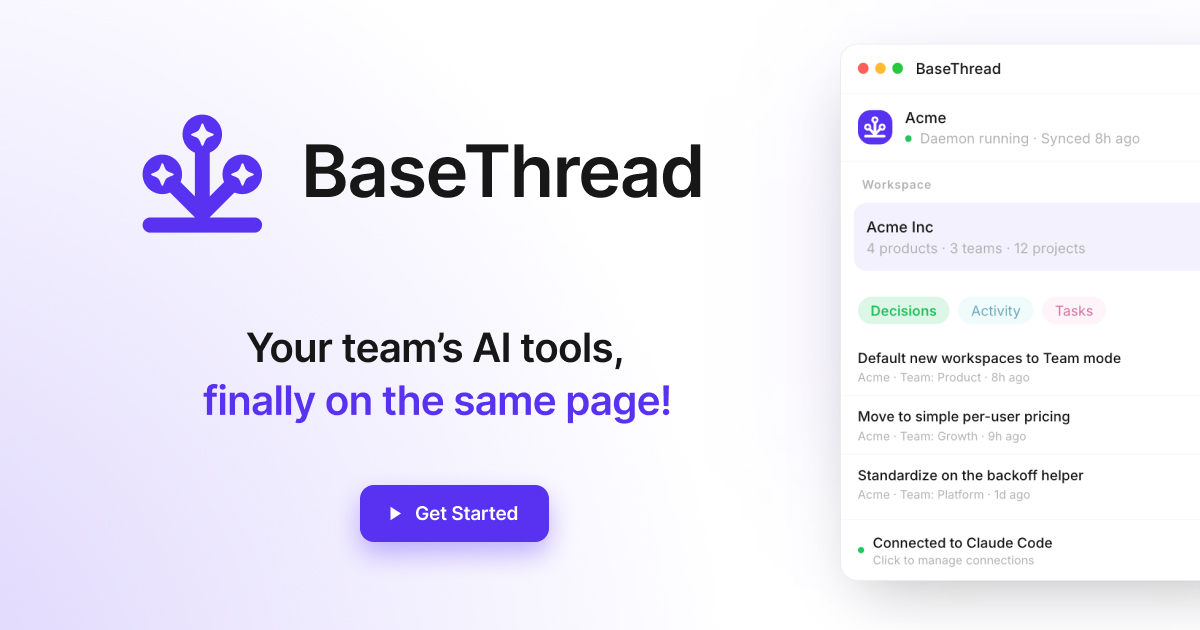
That is the idea behind BaseThread: a single, curated context graph, your company, products, teams, projects, and your own area, plus a running record of activity, decisions, and tasks, exposed over MCP so every tool your team uses reads the same thing. Desktop tools connect through a local bridge in a native Mac app. Web tools and hosted agents connect through a remote endpoint at mcp.basethread.ai. Same context either way.
And the context is curated, not scraped. Integrations with tools like Notion and HubSpot distill the signal from connected systems rather than dumping every page into the model. Your tools read that context at the start of a session, and they write activity, decisions, and tasks back as work happens, so the next session and the next teammate start caught up. We unpack the team angle in MCP for teams.
The quick test
If your AI tool gives a great answer but knows nothing about your project, you have a model without context. MCP is the connection that closes that gap. What you connect it to is the part that actually decides answer quality.
Go deeper on MCP
- The comparisons: MCP vs API and RAG vs MCP.
- Local vs remote: local vs remote MCP servers and what is a remote MCP server.
- For teams: MCP for teams, how to use MCP across your AI tools, and the best MCP servers for engineering teams.
- Security: is MCP secure.
TL;DR
MCP, the Model Context Protocol, is an open standard for connecting AI tools to outside context and actions through one protocol, instead of a custom integration per data source. It works through clients inside AI tools and servers in front of your data, exposing tools, resources, and prompts the model reads at runtime, locally or over the network. MCP solves the connection; it does not decide which context is worth connecting. For a team, the win is one curated source every tool reads, which is what BaseThread provides.
One curated context, read by every tool over MCP, written back as your team works.
Related reading
MCP vs API: what is actually different
MCP and APIs both connect software, but they solve different problems. Here is the real difference, when each one fits, and why MCP sits on top of APIs.
MCP for teams: one context layer across your AI tools
MCP for teams turns scattered docs and decisions into one context layer every AI tool reads, so Claude Code, Cursor, and ChatGPT share the same source.
What is a remote MCP server (and when teams need one)?
A remote MCP server is a hosted endpoint any AI tool can connect to over the network. Here is how it differs from a local server and when a team should use it.
What is shared context for AI tools? (2026 guide)
Shared context for AI tools is the company, project, and decision background every AI reads automatically, so your whole team's tools stop guessing.
Frequently asked questions
What is MCP in simple terms?
MCP, the Model Context Protocol, is an open standard for connecting AI tools to outside context and actions. Instead of every assistant inventing a custom integration for every data source, a tool that speaks MCP can read from or act through any MCP server using one protocol. The popular shorthand is that MCP is USB-C for AI: one plug, many devices.
Who created MCP and when?
Anthropic released MCP as an open standard in late 2024. It is not owned by any single company in practice; the spec is open and the major AI assistants, including Claude, Cursor, Windsurf, and Copilot, added native support within about a year, along with thousands of public servers.
Do I need to be a developer to use MCP?
To connect to an existing MCP server, usually not. Most tools let you add a server by installing an app or pasting a URL and signing in. Building a brand-new server takes some engineering, but connecting to one a vendor already runs is closer to adding an integration than writing code.
Is MCP the same as an API?
No. An API is how two pieces of software talk in general. MCP is a narrower protocol designed for AI models to discover and use context and tools at runtime. You can think of MCP as sitting on top of APIs: a server often wraps existing APIs and exposes them to a model in a shape the model can reason about.