
MCP for teams
Best MCP servers for engineering teams (2026)
The best MCP servers for engineering teams in 2026: GitHub, issue trackers, databases, observability, and a shared context server, with what each is good for.
The MCP ecosystem went from nothing to thousands of public servers in about a year, with an official registry to find them. For an engineering team, a handful are worth wiring up first. Here are the categories that matter, with what each does well and where it stops.
1. Code hosting (GitHub / GitLab MCP)
Connects your AI to repositories, issues, and pull requests.
- Good for: letting a tool read and act on PRs, issues, and code without leaving the assistant.
- Note: it gives access to the code system, not to why the team built things the way it did. That context lives elsewhere.
2. Issue tracking (Linear, Jira)
Brings tickets and project state into the assistant.
- Good for: "what is assigned to me", drafting updates from real ticket state.
- Note: tickets capture the task, rarely the decision and the reasoning behind it.
3. Databases (Postgres and friends)
Lets a tool query a database directly, with guardrails.
- Good for: answering data questions, drafting queries against the real schema.
- Note: powerful and worth scoping carefully to read-only and the right environments.
4. Observability (Sentry and similar)
Surfaces errors and traces to the assistant.
- Good for: triaging an incident with the AI reading the actual error data.
- Note: great for the present incident, not for the team's accumulated knowledge.
5. Filesystem
Reads local files and docs.
- Good for: quick local context for a single developer.
- Note: local and per-person, so it does not give the team a shared source.
6. A shared team context server
Gives every member's tools the team's curated context, decisions, and activity over MCP.
- Good for: the gap none of the above fill, one shared, current, scoped source so every tool and teammate works from the same facts and the same decisions.
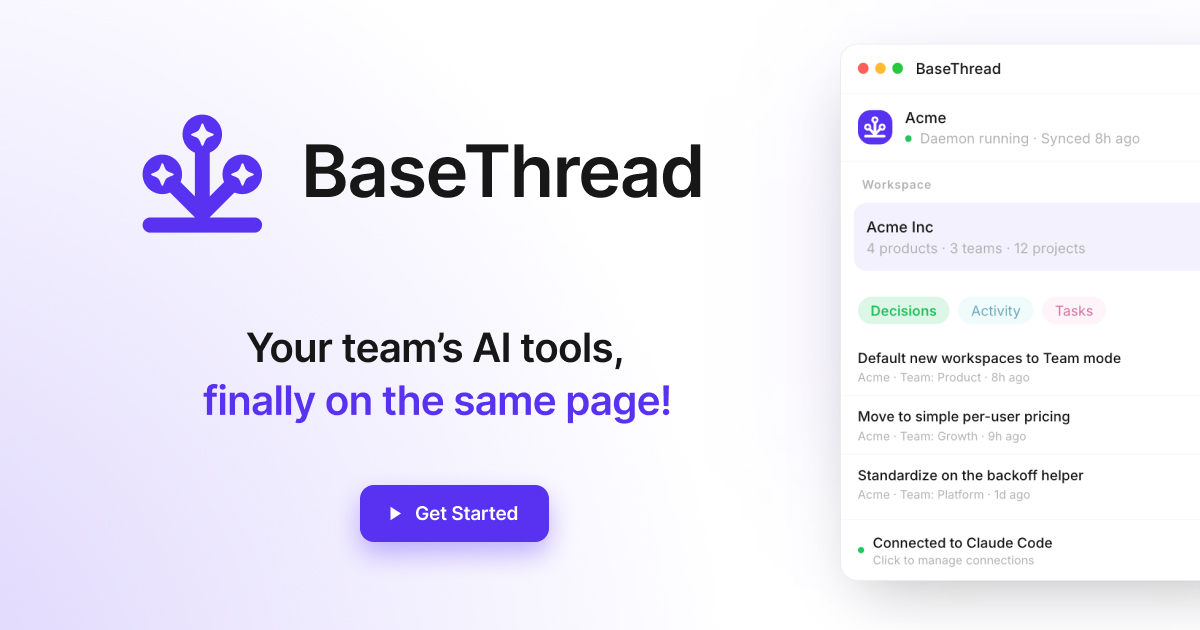
- Note: this is the team-knowledge layer, distinct from the system-connector servers above. It is what MCP for teams is about, and BaseThread is the one in this list built for it.
How to think about the mix
| Server | Connects your AI to | Team-shared context |
|---|---|---|
| GitHub / GitLab | Code, PRs, issues | No |
| Linear / Jira | Tickets and project state | No |
| Postgres | Your data | No |
| Sentry | Errors and traces | No |
| Filesystem | Local files | No |
| Shared context (BaseThread) | The team's curated context + decisions | Yes |
The system connectors and the context layer are complementary, not competing. The connectors plug your AI into tools; the context layer plugs it into your team's understanding. Most teams want several connectors and one context layer. How BaseThread connects over MCP shows how it works, and setting up a shared MCP context server covers the team setup.
TL;DR
The most useful MCP servers for an engineering team fall into two groups. System connectors (GitHub, Linear, Postgres, Sentry, filesystem) plug your AI into the tools you already run. A shared team context server plugs it into the team's curated context, decisions, and activity, the gap the connectors do not fill. Use several connectors plus one context layer; they complement each other.
The shared-context server that gives every tool your team's decisions and activity.
Related reading
MCP for teams: one context layer across your AI tools
MCP for teams turns scattered docs and decisions into one context layer every AI tool reads, so Claude Code, Cursor, and ChatGPT share the same source.
What is a remote MCP server (and when teams need one)?
A remote MCP server is a hosted endpoint any AI tool can connect to over the network. Here is how it differs from a local server and when a team should use it.
How to set up a shared MCP context server for your team
Set up a shared MCP context server your whole team's AI tools read: curate the context, choose local or remote, connect tools, scope access, and let it update.
RAG vs MCP: when to retrieve, when to share context
RAG retrieves chunks from documents; MCP connects tools to live context and actions. Here is the real difference, when to use each, and how they work together.
Frequently asked questions
What are the most useful MCP servers for an engineering team?
The most useful fall into a few categories: code hosting (a GitHub or GitLab server), issue tracking (Linear, Jira), databases (Postgres), observability (Sentry), the filesystem, and a shared team context server that gives every tool the team's curated context, decisions, and activity. The first few connect your AI to systems; the last connects it to your team's shared understanding, which is the gap the others do not fill.


