
Shared context for AI tools
Team second brain vs personal second brain
A personal second brain (Notion, Obsidian, Roam) is built for one human to read. A team second brain is built for your whole team's AI to read. Here is the difference and when each one matters.
A personal second brain and a team second brain sound like the same idea at two sizes. They are not. They have different readers, different upkeep, and different jobs. Getting the distinction right is the difference between better notes for one person and shared memory for a whole team's AI.
The short version: a personal second brain is built for a human to read; a team second brain is built for your team's AI to read. Everything else follows from that one change of audience.
What a personal second brain is
A personal second brain is the system you build for yourself: a Notion workspace, an Obsidian vault, a Roam graph. You capture what your own memory cannot hold, link it together, and come back to re-read it later. It is one of the best personal-productivity ideas of the last decade.
It has one defining limit, and it is not a flaw, it is the design: it is yours, and only you read it. The audience is a single human. The upkeep is manual. And the AI tools you use all day are not in the loop at all.
What a team second brain is
A team second brain inverts the audience. It is one curated, structured context that every teammate's AI tools read automatically, at the moment they start a task. No one re-reads it by hand. The assistant pulls the relevant slice when it needs it, and writes activity, decisions, and tasks back as the work happens.
Definition
Team second brain
One curated, structured context, the company, products, projects, decisions, and current work, that every AI tool on the team reads automatically over a protocol like MCP, and writes back to as work happens. Unlike a personal second brain meant for a human to read, it is built for tools, shared across the whole team, and kept current by the work itself.
For the full picture of what this is and what goes in it, see a second brain for your team's AI.
Side by side
| Personal second brain | Team second brain | |
|---|---|---|
| Built for | A human to read | Your team's AI to read |
| Who reads it | You | Every teammate's AI tools |
| How it is read | You open the app | Tools read it over MCP at task start |
| Who maintains it | You, by hand | Your AI writes it as work happens |
| Shared across people | No, it is yours | Yes, the whole team |
| Stays current | Only when you update it | On its own, as the work moves |
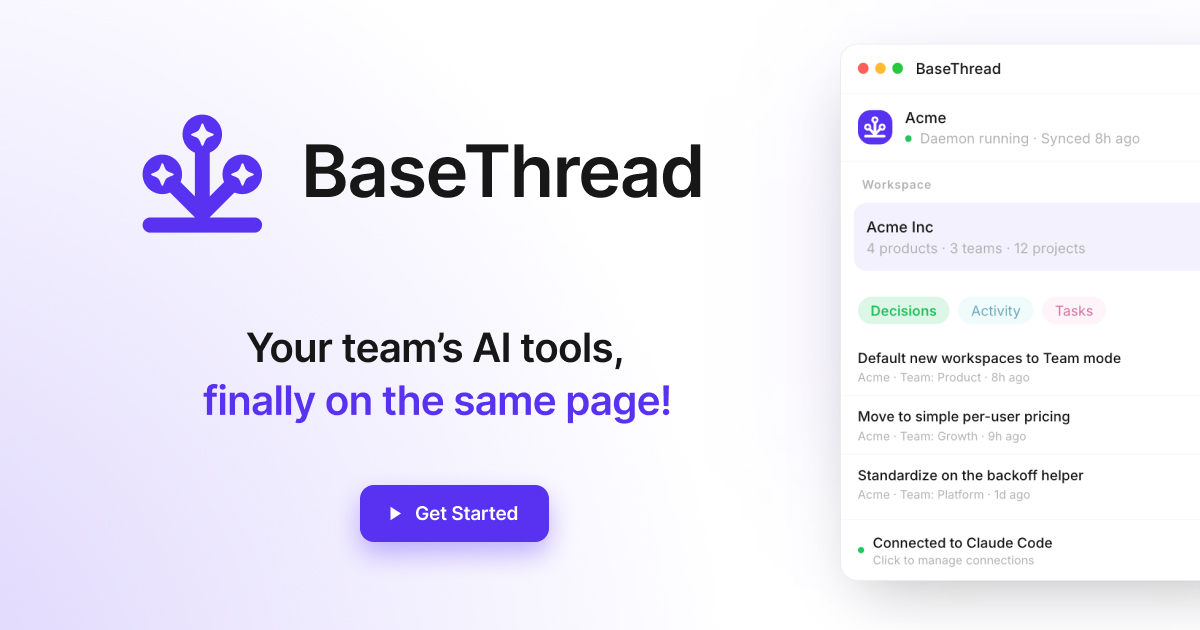
| Examples | Notion, Obsidian, Roam | BaseThread |
Why a team needs the second kind
For one person, a personal second brain is enough, because the only reader is you. For a team, the hard problem is different. It is not that one tool forgets you. It is that ten people's AI tools each hold a different, partial picture, and no two of them agree.
A personal second brain, even ten of them, never solves that. Each one is private, so the privates never reconcile. One engineer's AI suggests an approach the team killed last sprint. Two assistants make contradicting calls on the same service in the same week. A new hire's tools know nothing. These are coordination failures, and only a shared source fixes them. We make the deeper case in per-user AI memory doesn't compound into team knowledge.
The quick test
If everyone on your team keeps great personal notes but none of their AI tools know what the team decided last week, you have a pile of personal second brains, not a team one. The shared one is the job.
They are not rivals
This is not a case for throwing out your Notion or Obsidian. Keep your personal notes for your own thinking. A team second brain sits next to them and does the job they cannot: it gives every teammate's AI tools one current context to read and write, so the team's answers agree. The two layers complement each other. For how shared context relates to single-tool memory, see AI memory vs shared context.
TL;DR
A personal second brain (Notion, Obsidian, Roam) is built for one human to read and maintain by hand. A team second brain is built for your team's AI to read automatically over MCP, and it stays current as tools write activity and decisions back. The personal kind helps one person; only the team kind solves the real problem, which is ten people's AI tools each holding a different, partial picture. BaseThread is a team second brain, and it sits next to your personal notes, not against them.
One curated context, read by every tool your team uses and written by your AI as you work.
Related reading
A second brain for your team's AI
A second brain for your team's AI is one curated context every tool reads, so the whole team's assistants share the same memory instead of guessing alone.
What is shared context for AI tools? (2026 guide)
Shared context for AI tools is the company, project, and decision background every AI reads automatically, so your whole team's tools stop guessing.
Per-user AI memory doesn't compound into team knowledge
Per-user AI memory can't add up to team knowledge. Here is the structural reason ten people's personal memories never become one shared team brain, and what does.
AI memory vs shared context: the difference
AI memory vs shared context: memory is personal and locked to one tool, shared context is team-wide and read by every tool. Here is how to tell them apart.
Frequently asked questions
What is the difference between a team second brain and a personal second brain?
A personal second brain (Notion, Obsidian, Roam) is a system one human builds, reads, and maintains by hand. A team second brain is one curated context that every teammate's AI tools read automatically, over a protocol, as work happens. The first is notes for a person; the second is shared memory for the machines doing the work, kept current by the AI itself.
Can I use Notion or Obsidian as a team second brain for AI?
They are excellent for human-written notes, but they are read by people, not by tools. Your Cursor or Claude Code does not open your Obsidian vault at the start of a task, and nobody updates the vault the moment a decision changes. A team second brain is built to be read by every AI tool over MCP and written back to as work happens, which a personal note app does not do.
Do I still need a personal second brain if my team has one?
They serve different jobs. A personal second brain holds your own notes and thinking. A team second brain holds the shared company, project, and decision context your team's AI tools need to agree with each other. Many people keep both: personal notes for themselves, shared context for the team's AI.