
The activity, decisions & tasks ledger
What is an AI activity and decisions ledger?
An AI activity and decisions ledger is a running record your AI writes as work happens, what shipped and what the team decided, so nothing important is lost.
Every team loses the same thing: the reasoning behind its own decisions. Six months later someone asks why the service is built this way, and the answer is buried in a Slack thread nobody can find, or it left with the person who made the call. The code records what changed. It does not record why.
The usual fixes ask for discipline that never holds. Architecture decision records are great in theory and abandoned in practice, because writing them is a separate chore from doing the work. Changelogs capture events, not reasoning. The honest question is: what if the AI that was already in the room, doing the work, wrote the record itself? That is an AI activity and decisions ledger.
Definition
AI activity and decisions ledger
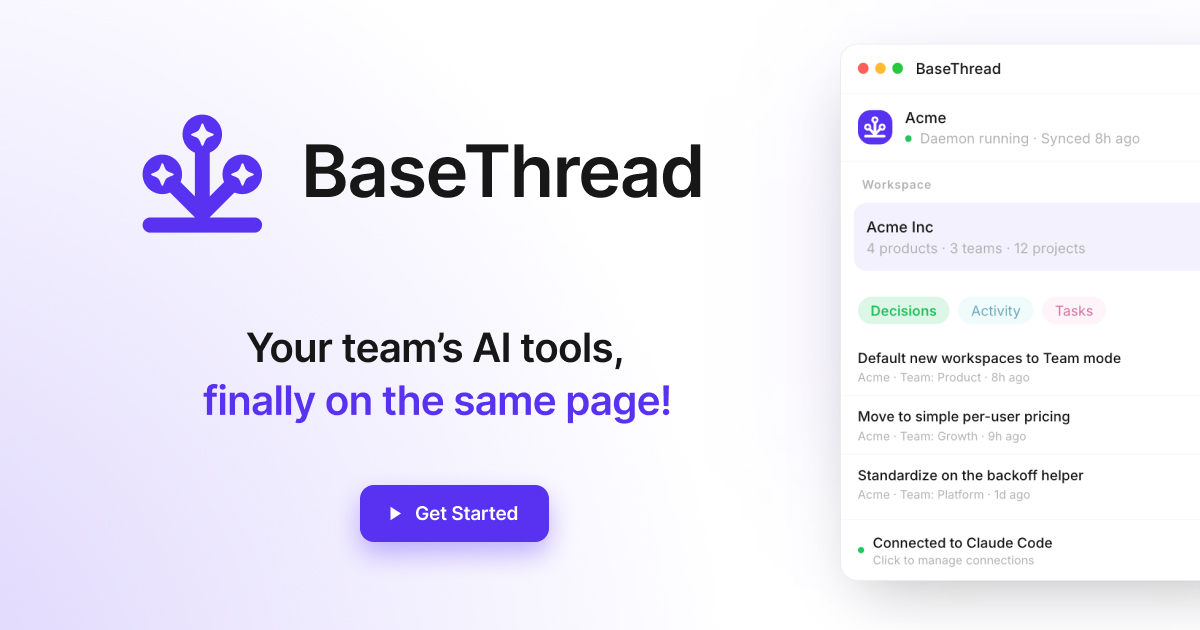
A running record your AI writes as work happens: activity (what shipped and changed) and decisions (what the team settled, and why). Each member's AI logs entries in the right place as it works, so the record builds itself instead of depending on someone to keep notes. Tasks, what is next and who owns it, are the forward-looking third stream.
The two streams: activity and decisions
The ledger has two streams because they answer different questions.
- Activity is the high-frequency record of what happened: what shipped, what changed, what ran. It is the team's work journal, written continuously.
- Decisions are the lower-frequency record of what got settled, with the reasoning attached. These are the calls that stick, and the why is the valuable part.
Keeping them apart is deliberate. It means your AI can answer "what did we decide about pricing" cleanly, without making you wade through a feed of every commit. A third stream, tasks, points forward: who owns what, by when. Past, settled, and next, in one place. The ledger sits inside the broader shared context every tool reads.
What does "AI-witnessed" mean?
This is the part that makes the ledger work where ADRs fail. The record is written by the AI that was already doing the work, not gathered from elsewhere and not logged by hand. Three things follow from that, and together they are the differentiator:
- Witnessed, not reconstructed. The ledger is the deliberate record of the work itself, written as it happens, not stitched together after the fact. Integrations can add distilled context from your tools as an additive, curated source on top.
- No manual logging. Nobody has to remember to write it down. When the assistant finishes a task or recognizes a decision in the conversation, it writes the entry.
- AI-witnessed. The record comes from the tool that watched the work, so it captures the reasoning while it is fresh, not reconstructed weeks later.
The reason ADRs get abandoned is that logging is a separate task from working. An AI-witnessed ledger removes the separation: writing the record is part of doing the work. We make the full case in manual context-logging is dead.
Why a decision log beats threads and changelogs
Compare the ways teams capture what they decided. Most leak in the same place: the why.
| Approach | Who writes it | Stays current | Captures the why | Readable by your AI |
|---|---|---|---|---|
| Slack threads | People, scattered | No | Sometimes | No |
| Manual ADRs | People, if disciplined | No | Yes | No |
| Changelog / commits | People | Partly | No | Partly |
| AI-witnessed ledger | Your AI, as work happens | Yes | Yes | Yes |
The last row is the only one that gets all four right, and the reason is the same throughout: the record is a by-product of the work, written by a tool that is already there, in a form other tools can read. For engineers specifically, this is auto-generated ADRs without the discipline tax. For the team, it is part of the context problem most tools never solved.
What happens when teammates' AIs log overlapping things?
In a real team, several people's tools will write about the same work. A naive log would fill with duplicates and contradictions. The ledger reconciles them, a step called harmonization, and it handles three cases:
- Corroboration. Three people independently log the same decision. Instead of three duplicate rows, they merge into one canonical decision with a count, which is a strong signal the whole team agrees.
- Supersession. A newer decision replaces an older one. The old entry is kept and linked, marked superseded, so the history of why is intact rather than overwritten.
- Conflict. Two decisions contradict each other. The ledger flags them, links them, surfaces the conflict to the people involved, and leaves it for humans to settle rather than silently picking one.
That reconciliation is what turns many people's individual logs into one trustworthy team record. It is also something a personal memory feature cannot do, because it never sees more than one person.
The test
If your team can answer "what did we ship this week" and "why did we decide this, months ago" without anyone having kept notes, you have a working ledger. If those answers live in someone's head, you do not.
How the ledger stays current
The ledger is part of the same loop as the rest of shared context: tools read the relevant slice at the start of a session, and write activity and decisions back when they finish. Because writing is automatic and tied to the work, the record does not rot the way a wiki or an ADR folder does. The next teammate, and the next session, start already caught up. The compare page shows how this differs from the memory and wiki approaches that have no such record at all.
TL;DR
An AI activity and decisions ledger is a running record your AI writes as work happens: activity (what shipped), decisions (what was settled and why), and tasks (what is next). It is AI-witnessed and needs no manual logging, so it stays current because writing it is part of the work. Harmonization merges duplicate decisions, marks superseded ones, and flags conflicts, turning many people's logs into one trustworthy team record that every tool can read.
Your team's AI writes activity and decisions back as it works, so context stays current on its own.
Related reading
What is shared context for AI tools? (2026 guide)
Shared context for AI tools is the company, project, and decision background every AI reads automatically, so your whole team's tools stop guessing.
Manual context-logging is dead: your AI should witness the work
Manual context-logging never holds, because writing it is a chore separate from the work. The fix: let the AI that did the work witness and record it.
The team-context problem nobody has solved yet
Every AI tool solves context for one person. The team-context problem, one shared, current context across every tool and teammate, is the gap nobody filled.
AI memory software for teams: what to look for in 2026
Most AI memory software is built for one person. For a team you need shared, cross-tool memory every teammate's AI reads. Here is what to look for and the options.
Frequently asked questions
What is an AI activity and decisions ledger?
It is a running record your AI writes as work happens: activity (what shipped, what changed) and decisions (what the team settled, and why). Each member's AI logs entries in the right place as it works, so the record builds itself instead of relying on someone to keep notes. Tasks, what is next and who owns it, form a third forward-looking stream alongside the two.
How is a decision log different from a changelog or commit history?
A changelog and commit history record what changed in the code. A decision log records what the team agreed and the reasoning behind it, which is the part that gets lost in chat threads and is the most expensive to reconstruct months later. The ledger keeps both the events and the decisions, linked, and an AI writes them as the work happens rather than after the fact.
What does AI-witnessed mean?
AI-witnessed means the record is written by the AI that was already in the conversation doing the work, not reconstructed after the fact and not logged by hand. When your assistant finishes a task or recognizes a decision, it writes a structured entry to the ledger. It needs no manual logging, and the record stays current because writing it is part of doing the work.