
Shared context for AI tools
How to share context between Cursor and ChatGPT
Share context between Cursor and ChatGPT without copy-paste. Keep one source both tools read over MCP, so your project context follows you between them.
You write code in Cursor and think out loud in ChatGPT, and the two have no idea about each other. The project context you built up in one is invisible to the other, so you re-explain it every time you switch. Multiply that across a team using even more tools and the gap is constant.
There is no native bridge between Cursor and ChatGPT. The way to make context follow you is to stop treating it as something that lives inside a tool, and put it in one source both tools read.
Why doesn't context carry between Cursor and ChatGPT?
Each tool keeps its own state. Cursor has its rules and its open files; ChatGPT has its memory and its current thread. Neither was built to read the other's context, and their built-in memory is per-user and per-tool by design (more on that in AI memory vs shared context). So the only context that "carries" is whatever you re-type.
The fix: one source both tools read
The reliable pattern is a single shared context that both tools connect to over the Model Context Protocol, rather than syncing two tools to each other:
- Cursor reads it over MCP at the start of a session.
- ChatGPT reads the same source through a remote MCP endpoint.
- Update the source once, both tools see the change. No copy-paste, no drift.
This is the core idea of shared context for AI tools: the context is the hub, the tools are spokes.
How to set it up
- Put your project context in one place. Goal, stack, conventions, and the decisions already made.
- Connect Cursor over MCP. It reads the relevant slice when you start working.
- Connect ChatGPT to the same source over the remote endpoint, so a planning chat is grounded in the same facts as your editor.
- Let both write back. When either tool finishes something worth recording, its AI logs it to the shared source, so the other is caught up next time.
How BaseThread connects over MCP shows exactly how each tool connects, locally or remotely.
Why this beats syncing tools directly
- It scales past two. Add Claude Code, Gemini CLI, or Windsurf, whose Cascade memory is its own per-tool store, and they read the same source, no new bridge per pair.
- It works for a team. A teammate's Cursor and your ChatGPT read the same decisions, so answers agree across people, not just across your own tools.
- It stays current. Because tools write back, the source does not rot the way a pasted summary does.
The quick test
If a decision you made in a ChatGPT planning session never reaches your Cursor, you are syncing by memory and copy-paste. One shared source removes both.
TL;DR
Cursor and ChatGPT keep separate state and there is no native bridge, so context only carries if you retype it. Instead, keep one shared source both tools read over MCP, Cursor locally and ChatGPT over a remote endpoint, and let both write back. Update once, both see it, and the same approach scales to every other tool and to your whole team.
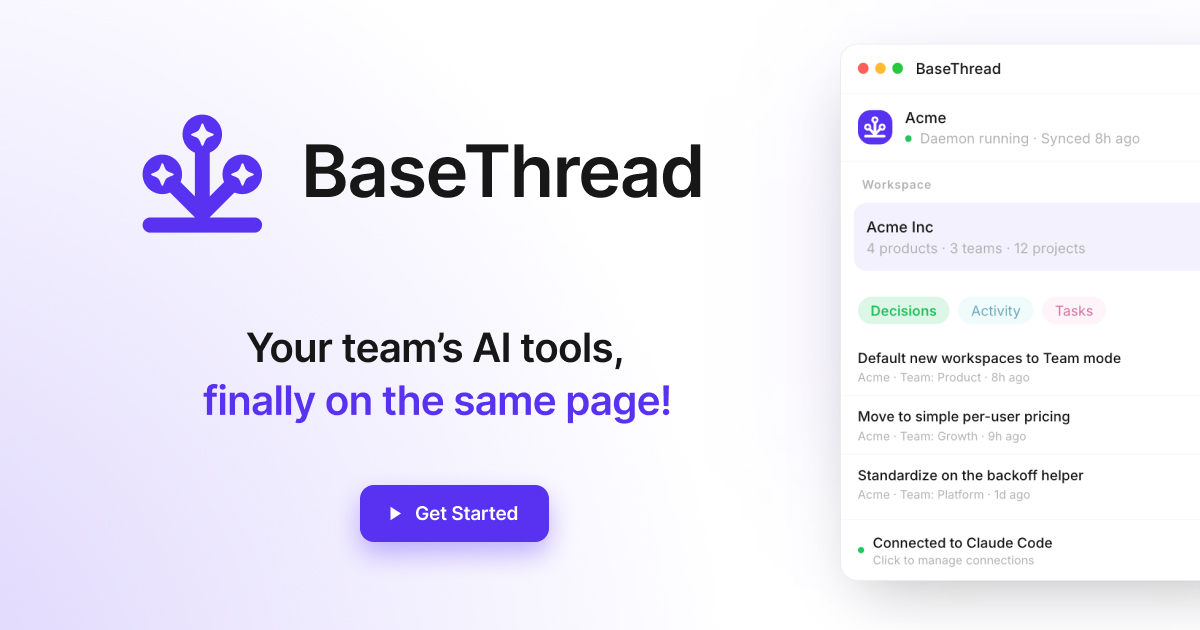
Cursor, ChatGPT, Claude Code, and more, all reading one shared context.
Related reading
What is shared context for AI tools? (2026 guide)
Shared context for AI tools is the company, project, and decision background every AI reads automatically, so your whole team's tools stop guessing.
How to stop re-explaining your project to AI
Stop re-explaining your project to AI every session. Put your context in one place every tool reads automatically, so each chat starts already caught up.
How to keep CLAUDE.md and .cursorrules in sync
Keeping CLAUDE.md and .cursorrules in sync by hand drifts fast. Here is why, and how a shared context source keeps every tool's rules current across a team.
How to build a team second brain (step by step)
A team second brain is one curated context every teammate's AI reads. Here is how to build one in five steps, starting small and letting your AI keep it current.