
Context engineering for teams
Context engineering vs prompt engineering
Prompt engineering tunes one question. Context engineering builds the system the model answers from. Here is the difference, and why teams need the second one.
Two phrases get used like synonyms, and they are not. Prompt engineering is about how you ask. Context engineering is about what the model already knows when you ask. Conflating them is why a lot of teams spend weeks polishing prompts and still get answers that miss their actual situation.
Here is the cleanest way to hold the distinction. Prompt engineering gives you better questions. Context engineering gives you better systems.
What each one actually tunes
Prompt engineering is the wording of a single request. You pick the verbs, you add the constraints, you show an example, you tell the model to think step by step. It is real skill, and it moves the needle on one task at a time.
Context engineering works a layer below that. It is the discipline of getting the right information in front of a model at the right time, which in practice means just-in-time context for AI: pulling the relevant slice at the moment of the task rather than pre-loading everything. Anthropic formalized the term and put it bluntly: the quality of an AI's output is mostly the quality of the context it was given. The prompt is the last inch. The context is the road that leads to it.
| Prompt engineering | Context engineering | |
|---|---|---|
| What you tune | The wording of one request | What the model can see when it answers |
| Scope | A single prompt | The whole task's background |
| Reused across prompts | No, you redo it each time | Yes, supply it once |
| Shared across a team | No, per person | Yes, one source for everyone |
| Main failure it fixes | A vague instruction | A model that lacks the facts |
Why the field moved
For a while, prompt engineering was the whole conversation. People traded prompt templates like recipes. Then reality set in: a brilliant prompt over thin context still produces a confident, generic answer. The model was never going to know your team reversed a decision last sprint, because nothing told it.
So the attention shifted to the thing that was actually limiting output, the context. Reliable AI comes from architecture, not phrasing. You can feel this the first time you watch a plainly worded request return a sharp, situation-specific answer simply because the model could see the right background. The wording barely mattered. The context did all the work.
That is the heart of context engineering for teams: stop optimizing the question and start building the system the question runs against.
Where prompt engineering still earns its keep
This is not a takedown of prompts. A muddy instruction wastes good context. The two stack:
- Prompt engineering sets the intent for one task. What you want, in what shape, with what constraints.
- Context engineering sets the ground truth for every task. Who you are, what you build, what the team decided, where things stand right now.
Get the prompt right and one answer improves. Get the context right and every answer improves, for every teammate and every tool, without anyone re-typing it. One is tactical. The other is structural.
The team problem prompts can't solve
A prompt lives in one chat, written by one person, for one moment. That is fine when you work alone. It falls apart on a team.
When ten people each engineer their own context by hand, you get ten private versions of the truth. One engineer's assistant suggests an approach the team killed two sprints ago. A marketer's AI pitches a feature that slipped. None of these are wording problems. No prompt fixes them, because the missing piece is shared, current context, not a better-phrased question.
That is the case for treating context as something you engineer once, for the whole team, in a place every tool reads. A model only knows what is in front of it. The job is making sure the right thing is in front of it, the same right thing, for everyone. That is shared context for AI tools, and it is the team-scale version of context engineering.
A caution: more context is not the goal. Dump everything and you trigger context rot, where answers degrade as noise crowds out signal. The skill is curation, the right slice, not the whole pile.
How BaseThread fits
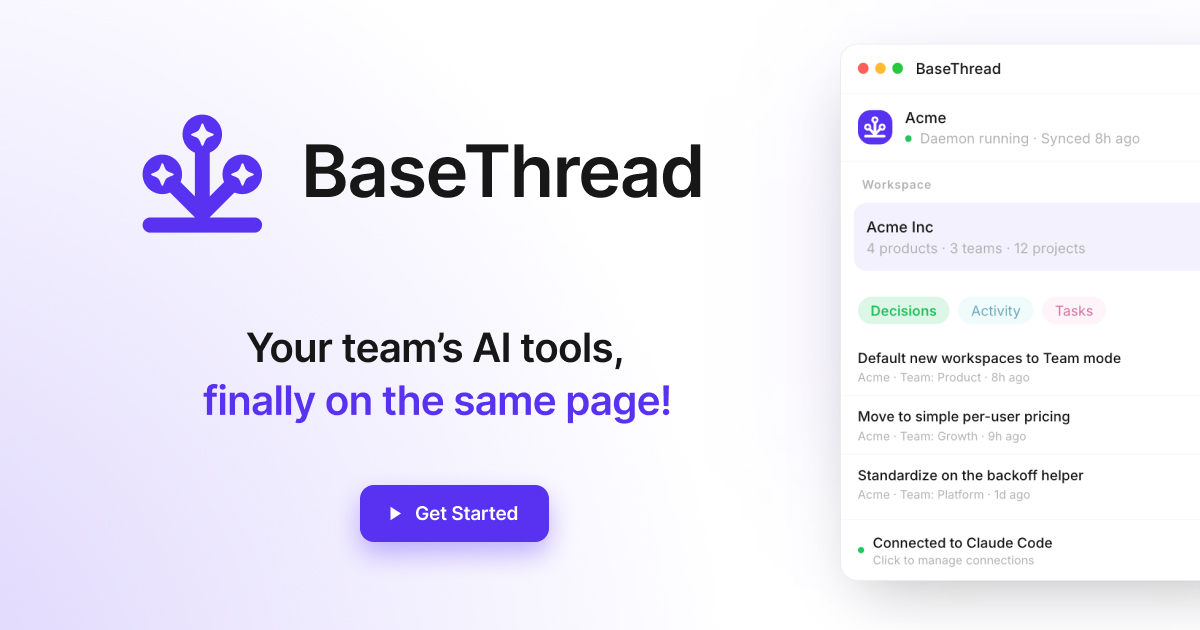
BaseThread is the team's context-engineering layer. You curate your context once into a structured graph, the company, products, teams, projects, and you, plus the running streams of activity, decisions, and tasks. Every AI tool reads the relevant slice over MCP at the start of a session, through a local Mac app or a remote endpoint. As tools work, they write activity, decisions, and tasks back, so the context stays current without anyone maintaining it by hand. Integrations distill context from tools you already use, like Notion and HubSpot, pulling the signal rather than dumping the raw data.
You keep doing prompt engineering. You just stop doing it on top of a blank slate.
The one-liner
Prompt engineering is how you ask. Context engineering is what the model already knows. For a team, the second one should live in one shared place every tool reads.
TL;DR
Prompt engineering tunes the wording of a single request. Context engineering tunes what the model can see when it answers, which is the bigger lever on quality and the one that compounds. Prompts help one task; context helps every task, person, and tool. For teams, context has to be shared and current, which a per-prompt approach can never deliver. BaseThread is the context-engineering layer that curates that context once and lets every tool read it over MCP.
One curated context, read by every tool, written back by the work itself.
Related reading
What is context engineering for teams?
Context engineering is the discipline of getting the right information in front of a model. For teams it means doing it once, shared, so every tool answers well.
Prompt engineering is not enough anymore
The perfect prompt era is ending. Reliable AI comes from architecture, not phrasing. Why context engineering is the skill that actually moves output quality.
What is shared context for AI tools? (2026 guide)
Shared context for AI tools is the company, project, and decision background every AI reads automatically, so your whole team's tools stop guessing.
What is context rot, and how to avoid it
Context rot is when an AI's answers get worse as its context window fills with stale or irrelevant information. Here is why it happens and how to keep context clean.
Frequently asked questions
What is the difference between context engineering and prompt engineering?
Prompt engineering is the craft of wording a single request well. Context engineering is the craft of deciding what the model can see when it answers: the background, the prior decisions, the current state. A perfect prompt over no context still gives a generic answer. Plain wording over the right context gives a fitted one. Prompt engineering tunes the question. Context engineering builds the system the question runs against.
Is context engineering replacing prompt engineering?
It is not replacing it, it is surrounding it. You still want clear instructions. But the field has moved its attention to context because that is the bigger lever on output quality, and the one that compounds. A good prompt helps one request. Good context helps every request, every person, and every tool that reads it.
Why does context engineering matter more for teams?
A prompt is something one person writes for one task. Context is something a whole team can share. When ten people each engineer their own context by hand, their tools give ten different answers about the same project. Context engineering at the team level means curating that background once, in a shared source every tool reads, so the answers agree and stay current.