
Context engineering for teams
Prompt engineering is not enough anymore
The perfect prompt era is ending. Reliable AI comes from architecture, not phrasing. Why context engineering is the skill that actually moves output quality.
There was a moment, somewhere in 2024, when prompt engineering looked like a career. People sold courses on it. Teams hired for it. The premise was that if you just worded the request perfectly, the model would deliver.
That premise has cracked. Not because prompts stopped mattering, but because everyone hit the same wall: a flawless prompt over thin context still hands you a confident, generic, slightly-wrong answer. The phrasing was never the bottleneck. The context was.
The wall everyone hit
You can spend an afternoon perfecting an instruction. You add the role, the constraints, the examples, the step-by-step. And the model still suggests the architecture your team rejected last month, or pitches the feature that got cut, or briefs you on a project as if it were last quarter.
None of that is a wording failure. The model simply did not have the facts. No amount of prompt craft puts information into a model that was never given it. That is the ceiling on prompt engineering, and it is a hard one.
Leaders feel it too. Survey after survey lands in the same place: a large majority, around 82% in recent reads, say prompt engineering alone is not enough to get dependable results from AI. The instinct to blame the prompt is fading. The new instinct is to ask what the model could actually see.
Better questions vs better systems
Here is the line I keep coming back to. Prompt engineering gives you better questions. Context engineering gives you better systems.
A better question helps one task. A better system helps every task. When the model can read the right background at the start, the wording of the request barely matters, because the hard part is already solved. Reliable AI comes from architecture, not phrasing.
This is the whole argument of context engineering vs prompt engineering: the two operate at different layers, and the field has moved its attention to the layer that compounds.
What context engineering actually means
Context engineering is the discipline of getting the right information in front of a model at the right time. Anthropic named it and made it the center of the conversation, framing it plainly: output quality is mostly a function of the context the model was given.
In practice it means three things prompt engineering never touched:
- What the model knows. The structure of your situation, the decisions already made, the state of the work right now.
- When it sees it. The right slice for this task, delivered at the start, not a wall of everything. This is just-in-time context, and it is its own skill.
- Whether it stays true. Context that updates as work happens, instead of going stale the moment someone changes the plan.
None of that is reachable from inside a prompt box. It is architecture.
The team makes it undeniable
For a solo user, you can almost get by on prompts plus pasted context. Tedious, but workable. On a team, prompt engineering collapses completely.
A prompt is written by one person, for one task, in one tool. It does not reach your teammate's assistant. So you get the familiar mess: ten people, ten private versions of the context, no two answers agreeing. The fix was never a shared prompt library. It is a shared context, curated once and read by every tool.
That is context engineering for teams, and it is the real successor to the prompt-engineering era. The skill that matters now is not phrasing a question. It is building the source the question runs against.
Where BaseThread comes in
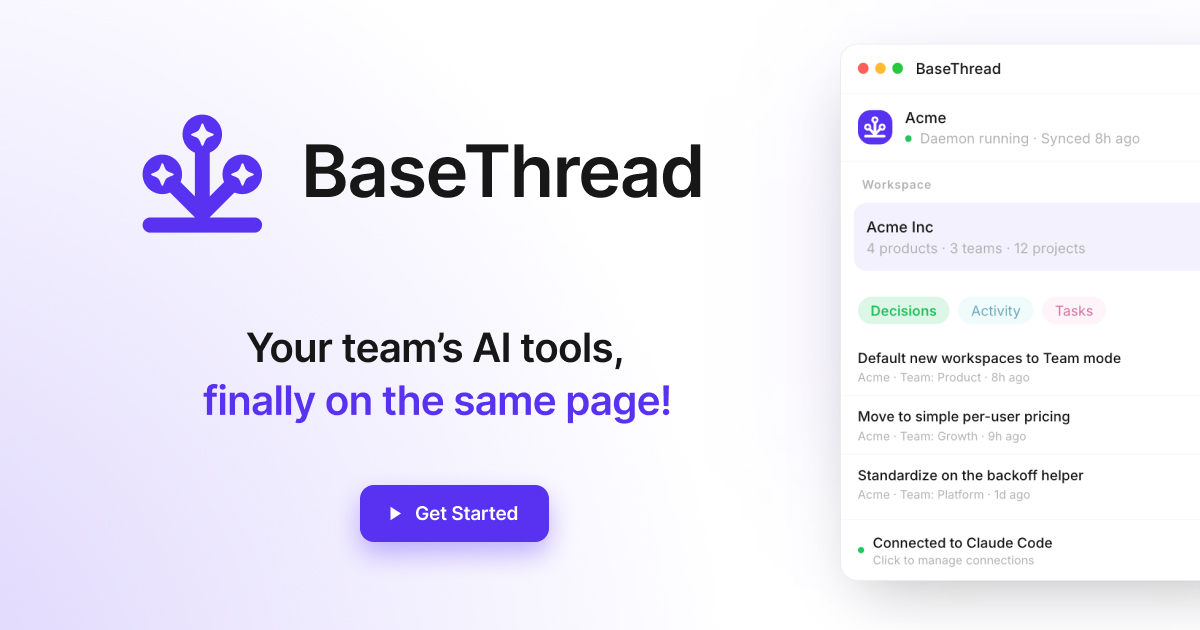
BaseThread is built for exactly this shift. Your team curates its context once into a structured graph, the company, products, teams, projects, and you, plus the live streams of activity, decisions, and tasks. Every AI tool reads the relevant slice over MCP, through a local Mac app or a remote endpoint, and writes activity, decisions, and tasks back as work happens, so the context stays current on its own. Integrations distill context from tools like Notion and HubSpot, the signal, not a dump.
You will still write good prompts. You will just stop pretending they can carry the whole load.
The trap to avoid
"We just need a better prompt" is the sentence that keeps teams stuck. Past a point, the prompt is fine. The model is missing context, and no rewording adds it.
TL;DR
Prompt engineering is not dead, but it is not enough. A perfect prompt over thin context still gives a generic, sometimes wrong answer, because no phrasing supplies facts the model lacks. Around 82% of leaders now say prompts alone do not deliver reliable AI. The work has moved to context engineering: getting the right, current information in front of the model, which for teams means one curated shared source every tool reads. Reliable AI comes from architecture, not phrasing.
Curate context once, let every tool read it and write back.
Related reading
Context engineering vs prompt engineering
Prompt engineering tunes one question. Context engineering builds the system the model answers from. Here is the difference, and why teams need the second one.
What is context engineering for teams?
Context engineering is the discipline of getting the right information in front of a model. For teams it means doing it once, shared, so every tool answers well.
Just-in-time context: give your AI the right slice, not everything
Stuffing the whole window hurts answers. Just-in-time context delivers the right slice at the right moment. Here is how to do it across your team's tools.
What is shared context for AI tools? (2026 guide)
Shared context for AI tools is the company, project, and decision background every AI reads automatically, so your whole team's tools stop guessing.
Frequently asked questions
Is prompt engineering dead?
Not dead, but demoted. Clear prompts still matter. What changed is the realization that wording is the small lever and context is the big one. A perfect prompt over no context still produces a generic answer. The work that actually moves output quality has shifted from phrasing the question to engineering the context the model answers from.
Why is prompt engineering not enough?
Because a prompt only controls one request, and it cannot supply facts the model does not have. If the model does not know your team reversed a decision or that a project shipped, no phrasing recovers that. Reliable AI comes from architecture: a structured, current, shared context the model reads, not a cleverly worded question on top of a blank slate.
What replaces prompt engineering?
Context engineering, the discipline of getting the right information in front of a model at the right time. For teams that means curating context once in a shared source every tool reads, kept current as work happens, so every answer starts from the same accurate background instead of each person re-supplying it by hand.