
Shared context for AI tools
From a team wiki to context your AI tools actually read
Your wiki is full of knowledge your AI tools never read. Here is how to move from a human-read wiki to shared context every AI tool reads at session start.
Your team's wiki is full of hard-won knowledge: how things work, why you chose what you chose, the runbooks. And your AI tools read almost none of it. A wiki is written for people, organized for browsing, and not something Claude Code or Cursor pulls in when you start a session. This is how to move that knowledge from human-read pages to context your tools actually read.
Why your AI tools don't read your wiki
A wiki and an AI-readable context source are built for different consumers:
- A wiki is long-form and human-organized. Great for reading, poor as the structured, scoped context a tool reads at session start.
- It is not read by your tools. Out of the box, nothing pulls a Confluence or Notion page into your Cursor session, which is exactly the gap a shared context layer closes: your AI reads the wiki with the access it already has, writes the signal into the shared context, and every tool reads it back over MCP. (Notion's own AI reads Notion, but not your other tools, see Notion AI vs BaseThread.)
- It goes stale quietly. Pages age, and there is no signal to the tool that a page no longer reflects reality.
So the knowledge exists and stays unused by the tools that could act on it.
You are not deleting the wiki
Important: this is not "replace your wiki." Wikis are a good home for long-form, human-read material, onboarding guides, deep explainers, meeting notes. Keep them for that. The migration is about the subset that should also drive your AI tools.
Step 1: identify the decision-grade knowledge
Go through the wiki and pull out the parts that are durable and would change an AI's answer:
- Conventions and standards the team follows.
- Decisions and the reasoning behind them.
- The current state of products and projects.
Skip the ephemeral and the purely human (meeting notes, brainstorms). You are extracting the context that should shape tool output, not migrating everything.
Step 2: move it into a structured shared source
Put that decision-grade knowledge into a shared context source, organized by company, product, and project, and scoped by who should see it. Structured and scoped beats a long page, because the tool reads the slice that fits the task instead of a wall of prose.
Step 3: point your AI tools at the shared source
Point your AI tools at the shared source over MCP so they read it at session start. You connect nothing new, your AI is the integration. Now the knowledge that sat unread in the wiki actually reaches Claude Code, Cursor, and ChatGPT.
Step 4: let it stay current automatically
The wiki went stale because updating it was manual. In the shared source, let tools write activity and decisions back as work happens, so the AI-readable context updates itself. The wiki can stay the human home; the shared source is the current, tool-readable one.
What you end up with
- The wiki remains for human reading and long-form material.
- The shared context layer holds the curated, decision-grade essentials your tools read and keep current.
- The knowledge that used to sit unread now shapes every AI answer, and a new hire's tools inherit it on day one.
The split to remember
Keep the wiki for what humans read. Mirror the decision-grade essentials into a source your tools read. The migration is a split by consumer, not a deletion.
TL;DR
Your wiki holds knowledge your AI tools never read, because a wiki is human-organized long-form, not connected to your tools, and goes stale. Do not delete it. Extract the decision-grade parts (conventions, decisions, current state), move them into a structured, scoped shared context source tools read over MCP, connect your tools, and let write-back keep it current. The wiki stays the human home; the shared layer becomes the tool-readable, current one.
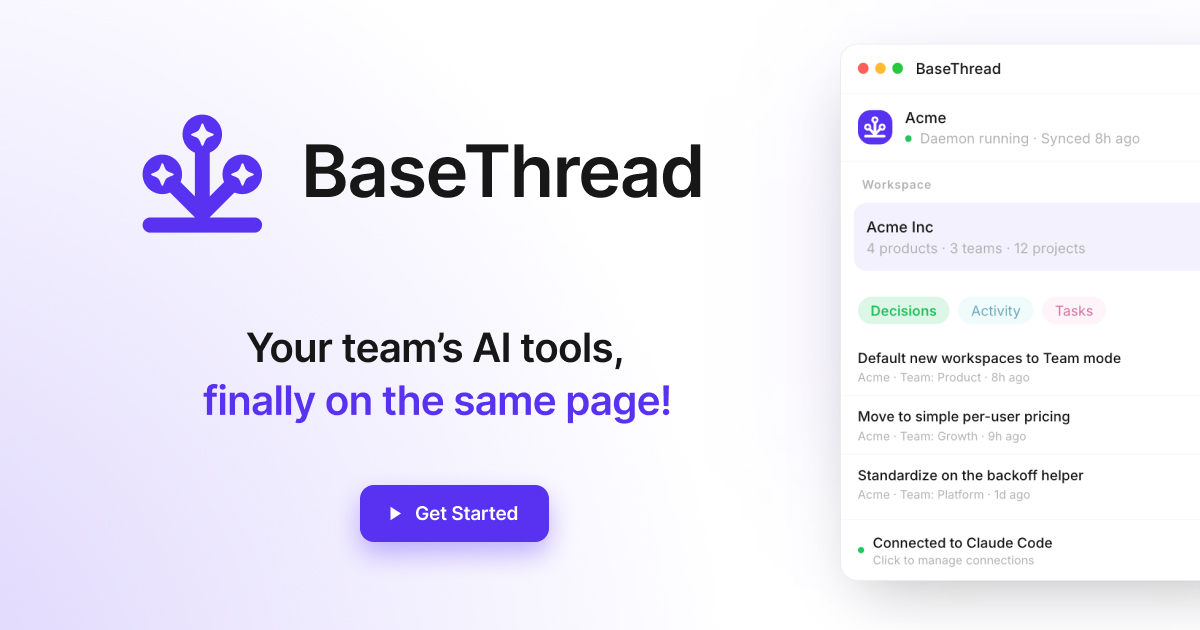
The decision-grade essentials from your wiki, structured and read by every tool.
Related reading
Notion AI vs BaseThread: a wiki your AI reads vs context your tools read
Notion AI vs BaseThread: Notion AI answers inside your Notion docs. BaseThread feeds your team's context to every AI tool. Here is the honest difference.
What is shared context for AI tools? (2026 guide)
Shared context for AI tools is the company, project, and decision background every AI reads automatically, so your whole team's tools stop guessing.
Best ways to give your AI team context in 2026
The best ways to give your AI team context in 2026, from rules files and wikis to memory and a shared context layer, with the honest tradeoffs of each.
How to build a team second brain (step by step)
A team second brain is one curated context every teammate's AI reads. Here is how to build one in five steps, starting small and letting your AI keep it current.
Frequently asked questions
How do I make my team wiki readable by AI tools?
A wiki is written for humans and not read by your AI tools at session start. To make the knowledge usable by AI, move the durable, decision-grade parts into a structured shared context source that tools read over MCP, rather than expecting tools to crawl long-form pages. Keep the wiki as a human reading home; mirror the curated essentials into the shared context layer, and let decisions and activity write back so the AI-readable version stays current.