
Shared context for AI tools
Moving from scattered CLAUDE.md files to a shared context layer
A practical migration: move your team from scattered CLAUDE.md and .cursorrules files to one shared context layer every AI tool reads, without losing what works.
If your team has been using AI coding tools for a while, you have files everywhere: a CLAUDE.md in each repo, a .cursorrules here, maybe an AGENTS.md there, all saying overlapping things and quietly disagreeing. This is the migration from that sprawl to one shared context layer, done without throwing away what genuinely works at the repo level.
When this migration is worth it
If you are one developer in one repo, it is not, keep your file. Do this when you recognize the sprawl: more than one tool, more than one repo, files that contradict each other, and decisions that have nowhere to live. That is the breakpoint where a flat file stops being enough.
Step 1: audit what you have
Gather the context files across your repos and tools and sort their contents into three buckets:
- Repo-local detail , build commands, how to run tests, repo-specific quirks. This stays in the file.
- Shared conventions , style, patterns, architecture rules that apply across repos. This moves to the shared source.
- Decisions , "we chose X over Y because Z." This was probably homeless; it moves to the decisions record.
Step 2: move the shared parts into one source
Put the shared conventions and the decisions into one shared context source, structured by company, product, and project. This is now the single place a change lands, instead of N files.
Step 3: connect your tools over MCP
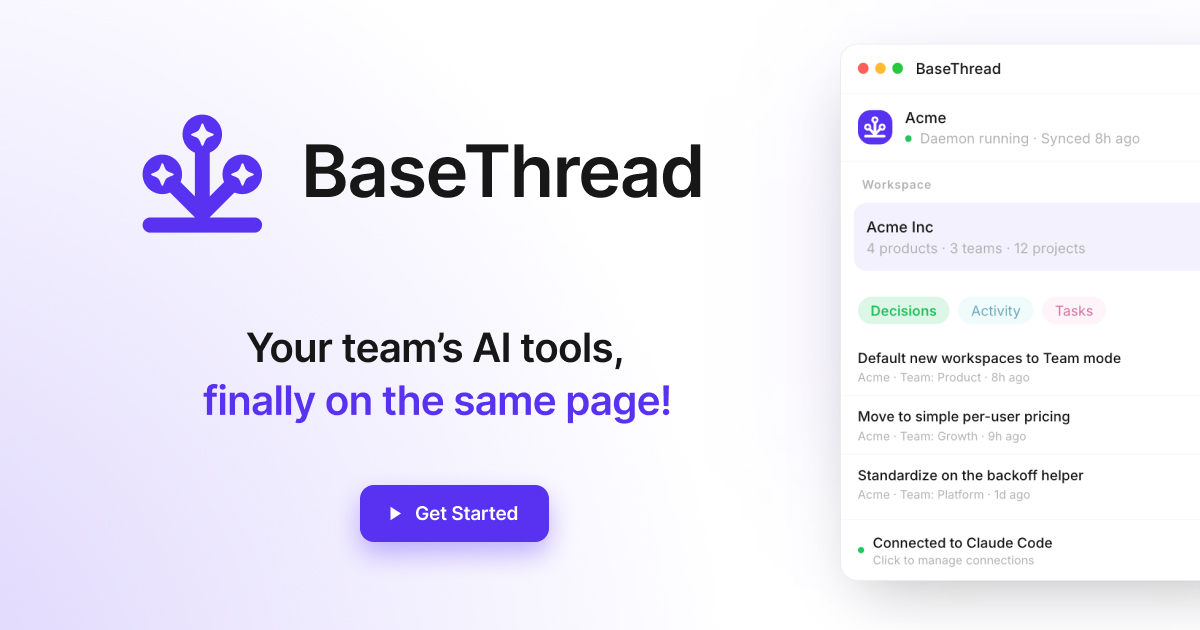
Point Claude Code, Cursor, and the rest at the shared source over MCP, so they read the consolidated conventions and decisions at session start. How BaseThread connects over MCP has the per-tool steps.
Step 4: thin out the files
Reduce each CLAUDE.md and .cursorrules to only the repo-local detail. They become short pointers, not the whole story, so there is far less to keep in sync. The drift problem shrinks because the duplicated content is gone.
Step 5: turn on write-back
Have tools log new decisions and activity to the shared source as work happens. This is what stops the sprawl from re-forming: new context goes to the one source automatically, instead of being pasted into another file.
What you keep, what you gain
- Keep: repo-local files for genuinely local detail. They still earn their place.
- Gain: one source for conventions and decisions, read by every tool and repo; new hires and new repos inherit it; and it stays current on its own.
Migration in one line
Pull the shared and the decisions out of your scattered files into one source every tool reads. Leave only repo-local detail behind. The drift stops because the duplication is gone.
TL;DR
Teams accumulate contradicting CLAUDE.md, .cursorrules, and AGENTS.md files. To consolidate: audit them and sort content into repo-local detail (stays), shared conventions (moves), and decisions (moves to a record that had no home). Put the shared parts in one source every tool reads over MCP, thin the files to local detail, and turn on write-back so new context goes to the one source. You keep repo-local files and gain a single, current, shared context.
One source for conventions and decisions, with files reduced to thin local pointers.
Related reading
How to keep CLAUDE.md and .cursorrules in sync
Keeping CLAUDE.md and .cursorrules in sync by hand drifts fast. Here is why, and how a shared context source keeps every tool's rules current across a team.
AGENTS.md vs CLAUDE.md vs .cursorrules: the landscape
AGENTS.md vs CLAUDE.md vs .cursorrules: what each context file is, how they differ, and the limit all three share once your team uses more than one tool.
What is shared context for AI tools? (2026 guide)
Shared context for AI tools is the company, project, and decision background every AI reads automatically, so your whole team's tools stop guessing.
How to build a team second brain (step by step)
A team second brain is one curated context every teammate's AI reads. Here is how to build one in five steps, starting small and letting your AI keep it current.
Frequently asked questions
How do I consolidate scattered CLAUDE.md and .cursorrules files?
Move the shared parts (conventions, architecture, decisions) into one shared context source every tool reads over MCP, and keep only thin, repo-local detail in the files themselves. Audit your existing files, pull the common content into the shared source, connect your tools, and let new decisions write back automatically. The files shrink to build commands and local specifics; the cross-repo, cross-tool context lives once.