
Shared context for AI tools
Onyx alternative: curated context vs open-source enterprise search
Looking for an Onyx alternative? Onyx is open-source enterprise search you self-host. BaseThread is the shared brain your AI writes the signal into and every AI tool reads back.
Onyx is one of the better answers to "I want enterprise search, but I want to own it." It is open-source, ships with 40-plus connectors, does AI chat over your indexed data, and you can self-host the whole thing. If that is exactly what you need, Onyx is a genuinely good pick. But a lot of teams searching for an "Onyx alternative" are not actually after another search engine. They want their AI tools to share their team's context. That is a different category, and it is worth knowing the difference before you stand up another index.
What Onyx does well
Credit where it is due. Onyx covers real ground for its target user.
- Open-source and self-hostable. Run it on your own infrastructure, keep the index in-house, no vendor lock-in on the search layer.
- 40-plus connectors. It reaches into a wide range of tools and pulls them into one searchable place.
- AI chat over your data. Ask questions in natural language and get answers grounded in what it indexed.
If your problem is "our knowledge is scattered and we want a self-hosted way to search all of it," Onyx is a strong choice and this comparison is academic.
Where it is a different shape than you might want
The strengths come with a shape. Onyx, like other enterprise search, is built around indexing and searching.
- It is a search destination. Onyx answers in Onyx. People go to it. It is not built to feed your Claude Code, Cursor, or ChatGPT the context they need as they work.
- It indexes everything. A full searchable copy is great for search and a lot for context. Your AI tools do not want the whole index at session start; they want the right, scoped context.
- Self-hosting is real work. Open-source is a benefit and a responsibility. You run it, you maintain it, you scale it.
The curated-context alternative
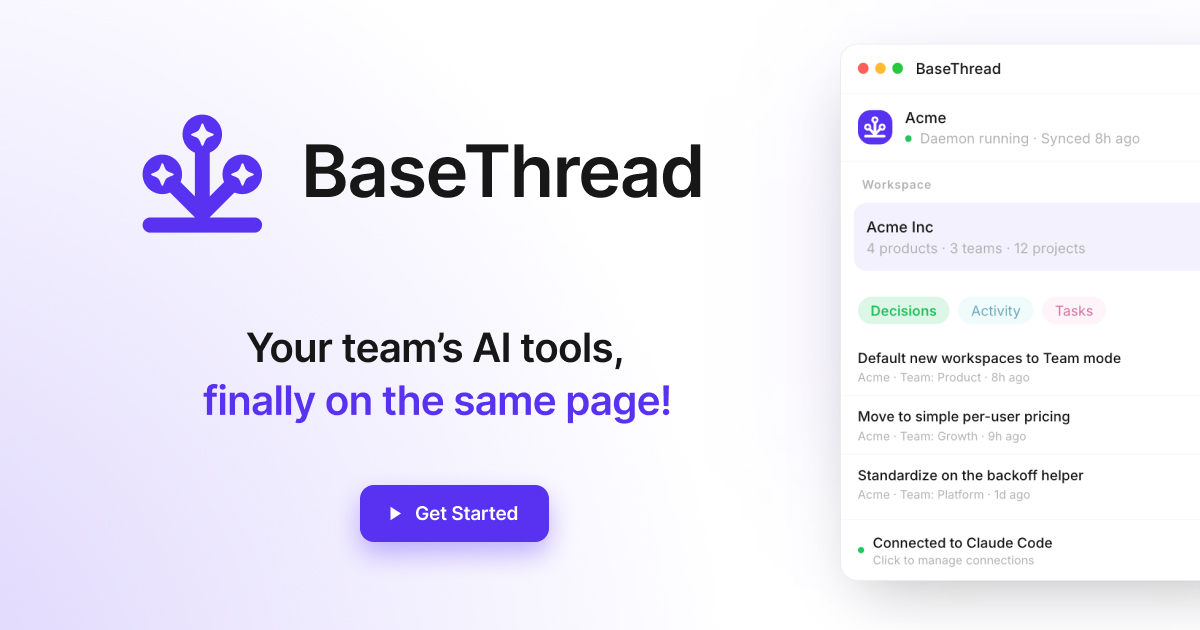
BaseThread is not another search engine. It starts from a different goal: get the AI tools your team already uses onto the same context, without sending anyone to a separate box.
- The signal, not a dump. Your AI writes what matters into a curated context graph, structured the way your company works (Company, Products, Teams, Projects, You).
- Scoped to the right work. Context is scoped to a team or project, not a flat index of everything you own.
- Read by your tools over MCP. Claude Code, Cursor, ChatGPT, and any MCP client read the curated context, local or remote, so it appears where you already work.
- Your AI is the integration. Your AI already reaches tools like Notion and HubSpot with the access it has; it works with them through your AI and writes what matters in, curated not scraped. BaseThread never connects to or copies your tools.
Onyx vs BaseThread
| Onyx | BaseThread | |
|---|---|---|
| Category | Open-source enterprise search | Curated context layer |
| Core model | Index everything, search it | Your AI writes the signal into a graph |
| Touches your tools | Connects to and indexes them | Never, your AI is the integration |
| Hosting | Self-host or run yourself | Hosted |
| Where you use it | Onyx's own UI | Your existing AI tools, over MCP |
| Scope | Everything you index | The right team or project |
| Captures decisions | No | Yes, Activity, Decisions, and Tasks |
Which should you pick?
- You want open-source, self-hosted search over all your apps: Onyx is a strong fit, and the wider field of Glean alternatives covers the rest of the search camp.
- You want your AI tools to share your team's context, not another search box: that is BaseThread.
Search and context look adjacent until you try to use them. One sends a person to query a box. The other hands your tools the context before they answer.
The honest framing
Onyx is a great way to own your enterprise search. BaseThread is not a search engine at all. It is the curated context your AI tools read so the right answer shows up in the tool you are already using.
TL;DR
Onyx is open-source, self-hostable enterprise search with 40-plus connectors and AI chat over your indexed data, a strong pick if you want to own your search layer. BaseThread is a different category: instead of connecting to and indexing everything to search, your AI reads your sources with the access it already has and writes the signal into a curated, scoped context graph, and the AI tools you already use read it back over MCP. Pick Onyx for self-hosted search; pick BaseThread for curated context your tools read.
Skip standing up enterprise search. Give your AI tools one curated context they read over MCP.
Related reading
Glean alternatives in 2026, ranked
Looking for Glean alternatives in 2026? Here are the real enterprise-search options, ranked, plus the curated-context approach that feeds your AI tools instead.
Glean vs BaseThread: enterprise search vs curated context
Glean vs BaseThread compared. Glean indexes everything and answers in its own UI. BaseThread is the shared brain your AI writes the signal into and every AI tool reads back.
What is shared context for AI tools? (2026 guide)
Shared context for AI tools is the company, project, and decision background every AI reads automatically, so your whole team's tools stop guessing.
How to build a team second brain (step by step)
A team second brain is one curated context every teammate's AI reads. Here is how to build one in five steps, starting small and letting your AI keep it current.
Frequently asked questions
What is a good alternative to Onyx?
If you want what Onyx does, open-source enterprise search you can self-host, the closest peers are other search products like GoSearch, Coveo, or Glean. If your goal is less about searching everything and more about getting your AI tools to share your team's context, BaseThread is a different category built for that: your AI writes the signal into a curated graph and every AI tool reads it back over MCP. BaseThread never connects to or indexes your tools.
Is BaseThread open-source like Onyx?
No. Onyx is open-source and self-hostable, which is one of its biggest strengths. BaseThread is a hosted product. They also do different jobs: Onyx connects to and indexes everything so people can search it, while BaseThread never touches your tools, your AI writes the signal into a curated context layer and every AI tool reads it back over MCP.
Why curate context instead of indexing everything?
Indexing everything gives you a searchable copy of all your data, useful when the job is search. But it does not hand your AI tools a clean, scoped context to start from. With BaseThread, your AI writes the signal into a curated graph, scoped to the right team or project, curated not scraped, so your tools read the right thing, not the whole haystack.