
AI memory vs shared context
AI memory software for teams: what to look for in 2026
Most AI memory software is built for one person. For a team you need shared, cross-tool memory every teammate's AI reads. Here is what to look for and the options.
Search for "AI memory software" and almost everything you find is built for one person: a tool that remembers your chats, your notes, your preferences, inside one app. That is useful for you. It does nothing for your team, because the moment a second person's AI is working from a different memory, your answers stop agreeing.
AI memory software for a team is a different category. The job is not to make one assistant remember one person. It is to give a whole team's AI tools a shared, lasting memory of the work, so everyone's assistant reads the same current picture. Here is what that means, what to look for, and how the options stack up.
Why per-user memory doesn't work for a team
Built-in memory features (ChatGPT memory, Claude's memory, Cursor memories) remember you, inside that tool. On a team that produces the exact problem you are trying to solve:
- One engineer's AI suggests an approach the team killed two sprints ago, because nothing told it the decision was made.
- Two teammates' assistants give contradicting answers on the same service in the same week.
- A new hire's tools know nothing, so onboarding stalls.
None of these are model failures. They are missing-shared-memory failures. Ten private memories never reconcile into one team memory. We make the full case in why per-user AI memory doesn't compound into team knowledge.
Definition
AI memory software for teams
Software that gives a whole team's AI tools a shared, lasting memory of the work, the company, projects, decisions, and activity, so every teammate's AI reads the same current context. Unlike per-user memory features, it is team-shared, cross-tool, and kept current automatically.
What to look for (five criteria)
- Shared, not per-user. The memory belongs to the team, not one person's profile. Everyone's AI reads and writes the same source.
- Cross-tool. It works with every AI tool your team uses, Claude Code, Cursor, ChatGPT, Copilot, not just one app.
- Captured automatically. Your AI writes activity and decisions as work happens, so the memory stays current without anyone maintaining a wiki.
- Structured to your company. Company, products, teams, projects, so a tool reads the relevant slice, not a flat pile.
- Read over an open standard. It reaches your tools over the Model Context Protocol (MCP), so any MCP-capable tool can read it.
Anything that only does per-user, single-tool memory fails criteria 1 and 2, which are the ones that matter for a team.
The options, mapped honestly
| Option | Shared across team | Cross-tool | Auto-captured | Best for |
|---|---|---|---|---|
| Built-in memory (ChatGPT, Claude, Cursor) | No, per user | No, one tool | Yes | One person, one app |
| Memory APIs (Mem0, Zep, Supermemory) | A primitive you build on | If you build it | You write code | Developers adding memory to an app |
| A team wiki (Notion, Confluence) | Yes | No, humans read it | No | Human-written reference docs |
| Shared context (BaseThread) | Yes, whole team | Yes, every tool | Yes, AI-written | A team's AI on one memory |
Memory APIs like Mem0, Zep, and Supermemory are excellent infrastructure, but they are building blocks a developer wires up, not a finished team product; see Mem0 alternative for teams and the best AI memory and context tools for teams. A wiki is team-shared but read by people, not by your tools as they work. The gap the others leave is a memory that is shared, cross-tool, and automatic, all at once.
The team-first answer: shared context
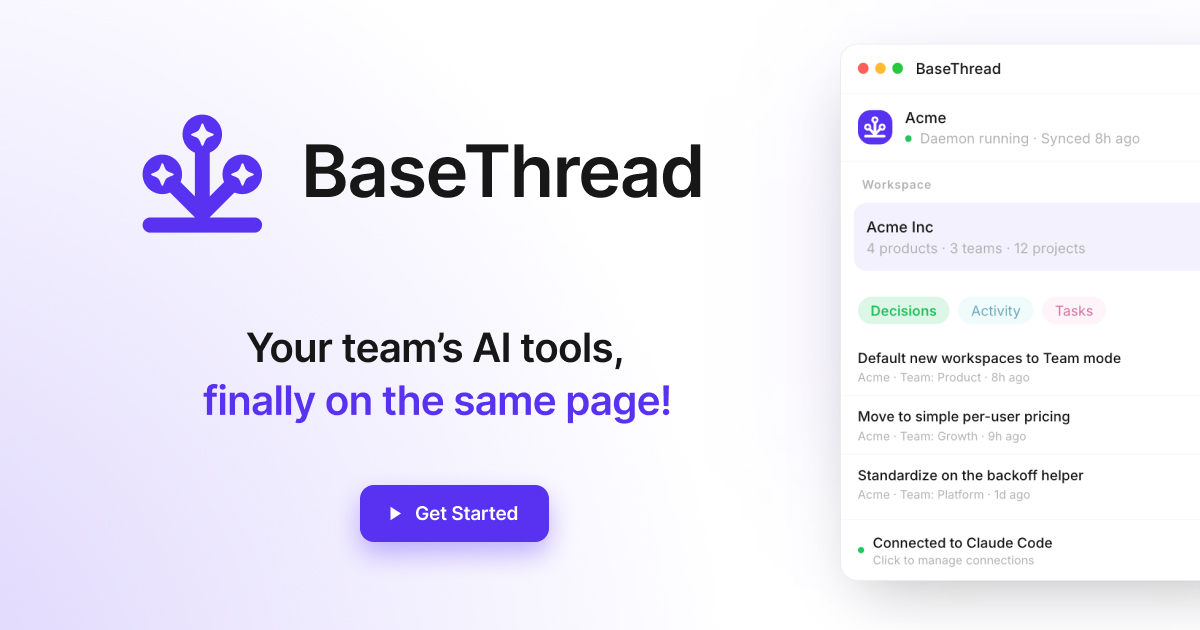
This is why we build BaseThread as shared context rather than per-user memory. Your team curates the structure once (company, products, teams, projects); every AI tool reads the relevant slice over MCP and writes activity, decisions, and tasks back as work happens. It is team-shared by default, works with the tools you already use, and stays current on its own. The deeper distinction is in AI memory vs shared context.
The quick test
If every teammate's AI knows that one person's chats but none of them know what the team decided last week, you have per-user memory, not team memory. The shared one is the job.
TL;DR
Most AI memory software is per-user and single-tool, which is exactly what breaks on a team, because ten private memories never reconcile. Team AI memory needs five things: shared across the team, cross-tool, auto-captured, company-structured, and read over MCP. Built-in memory and memory APIs each miss some of these; a shared context layer is built to have all five. BaseThread is that layer.
Give your whole team's AI one shared memory over MCP, instead of ten private ones. Free to start, no card.
Related reading
Best AI memory and context tools for teams (2026)
The best AI memory and context tools for teams in 2026: Mem0, Zep, built-in memory, wikis, and shared context layers, with the job each one is actually for.
AI memory vs shared context: the difference
AI memory vs shared context: memory is personal and locked to one tool, shared context is team-wide and read by every tool. Here is how to tell them apart.
Per-user AI memory doesn't compound into team knowledge
Per-user AI memory can't add up to team knowledge. Here is the structural reason ten people's personal memories never become one shared team brain, and what does.
Does AI actually remember anything? How AI memory works
Does AI remember? By default, no. A model forgets between sessions. Memory features bolt recall on top. Here is how AI memory really works, in plain English.
Frequently asked questions
What is AI memory software for teams?
It is software that gives a whole team's AI tools a shared, lasting memory of the work: the company, projects, decisions, and activity, so every teammate's AI reads the same current context instead of each one remembering a different, partial slice. It is different from per-user memory features (ChatGPT memory, Claude memory), which remember one person inside one tool and never reach the rest of the team.
Is ChatGPT or Claude memory enough for a team?
No. Built-in memory in ChatGPT, Claude, or Cursor is per-user and locked to that one tool. It remembers your chats, not your team's decisions, and it does not travel to the other tools your teammates use. For a team you need shared context that every tool and every person reads, which built-in memory is not designed to do.
What should I look for in AI memory software for a team?
Five things: it is shared across the team (not per-user), it works across every AI tool you use (not one app), it captures context automatically as work happens (not manual logging), it is structured to your company, and it is read by your tools over an open standard like MCP. Anything that only does per-user, single-tool memory will not compound into team knowledge.