
AI memory vs shared context
Mem0 alternative for teams (shared, not just agent, memory)
Looking for a Mem0 alternative for teams? Mem0 is a memory SDK for agents you build. If you want shared, curated context across your team's AI tools, here's the difference.
If you searched "Mem0 alternative," the first question is which job you were using Mem0 for, because the honest answer depends on it. Mem0 is a strong, widely used memory layer for AI agents. It is an SDK you call from code to give an agent recall. That is a different thing from a shared context layer for a team's existing tools, and if it is the second one you actually wanted, this is the difference.
What Mem0 is, and is good at
Mem0 is developer infrastructure. You install it, call it from your agent's code, and it stores and recalls memories, typically per end-user, as your agent runs. It is a building block for people building AI products.
Where Mem0 genuinely wins, and we will say it plainly:
- Agent infrastructure. If you are building an agent and need a memory store, Mem0 is purpose-built for exactly that.
- Per-user recall at scale. It is designed to remember many individual end-users across sessions.
- A developer SDK. It lives in your code, where an agent builder wants it.
If that is your need, use Mem0. You do not need a different tool.
Where it is the wrong fit
The misfit is when you wanted to give your team's AI tools shared context, and reached for a memory SDK because "memory" sounded close. Mem0 is not built for that:
- It is called from code, not curated by a team in a product.
- Its memories are auto-extracted per end-user, not a deliberate, shared company-and-project context.
- It does not feed your existing tools (Claude Code, Cursor, ChatGPT) a shared source they read over MCP.
- It has no record of what the team decided, because that was never its job.
This is the distinction we draw in full in AI memory vs shared context: memory is per-user recall, shared context is team-wide understanding.
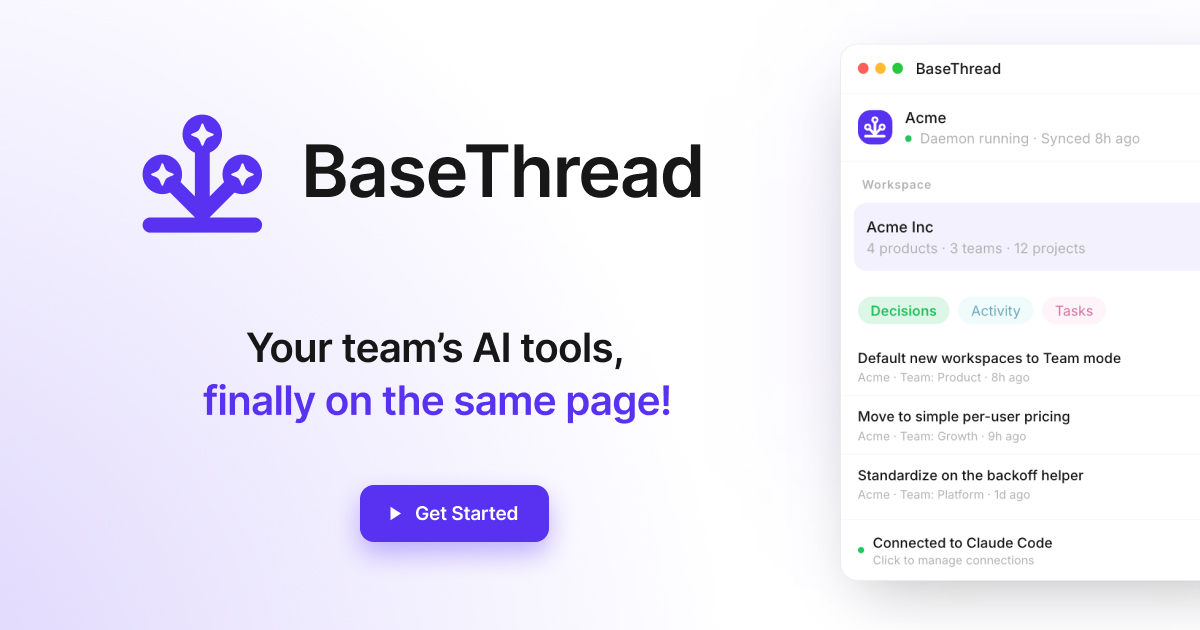
Mem0 vs a shared context layer
| Mem0 | BaseThread | |
|---|---|---|
| What it is | A memory SDK for agents | A shared context layer for teams |
| Who uses it | Developers building agents | A team and its existing AI tools |
| How you use it | Call it from code | Curate context, connect tools over MCP |
| Unit | Per end-user | Per team |
| Captures team decisions | No | Yes, an AI-written ledger |
| Read by Claude Code, Cursor, ChatGPT | No, not its job | Yes, over MCP |
The "No" rows are not knocks on Mem0; they are the boundary of what it is for. Mem0 serves an agent you build. BaseThread serves a team you already have.
Which should you choose?
- Building an agent that needs memory? Use Mem0 (or a similar memory store). That is the job it is built for.
- Want your team's AI tools to share one curated context and a record of decisions? That is a shared context layer, see what is shared context for AI tools and the full comparison, which also covers Zep, Letta, wikis, and built-in memory.
If Mem0 came up alongside other memory frameworks in your search, the same team-versus-agent split applies to them too, see a Zep and Letta alternative for teams for that side-by-side.
Plenty of teams end up using both: a memory store inside the agents they build, and a shared context layer across the tools they buy.
The honest summary
Mem0 is not a worse version of BaseThread, and BaseThread is not a worse version of Mem0. One is agent-memory infrastructure; the other is team-shared context. Pick by the job, not the keyword.
TL;DR
Mem0 is a memory SDK for agents you build, called from code, per end-user, and it is good at that. If you actually wanted your team's existing AI tools to share one curated context plus a record of decisions, that is a shared context layer, not a memory API. BaseThread is the team-shared, cross-tool option; Mem0 is the agent-infrastructure option. Many teams use both.
Give your whole team one shared context every AI tool reads, not a per-app memory or a wiki people forget to update.
Related reading
AI memory vs shared context: the difference
AI memory vs shared context: memory is personal and locked to one tool, shared context is team-wide and read by every tool. Here is how to tell them apart.
What is shared context for AI tools? (2026 guide)
Shared context for AI tools is the company, project, and decision background every AI reads automatically, so your whole team's tools stop guessing.
Best AI memory and context tools for teams (2026)
The best AI memory and context tools for teams in 2026: Mem0, Zep, built-in memory, wikis, and shared context layers, with the job each one is actually for.
AI memory software for teams: what to look for in 2026
Most AI memory software is built for one person. For a team you need shared, cross-tool memory every teammate's AI reads. Here is what to look for and the options.
Frequently asked questions
Is BaseThread a Mem0 alternative?
Only if you were using Mem0 for the wrong job. Mem0 is a memory SDK for developers building agents: you call it from code to give an agent recall. BaseThread is a shared context layer for a team's existing AI tools: a curated source plus an AI-written record of decisions and activity that Claude Code, Cursor, and ChatGPT read over MCP. If you wanted team-shared context rather than an agent-memory API, BaseThread is the fit. If you are building an agent and need a memory store, Mem0 is the right tool.
What is the difference between Mem0 and BaseThread?
Mem0 is infrastructure: an SDK that stores and recalls memories for agents you build, per end-user, called from code. BaseThread is a product for teams: human-curated context plus an AI-written activity and decisions ledger, read by every team member's AI tools, scoped by role. Different buyer, different unit. Mem0 serves an agent; BaseThread serves a team.