
AI memory vs shared context
Glean alternative for small technical teams
Looking for a Glean alternative for a small technical team? Glean is enterprise search built for large orgs. Here is the lighter, AI-tool-native option for smaller teams.
Glean is a strong product, and if you are a large organization that wants AI search across every app your company runs, it is built for exactly that. The trouble is what happens when a small technical team looks at it: the enterprise framing, the seat minimums, and the passive index-everything model are aimed at a different buyer. If that is you, here is the lighter, AI-tool-native alternative.
What Glean is good at
Be fair about it. Glean does real things well for the buyer it targets:
- Enterprise search across 100+ apps. It indexes your whole tool sprawl and answers across it.
- Passive coverage. You do not curate; it crawls and connects.
- Built for large orgs. Governance, scale, and an enterprise sales motion to match.
If you are a 1,000-person company drowning in apps, that is the value. For a small team, it is also the mismatch.
Where it is wrong for a small team
- Built for enterprise, priced for it. Seat minimums and enterprise contracts are a lot for a team of ten.
- Index-everything, not curate-deliberately. Passive search over all your data is a different thing from a curated, intentional shared context. More is not always better, see context rot.
- A search box, not your tools. Glean answers in Glean. It is not primarily about feeding your Claude Code and Cursor a shared context over MCP.
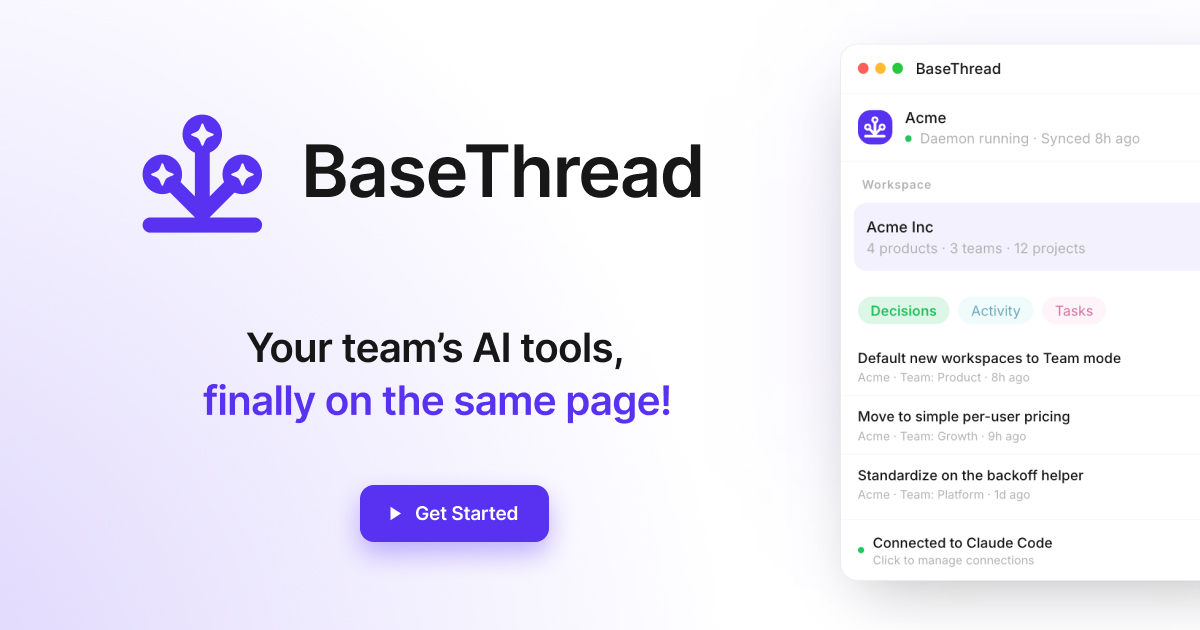
The alternative for a small team
A shared context layer takes the opposite, lighter approach:
- Curated, not crawled. You decide what context matters, in a deliberate structure, rather than indexing everything.
- Read by your existing AI tools. Claude Code, Cursor, ChatGPT, and the rest read it over MCP, so the context shows up where you already work.
- Decision-aware. An AI-written record of what the team decided and shipped, which passive search does not produce.
- Sized for a small team. No enterprise minimum to clear before it is useful.
Glean vs a shared context layer
| Glean | Shared context layer | |
|---|---|---|
| Built for | Large enterprises | Small and mid technical teams |
| Model | Index everything (search) | Curated shared context |
| Where you use it | Glean's search | Your existing AI tools, over MCP |
| Records decisions | No | Yes, AI-written |
| Entry size | Enterprise minimums | Start with a small team |
Which should you pick?
- Large org, want search over all your apps: Glean is built for that.
- Small technical team, want your AI tools to share a curated context and decisions: a shared context layer fits where Glean is too heavy. The compare page places both next to the memory and wiki options.
The honest framing
This is not "Glean is bad." It is "Glean is enterprise search, and a small team usually wants curated context in its own tools, which is a different product."
TL;DR
Glean is enterprise work-AI search: it indexes everything across a large org's apps and is priced and built for that buyer. A small technical team usually wants the opposite shape: a curated shared context read through its existing AI tools over MCP, with a decisions record, and no enterprise seat minimum to clear. For small teams, a shared context layer is the lighter, AI-tool-native alternative; for a large org wanting search over everything, Glean is the fit.
Skip the enterprise-search rollout. Give your small team one curated context every AI tool reads.
Related reading
What is shared context for AI tools? (2026 guide)
Shared context for AI tools is the company, project, and decision background every AI reads automatically, so your whole team's tools stop guessing.
Best AI memory and context tools for teams (2026)
The best AI memory and context tools for teams in 2026: Mem0, Zep, built-in memory, wikis, and shared context layers, with the job each one is actually for.
The team-context problem nobody has solved yet
Every AI tool solves context for one person. The team-context problem, one shared, current context across every tool and teammate, is the gap nobody filled.
AI memory software for teams: what to look for in 2026
Most AI memory software is built for one person. For a team you need shared, cross-tool memory every teammate's AI reads. Here is what to look for and the options.
Frequently asked questions
Is BaseThread a Glean alternative?
For a small technical team, yes, with a different shape. Glean is enterprise work-AI search that indexes everything across your apps and is sold to large organizations, often with a high seat minimum. BaseThread is a curated shared context layer that a small team reads through its existing AI tools over MCP, with a deliberate context and decision record rather than passive search over everything. If you are a small team that wants your AI tools to share context, BaseThread fits where Glean is built for enterprise IT.