
Works with your tools
Build your team's AI knowledge base from the tools you already use
Build an AI knowledge base your tools actually read. Your AI reads Notion, Slack, Jira, HubSpot, and GitHub and writes the signal into one shared context every tool reads back.
Your team's knowledge already exists. It is the product spec in Notion, the decision someone made in a Slack thread, the ticket in Jira that explains why a feature changed, the customer note in HubSpot, the PR description in GitHub. The problem is none of your AI tools can read any of it. So every session starts blank, and you end up pasting the same background in by hand.
The fix is not "write one more doc." It is to build a knowledge base from the tools you already use, in a shape your AI tools can actually read. The key idea: your AI already connects to these tools. BaseThread is where your AI writes the signal, and where every AI tool reads it back. You connect nothing new. Your AI is the integration. This post is the map: how the pieces fit, and where each tool plugs in.
Why a folder of docs is not a knowledge base
Most "AI knowledge base" advice ends with: dump your docs somewhere and point a model at them. That gets you a flat pile. A model reading a flat pile has no idea which page is current, which decision was reversed, or which note belongs to which project. More documents make this worse, not better, because the relevant fact gets buried under everything else.
A real knowledge base for AI has two things a folder lacks: structure and freshness. Structure means a tool can read the slice that fits the task. Freshness means the record reflects what your team did this week, not last quarter. We cover the underlying idea in what is shared context for AI tools.
The shape: a context graph, not a pile
BaseThread organizes your knowledge as a context graph with five layers:
- Company: how your org works, the conventions everyone follows.
- Products: what you build, and the rules around each one.
- Teams: who does what, and how each team operates.
- Projects: the work in flight, with its own context.
- You: an individual's role, preferences, and the way they like to work.
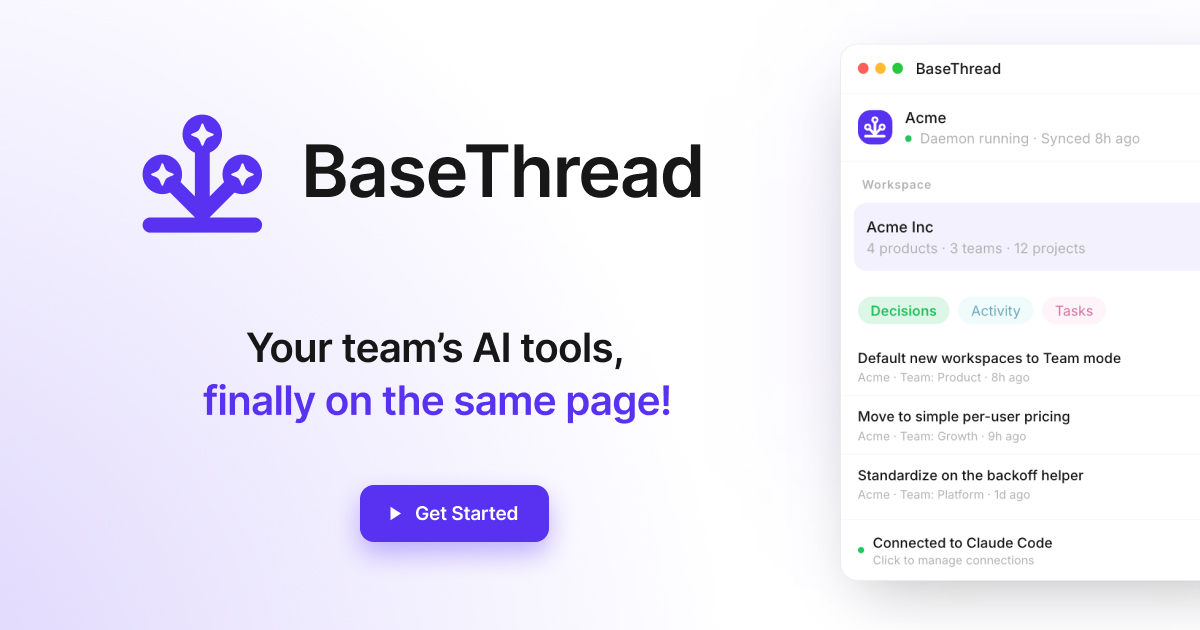
On top of those layers sit three live streams: Activity (what happened), Decisions (what the team agreed, and why), and Tasks (what is next). A tool reading the graph gets the structure plus the running record, scoped to the task, instead of an undifferentiated dump.
Curated signal, not a raw dump
Here is the part that matters most. When your AI reads Notion, Slack, or Jira, it does not copy every page and every message into your graph, and BaseThread never touches those tools itself. Your AI writes the signal: the decision out of the thread, the spec out of the doc, the customer detail out of the CRM record, placed in the right layer, scoped, and confirmed. You stay in control of what becomes shared context.
That is the difference between this and enterprise search that indexes everything. Index-everything is passive and noisy. Curated signal is deliberate and clean. The graph stays small enough to be useful and current enough to trust.
Where each tool plugs in
You do not point your AI at everything on day one. Start with the tool that holds the most context your AI is missing, then add the rest. Here is what each one brings.
Notion
If your specs, project docs, and conventions live in Notion, that is a deep well of context your AI tools cannot see today. Your AI already reads Notion, and it writes those docs into the Products and Projects layers, so Claude Code and Cursor read your actual spec, not a guess. See Notion MCP: give every AI tool your Notion context.
Slack
The decisions that never make it into a doc are the most expensive ones to lose. They get made in a thread and then evaporate. Your AI reads Slack and writes the settled decisions out of those conversations into the Decisions stream, so they reach every tool from then on. See connect Slack to your AI's shared context.
Jira and Confluence
Jira holds the why behind the work, and Confluence holds the long-form context around it. Your AI reads Atlassian and writes active tickets and the relevant pages into your Projects layer and Tasks stream, so a tool answering "where does this stand" sees the real backlog. See Jira and Confluence context for your AI tools.
HubSpot
For anyone working on customer-facing work, the context that matters lives in the CRM. Your AI reads HubSpot and writes the customer signal (who they are, what they care about, where the deal stands) into your graph, so a tool drafting an email or a plan knows the account. See give your AI the customer context in HubSpot.
GitHub
Your codebase already tells a story through its PRs, issues, and commits. Your AI reads GitHub and writes that into the Products and Projects layers, so your team's AI knows what shipped and what is open without you narrating it. See connect GitHub to your team's AI.
How your tools read it: MCP
Once the graph exists, every AI tool reads it over the Model Context Protocol, the open standard for connecting tools to outside context. Connect once, and the same shared context reaches Claude Code, Cursor, ChatGPT, and any other MCP client, locally through a native Mac app or remotely over a hosted endpoint.
This is the same loop, on a longer cycle. As your AI tools work, they write activity, decisions, and tasks back to the streams. So the knowledge base your AI built from Notion and Slack keeps getting sharper from the work itself, not just from the source tools. The graph is the team's brain; every tool reads it, and every tool contributes to it.
A practical order
- Pick the tool with the most hidden context. Usually Notion or Slack.
- Point your AI at it and at BaseThread, and let it write the signal into the graph.
- Connect one AI tool over MCP and watch the next answer fit your team.
- Add the next source. Jira for the why, HubSpot for customers, GitHub for code.
- Let the streams run. Decisions and activity write back, and the base stays current.
You do not build this once and maintain it forever. Your AI reads the tools you already run on, you curate what becomes shared context, and the loop keeps it fresh. What you end up with is a second brain for your team's AI, assembled from the tools your work already lives in. The integrations page lists what works with BaseThread, and how it works walks the loop end to end.
TL;DR
Your team's knowledge already lives in Notion, Slack, Jira, Confluence, HubSpot, and GitHub. Your AI already reads those tools, and it writes the signal from each into one context graph (five layers plus Activity, Decisions, and Tasks streams), curated rather than dumped, that every AI tool reads over MCP. BaseThread never touches your tools; your AI is the integration. Tools write activity and decisions back as they work, so the knowledge base built from your existing tools stays current on its own.
Build your team's AI knowledge base from the tools you already use.
Related reading
Notion MCP: give every AI tool your Notion context
Notion MCP lets your AI read Notion, but only inside one tool. Here is how to give Claude Code, Cursor, and ChatGPT your Notion context as shared context.
Connect Slack to your AI: turn thread decisions into shared context
Stop losing decisions in Slack threads. Your AI reads Slack and writes the signal into shared context every AI tool reads over MCP.
What is shared context for AI tools? (2026 guide)
Shared context for AI tools is the company, project, and decision background every AI reads automatically, so your whole team's tools stop guessing.
Give your AI the customer context in HubSpot
Your AI drafts blind without customer context. Your AI reads HubSpot and writes the signal into shared context every AI tool reads over MCP.
Frequently asked questions
What is an AI knowledge base built from my tools?
It is one shared context that your AI tools read, assembled from the work that already lives in Notion, Slack, Jira, Confluence, HubSpot, GitHub, and the rest. Instead of you writing and maintaining a separate doc, your AI reads each of those tools (it already connects to them) and writes the signal into the right layer of a context graph. Claude Code, Cursor, ChatGPT, and any MCP client then read that one source at the start of a session.
Do I have to move everything into BaseThread?
No. You keep working in Notion, Slack, Jira, and HubSpot. Your AI already reads those tools, and it writes the parts that matter into your shared context, scoped and confirmed. BaseThread never touches your tools. It is curated signal, not a copy of every page and every message. Your tools stay where they are; the context that your AI reads is what gets centralized.
How is this different from just pointing my AI at a folder of docs?
A folder of docs is a flat pile with no structure and no sense of what is current. A shared context graph has five layers (Company, Products, Teams, Projects, You) plus three live streams (Activity, Decisions, Tasks), so a tool reads the slice that fits the task instead of the whole pile. And because tools write activity and decisions back as work happens, the knowledge base stays current on its own.
Which tools can I connect?
Any tool your AI already reads. Notion, Slack, Jira, Confluence, HubSpot, GitHub, and the rest of your stack. Your AI is the integration, so there is no connector list to wait on: if your AI can read a tool, it can write that signal into your context graph. Get started free and we will help you point your AI at the tools your team actually runs on.