
Works with your tools
Notion MCP: give every AI tool your Notion context
Notion MCP lets your AI read Notion, but only inside one tool. Here is how to give Claude Code, Cursor, and ChatGPT your Notion context as shared context.
You want your AI to know what is in your Notion. The standard answer is Notion MCP: connect your Notion workspace to an AI tool over the Model Context Protocol and let it read your pages. That works, but it solves a smaller problem than the one you have. It wires one tool to your Notion. It does nothing for your other tools, and nothing for your team.
Here is what Notion MCP actually does, where it stops, and how to give every AI tool your Notion context instead of just one. The shift is simple: your AI already reads Notion. BaseThread is where your AI writes what matters, and where every other AI reads it back. You connect nothing new.
What Notion MCP does
Notion MCP exposes your Notion workspace to an AI tool through an MCP server. Once connected, the tool can search your pages and pull content into a session. Ask Claude Desktop about a spec, and it can go read the spec in Notion rather than make something up.
That is genuinely useful. For a single person working in a single tool, it closes the gap between "my docs are in Notion" and "my AI can see my docs." If that is all you need, the built-in connection does the job.
Where Notion MCP stops
The limits show up the moment you look past one person and one tool.
- It is one tool, not all of them. You connect Notion to Claude Desktop, and your Cursor and ChatGPT still start blank. Each tool needs its own connection, and each one reads Notion differently.
- It is your whole Notion, uncurated. The connection points at the workspace. There is no notion of "this spec is current and that one is abandoned." The model gets whatever search returns, noise included.
- It is per person. Your connection to your Notion does not give your teammate's tools the same context. Everyone wires up their own, and nobody shares a source.
- It does not capture decisions. Notion MCP reads what is written. It does not record what your tools decided as they worked, so the living history is still missing.
This is the same boundary we draw in Notion AI vs BaseThread: a tool that reads Notion makes that one tool smarter, but it does not give your team a shared context.
The better shape: write Notion into shared context
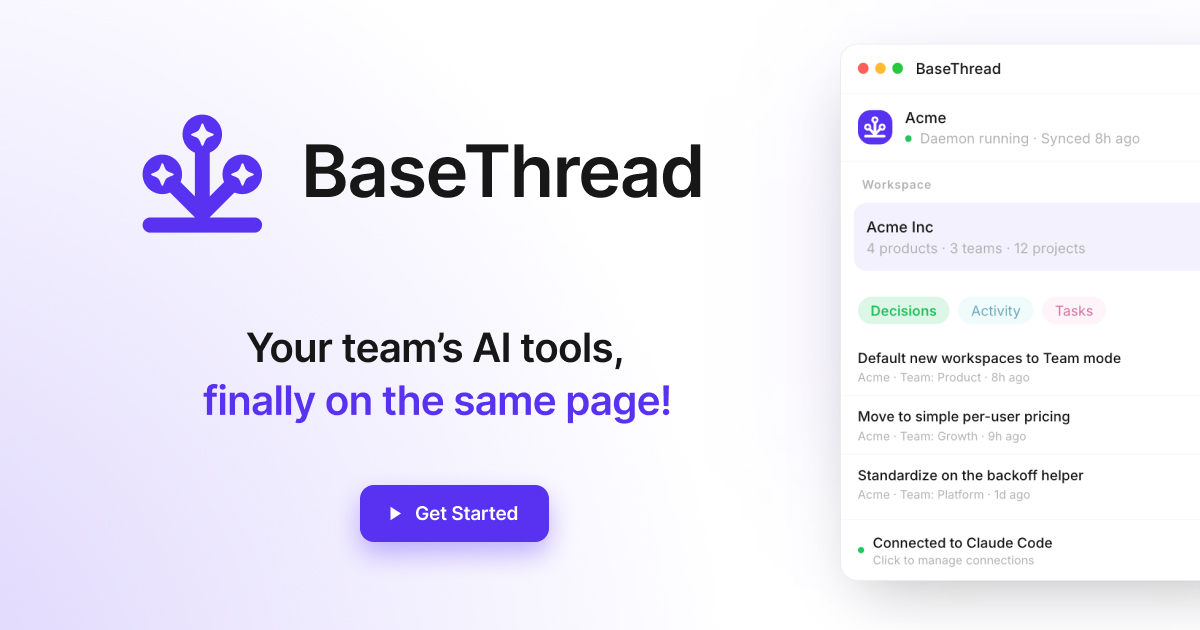
Your AI already reads Notion. The shift is what it does with it: instead of pulling Notion into one tool's session and losing it, point your AI at a shared context layer and have it write the signal there, where every tool reads it. BaseThread is that destination, and the loop works in three steps that change the result completely.
One: write the signal, not the dump
Your AI does the reading, and BaseThread never touches your Notion or holds its credentials. When your AI writes into BaseThread, it does not mirror your whole workspace. It writes the signal from the docs that matter into a context graph: the product spec goes in the Products layer, the project doc in the Projects layer, the conventions in the Company layer. Scoped and confirmed, so you control what becomes shared context. A current spec carries weight; an abandoned draft does not get pulled in to muddy the answer.
Two: every tool reads the same context
Once your Notion context lives in the graph, every MCP-capable tool reads it. Claude Code, Cursor, ChatGPT, and any other client connect once and get the same shared context at the start of a session, locally through a native Mac app or remotely over a hosted endpoint. Your AI writes the Notion signal in once, and every tool benefits, instead of repeating the work per app.
Three: the team shares it
Because the context lives in a team layer, your teammate's tools read the same Notion-derived context yours do. A decision your AI wrote from a Notion doc reaches everyone's AI, not just the person whose AI read it. That is the jump from convenience to coordination.
What this looks like day to day
You keep working in Notion. You write the spec, organize the project doc, update the conventions page, all where you already do it. Your AI reads it from Notion and keeps the distilled version in your shared context current, and every AI tool reads that back.
Then the loop runs the other way too. As your tools work against that context, they write activity and decisions back to the streams. So the knowledge that started in Notion gets sharper from the work, and the next session starts already caught up. The pattern is the same one we describe in moving from a team wiki to context your AI tools read.
Notion plus the rest of your stack
Notion is rarely the only place your context lives. The same approach works with Slack, Jira, HubSpot, and GitHub through your AI, each signal written into the right layer of the same graph. That is the whole idea behind building your AI knowledge base from the tools you already use: your context is scattered across the tools you run on, and the job is to have your AI write the signal into one place every AI reads.
If your team lives in Notion and your AI tools keep starting from zero, writing your Notion context into shared context closes that gap for every tool at once, not just one. The integrations page shows what works with BaseThread, and how it works walks the read-and-write-back loop.
TL;DR
Notion MCP connects one AI tool to your Notion, which helps that tool but leaves your other tools and your team blank. Point your AI at BaseThread instead: your AI already reads Notion, and it writes the signal from your docs into a shared context graph that every MCP client reads, scoped and confirmed rather than dumped. BaseThread never touches your Notion. Your Notion context reaches every tool and every teammate, and tools write decisions back as they work.
Give every AI tool your Notion context, not just one.
Related reading
Build your team's AI knowledge base from the tools you already use
Build an AI knowledge base your tools actually read. Your AI reads Notion, Slack, Jira, HubSpot, and GitHub and writes the signal into one shared context every tool reads back.
Notion AI vs BaseThread: a wiki your AI reads vs context your tools read
Notion AI vs BaseThread: Notion AI answers inside your Notion docs. BaseThread feeds your team's context to every AI tool. Here is the honest difference.
What is shared context for AI tools? (2026 guide)
Shared context for AI tools is the company, project, and decision background every AI reads automatically, so your whole team's tools stop guessing.
From a team wiki to context your AI tools actually read
Your wiki is full of knowledge your AI tools never read. Here is how to move from a human-read wiki to shared context every AI tool reads at session start.
Frequently asked questions
What is Notion MCP?
Notion MCP is a Model Context Protocol connection that lets an AI tool read your Notion workspace. With it, a tool like Claude Desktop can search and pull from your Notion pages. The catch is that it usually connects one tool to your whole Notion, with no curation of what matters and no way to share that context across your team or your other AI tools.
How do I give every AI tool my Notion context, not just one?
Point your AI at a shared context layer instead of wiring Notion into a single tool. Your AI already reads Notion, and it writes the signal from your docs into a context graph, then every MCP client (Claude Code, Cursor, ChatGPT) reads that one shared context. So your Notion context reaches every tool and every teammate, not just the one app you wired Notion into.
Does BaseThread copy all my Notion pages?
No. BaseThread never touches your Notion. Your AI reads the docs that matter, with the access it already has, and writes the signal into the right layer of your context graph, scoped and confirmed. It is not a raw export of your whole workspace. Your Notion stays the home for your docs; the shared context your AI reads is the distilled version.
Do I still use Notion after connecting it?
Yes. You keep writing and organizing in Notion exactly as you do now. The connection just makes that work readable by every AI tool your team uses. Notion stays your wiki; BaseThread makes it context your tools can act on.


