
AI memory vs shared context
Dust alternative: shared context your AI tools actually read
Dust builds AI assistants on your company data. If you want a curated context layer every teammate's AI reads and writes back to, here is the difference.
If you searched "Dust alternative," it helps to be clear about what Dust does well first, because it is a real product solving a real problem. Dust lets you build AI assistants and agents on top of your company's data. It is one of the few tools that takes "company context for AI" seriously. The question is whether you want assistants you build and chat with, or a shared context layer the AI tools you already use read from. Those are different jobs.
What Dust is, and is good at
Dust is a platform for building AI agents and assistants that run on your company knowledge. You connect your sources, configure assistants for specific jobs, and your team chats with them. It is well made, and where it wins it wins clearly:
- Building internal assistants. If you want a branded, purpose-built assistant for a workflow, Dust is designed for exactly that.
- A single place to query company data. Connect the sources, ask the assistant, get an answer grounded in your data.
- Agent workflows. It supports multi-step agents that act, not just answer.
If that is the shape of what you need, Dust is a strong choice and you do not need to look further.
Where the fit gets thin
The gap shows up when your team does not want to go somewhere new to ask an assistant. They want the AI tools they already live in, Claude Code in the terminal, Cursor in the editor, ChatGPT in the browser, to share the same understanding of the company. That is a different posture:
- Dust is a destination. You go to Dust, or to an assistant you built, to get the answer.
- BaseThread is a layer underneath the tools you already use. The context shows up inside Claude Code or Cursor, no new chat surface required.
- Dust assistants read your data to answer. BaseThread tools also write back what happened: activity, decisions, and tasks recorded as the work gets done.
This is the line we draw in AI memory vs shared context. A context layer is not a place you visit. It is the shared source every tool reads.
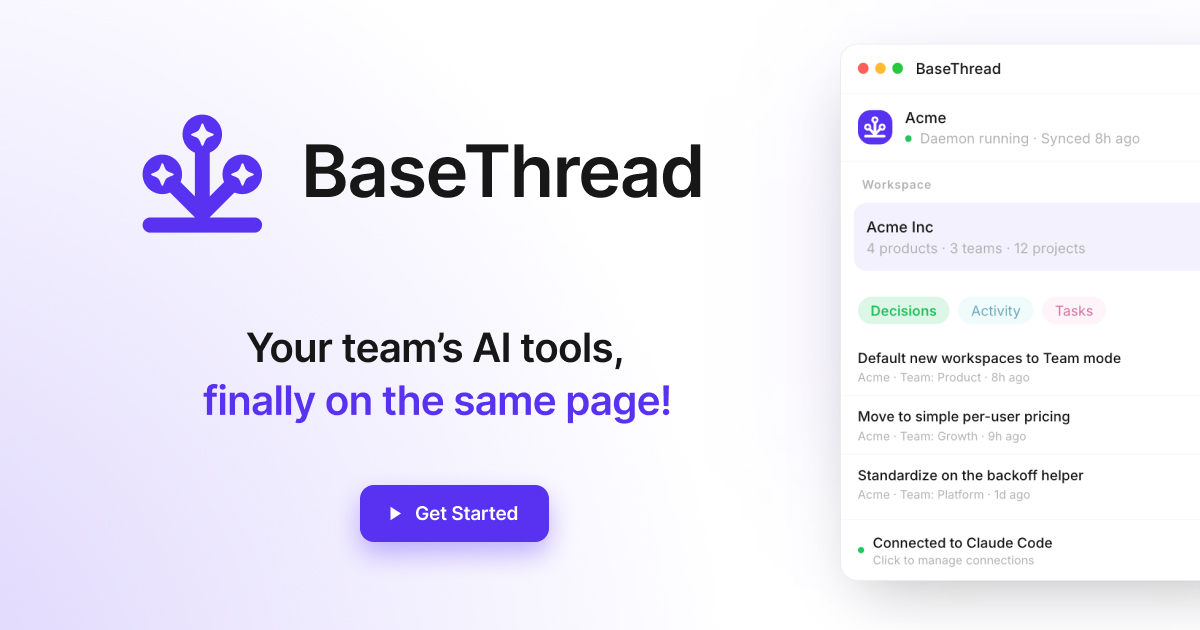
Dust vs a shared context layer
| Dust | BaseThread | |
|---|---|---|
| What it is | A platform to build AI assistants on your data | A shared context layer your AI tools read |
| Where you use it | In Dust, or an assistant you built | Inside Claude Code, Cursor, ChatGPT over MCP |
| How context is built | Connected sources power assistants | Your AI writes the signal into a curated graph by company structure |
| Writes back | Assistant answers | Tools write activity, decisions, and tasks back |
| Organized by | Assistants and data sources | Your real org: Company, Products, Teams, Projects, You |
| Best for | Building internal assistants | Aligning the AI tools your team already uses |
None of the Dust rows are knocks. They describe a platform for building assistants. BaseThread is not trying to be that. It is trying to be the shared source those tools, and yours, read from.
The part that is hard to copy: structure plus write-back
Two things make a shared context layer more than a search box over your docs.
The first is structure. BaseThread organizes context by your real company: Company, Products, Teams, Projects, and You. Context is curated, not scraped, so what your AI reads is the version a human stands behind, scoped by role. A new engineer's Cursor and a PM's ChatGPT pull from the same graph but see what is theirs to see.
The second is the write-back. As work happens, the AI tools your team uses record what they did. Activity for what happened, decisions for what the team agreed and why, tasks for what is next. That record is harmonized across the team, so ten people's tools contributing do not produce ten contradictory notes. This is the heart of the team-context problem: keeping a shared record that gets sharper as more people work, not noisier.
Which should you pick?
- Want to build assistants your team chats with, grounded in your data? Dust is built for that.
- Want one curated source your existing AI tools read, organized by your org, that records decisions and activity as you work? That is a shared context layer. See how it works and the full comparison.
Some teams run both, assistants in Dust for specific workflows, BaseThread as the context layer the rest of their tools read. Different parts of the same problem.
The honest summary
Dust is a platform for building AI assistants on your company data. BaseThread is a curated context layer your existing AI tools read and write back to, organized by your real structure. Pick by whether you want a new assistant or a shared source under the tools you already have.
TL;DR
Dust lets you build AI agents and assistants on your company data, and it is good at that. BaseThread is a shared context layer: a curated graph organized by your real org that Claude Code, Cursor, and ChatGPT read over MCP and write activity, decisions, and tasks back to. Dust is a destination you query; BaseThread is a layer under the tools you already use. Some teams use both.
Skip building assistants over connected data. Give the AI tools you already use one shared context.
Related reading
AI memory vs shared context: the difference
AI memory vs shared context: memory is personal and locked to one tool, shared context is team-wide and read by every tool. Here is how to tell them apart.
The team-context problem nobody has solved yet
Every AI tool solves context for one person. The team-context problem, one shared, current context across every tool and teammate, is the gap nobody filled.
Supermemory and LangMem alternative for teams
Supermemory and LangMem are memory layers you wire into apps and agents. If your team's AI tools need shared context instead, here is the difference.
AI memory software for teams: what to look for in 2026
Most AI memory software is built for one person. For a team you need shared, cross-tool memory every teammate's AI reads. Here is what to look for and the options.
Frequently asked questions
Is BaseThread a Dust alternative?
It depends on what you wanted Dust for. Dust is a platform for building AI agents and assistants that run on your company data. BaseThread is a shared context layer that your existing AI tools, like Claude Code, Cursor, and ChatGPT, read over MCP and write activity, decisions, and tasks back to. If you want to build branded internal assistants, Dust is built for that. If you want one curated source every teammate's AI already trusts reads from, BaseThread fits.
What is the difference between Dust and BaseThread?
Dust gives you assistants you configure and your team chats with. BaseThread gives you a context graph, organized by your real company structure, that any MCP-capable tool reads in the tool people already use. Dust is the place you go to talk to an assistant. BaseThread is the shared memory the tools you already have read from and write back to.
Does BaseThread connect to Notion and HubSpot like Dust?
No, and that's deliberate. Dust builds and maintains connectors into your tools; BaseThread is the shared brain your AI writes to. Your AI tools already read Notion and HubSpot with their own access, so there's nothing for BaseThread to connect to or maintain, and you never hand us another set of credentials.
Can I use Dust and BaseThread together?
Yes. Some teams build assistants in Dust for specific internal workflows and use BaseThread as the shared context layer the rest of their AI tools read. They solve different parts of the problem.