
Shared context for AI tools
How to get all your AI tools on the same page
Get all your AI tools on the same page by giving them one shared context every tool reads, instead of a separate setup per tool. Here is the practical way.
To get all your AI tools on the same page, stop setting up each one separately and give them one shared context they all read. Right now each tool runs on different inputs: Cursor has a rules file, ChatGPT has its own memory, Claude Code has whatever you pasted this morning. Different inputs, different answers. They only line up when they read the same source.
That is the whole trick. It is not a clever prompt or a master tool that bosses the others around. It is a single context that every tool pulls from, so they share one picture instead of four partial ones.
Why your tools disagree right now
Each AI tool keeps its own little world of context, and none of them talk to each other:
- Cursor reads a
.cursorrulesfile in the repo it happens to be in. - ChatGPT has a personal memory of your past chats, locked to your account.
- Claude Code reads a
CLAUDE.mdand whatever you typed this session. - The new tool you tried this week knows nothing about any of it.
So you get four versions of the truth. One tool suggests a pattern another just told you to avoid. One knows about a decision the others have never heard of. This is the same root cause behind why AI gives different answers to different people: different context in, different answers out.
Keeping all those per-tool setups in sync by hand is a losing game. Every change means editing a rules file here, a memory there, and re-pasting somewhere else. Nobody keeps that up.
The fix: one source every tool reads
Instead of N separate setups, you keep one shared context and point every tool at it. The standard that makes this possible is the Model Context Protocol, MCP, an open way for AI tools to read outside context. A tool connects once, then reads the relevant slice at the start of a session.
When Cursor, Claude Code, and ChatGPT all read the same source, they stop contradicting each other, because they are no longer guessing from different inputs. We cover the two-tool version of this in detail in share context between Cursor and ChatGPT.
The key difference from the per-tool approach is direction. With rules files and per-tool memory, you push the same facts outward into many places and then chase them when anything changes. With one shared source, the tools pull from a single place, so a change happens once and every tool sees it on the next session. You go from maintaining N copies to maintaining one, and the tools do the syncing for you.
How to set it up
Step 1: put your context in one place
Write down the background once, in plain language: what the company and project are, the conventions you follow, and the decisions you have already made. This becomes the single source, instead of a rules file per tool.
Step 2: connect each tool over MCP
Point Claude Code, Cursor, ChatGPT, and any other MCP-capable tool at that source. With BaseThread this is one connection per tool, and it works two ways: a local Mac app bridge for desktop tools, and a hosted endpoint at mcp.basethread.ai for tools that connect remotely. Either way they read the same context.
Step 3: let the tools write back
The source stays current because your tools update it as they work. When a tool finishes, its AI writes a short record of what shipped and what was decided back to the shared context, so the next session in any tool starts caught up. No manual re-syncing.
Step 4: bring the team onto it
This is where it gets powerful. When your teammate's tools read the same source, a decision your AI logged reaches their tools too. The team stops re-aligning in meetings because their tools are already aligned. That jump from personal to team is exactly what MCP for teams is about.
What it looks like when it works
- You ask the same question in Cursor and ChatGPT and get consistent answers.
- A tool you just started using is useful on the first prompt, because it read the same context.
- A decision made once reaches every tool and every teammate, instead of one chat.
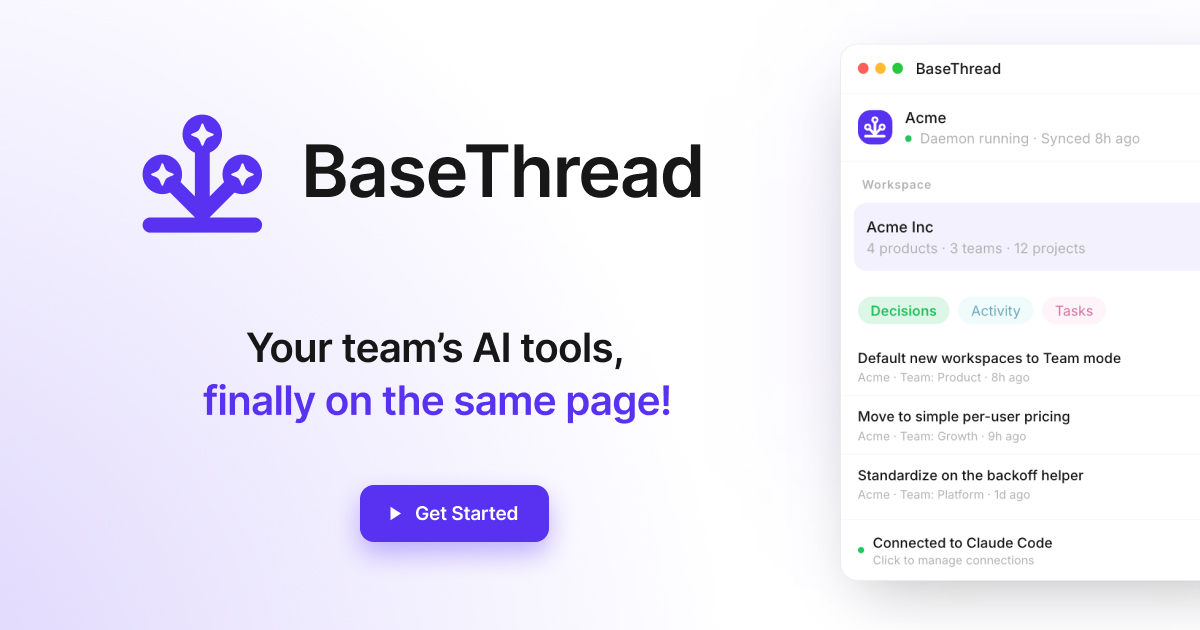
This is the practical face of shared context for AI tools, and it is what BaseThread is built to do: one curated context, read by every tool over MCP, kept current as you work.
The quick test
Ask two different AI tools the same question about your project. If the answers disagree, your tools are not on the same page, because they never read the same context.
TL;DR
Your AI tools disagree because each reads different context: a rules file here, a personal memory there, pasted background everywhere else. Get them on the same page by keeping one shared context and pointing every tool at it over MCP. Tools read the same source at the start of a session and write updates back, so they stay current. Add your team and a decision logged once reaches everyone's tools.
One shared context, read by every AI tool and every teammate, kept current as you work.
Related reading
How to share context between Cursor and ChatGPT
Share context between Cursor and ChatGPT without copy-paste. Keep one source both tools read over MCP, so your project context follows you between them.
MCP for teams: one context layer across your AI tools
MCP for teams turns scattered docs and decisions into one context layer every AI tool reads, so Claude Code, Cursor, and ChatGPT share the same source.
What is shared context for AI tools? (2026 guide)
Shared context for AI tools is the company, project, and decision background every AI reads automatically, so your whole team's tools stop guessing.
Why AI gives different answers to different people
AI gives different answers to different people because each person's tools read different context. Same model, different inputs, different output. Here is why.
Frequently asked questions
How do I get all my AI tools on the same page?
Stop configuring each tool separately and give them one shared context they all read. Instead of a rules file in Cursor, a memory in ChatGPT, and pasted background in Claude Code, you keep your company, project, and decisions in one place, and every tool reads the same source over MCP at the start of a session. One source, every tool, same answer.
Why do my AI tools give different answers?
Because each one is working from different context. Your Cursor read a rules file, your ChatGPT has its own memory of your chats, and your Claude Code got whatever you pasted today. Different inputs produce different outputs, even from good models. They line up only when they read the same context.
Can Cursor, Claude Code, and ChatGPT share the same context?
Yes, over the Model Context Protocol (MCP), the open standard that lets AI tools read outside context. When all of them connect to one shared source, they read the same company background, decisions, and current work, so their answers stop contradicting each other. BaseThread provides that single source and connects over MCP both locally and remotely.
What about my whole team's tools, not just mine?
Same mechanism, bigger payoff. When everyone's tools read one shared context, a decision logged by one person's AI reaches everyone else's tools from then on. That is the jump from personal convenience to team coordination, and it is the part single-tool memory cannot do.