
MCP for teams
How to give Claude Code your whole project context
Give Claude Code your whole project context, not just one repo's CLAUDE.md. Here is how a shared source keeps it current across repos, tools, and teammates.
Claude Code is sharp when it knows your project and generic when it does not. Most people give it context with a CLAUDE.md in the repo, which is a good start and also where most teams stop, even though it leaves Claude Code blind to everything outside that one file.
Here is how to give Claude Code the whole picture: the project, the decisions, and what the rest of the team is doing, and keep it current without hand-editing a file every time something changes.
How Claude Code reads context today
By default, Claude Code reads a CLAUDE.md at the root of the repo: conventions, commands, architecture notes. It is simple and it works for what it covers.
What it does not cover:
- Anything outside the repo. Cross-team decisions, the product roadmap, the project brief that lives elsewhere.
- What other people's tools just did. The file has no idea what a teammate shipped or decided yesterday.
- Staying current. Someone has to remember to edit it, so it lags reality.
A single repo file is the floor, not the ceiling. The broader idea is shared context for AI tools; this is how to apply it to Claude Code specifically.
Step 1: keep a CLAUDE.md for repo-local truth
Do keep one, for the things that genuinely belong to that repo: build commands, local conventions, how to run the tests. It is the right home for repo-specific detail.
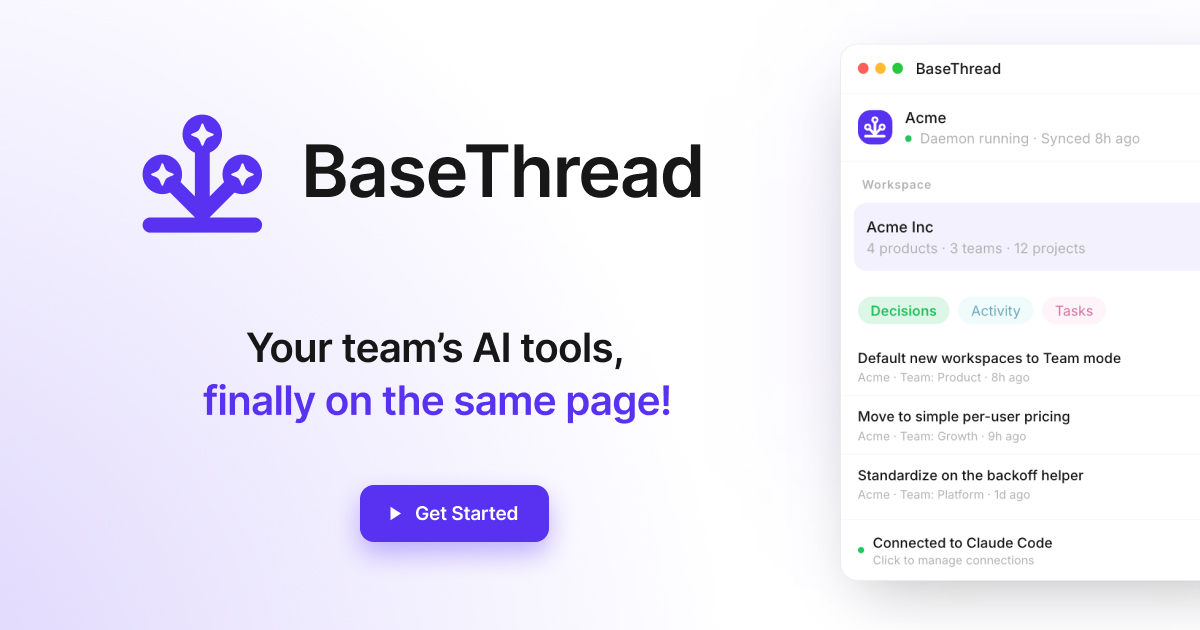
Step 2: connect Claude Code to your shared context over MCP
For everything bigger than one repo, connect Claude Code to a shared source over the Model Context Protocol. Now it reads:
- The project brief, goals, and owners, even when they live outside the repo.
- The decisions the team has logged, so it stops re-proposing what was already settled.
- Recent activity, so it knows what the last session and the last teammate changed.
How BaseThread connects to your AI tools over MCP covers the connection. For the team-server view of this, see MCP for teams.
Step 3: let it write back
When Claude Code finishes a task, have it log what shipped and what was decided to the shared source. That keeps the context current automatically and means the next session, yours or a teammate's, starts caught up. This is also how you give Claude Code memory across sessions without relying on the tool to hold anything. It also turns the hand-maintained file problem into a non-problem, which is the whole point of not syncing CLAUDE.md and .cursorrules by hand.
What good Claude Code context looks like
- Repo-local in CLAUDE.md: commands, conventions, how to run things.
- Shared over MCP: the project, the decisions, the recent activity, the cross-team facts.
- Current by default: because the tool writes back, not because someone remembered to.
The quick test
Ask Claude Code why a piece of architecture is the way it is. If it guesses instead of citing the decision, it has the repo file but not the team's context.
TL;DR
A repo CLAUDE.md is the floor: keep it for build commands and local conventions. Give Claude Code the whole picture by connecting it to a shared context source over MCP, the project, the decisions, and recent team activity, including everything that lives outside the repo. Let it write back so the context stays current automatically, and so the next session and the next teammate start caught up.
Give Claude Code your project, your decisions, and your team's recent work, over MCP.
Related reading
MCP for teams: one context layer across your AI tools
MCP for teams turns scattered docs and decisions into one context layer every AI tool reads, so Claude Code, Cursor, and ChatGPT share the same source.
How to keep CLAUDE.md and .cursorrules in sync
Keeping CLAUDE.md and .cursorrules in sync by hand drifts fast. Here is why, and how a shared context source keeps every tool's rules current across a team.
What is shared context for AI tools? (2026 guide)
Shared context for AI tools is the company, project, and decision background every AI reads automatically, so your whole team's tools stop guessing.
RAG vs MCP: when to retrieve, when to share context
RAG retrieves chunks from documents; MCP connects tools to live context and actions. Here is the real difference, when to use each, and how they work together.