
Shared context for AI tools
How to make AI smarter about your company
To make AI smarter about your company, give it your real context: company, products, projects, and decisions, in one place every tool reads automatically.
To make AI smarter about your company, you do not retrain the model. You give it your company's real context: who you are, what you build, what is in flight, and the decisions you have already made. The model already has the general intelligence. What it is missing is the specific truth about your business, and that arrives as context, not as a smarter model.
This trips people up because "smarter" sounds like it means a bigger or fine-tuned model. It almost never does. A capable model with your actual context will run circles around a custom model that is still guessing about how your company works.
Why training a custom model is the wrong instinct
The first idea most people have is to train or fine-tune a model on their company data. For nearly every team this is the wrong tool. Fine-tuning is slow, costs real money, and freezes your knowledge at the moment you trained it. The day you change your pricing, ship a feature, or reverse a decision, your custom model is quietly wrong, and retraining to fix it is a project.
Context is the opposite. You write down what is true, the model reads it at the start of the task, and when something changes you update the source, not the model. It is faster to set up, instantly current, and it works across every AI tool you use instead of one bespoke model you have to maintain.
What "company context" actually means
Making AI smart about your company means giving it four kinds of background.
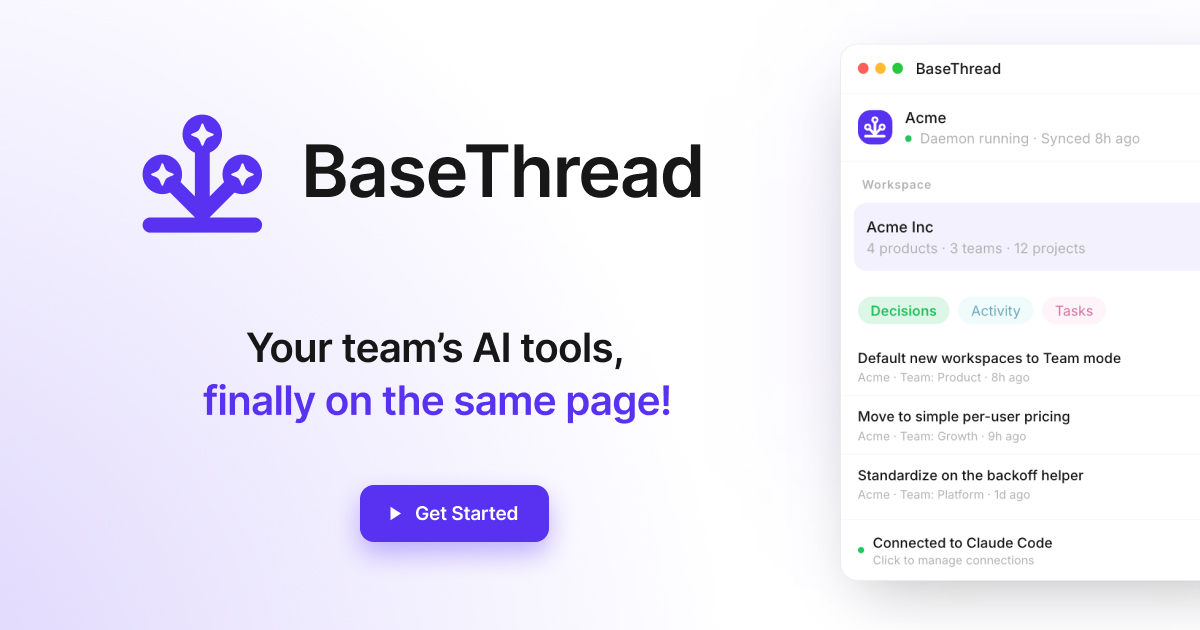
The structure: what is true. What the company does, the products you build, the teams and projects in motion. This is the map a tool needs to place any question.
The decisions: what you settled and why. This is the highest-value context and the one teams skip. When the AI knows you evaluated three vendors and picked one, it stops suggesting the two you rejected. Decisions are what turn a generic answer into your answer.
The conventions: how you actually work. The stack, the patterns, the style your code and your docs really follow, not the aspirational version.
The activity: what just happened. What shipped this week, what changed, so an answer fits this week's reality instead of last quarter's plan.
You do not need a manual to start. A handful of accurate lines about each beats a blank slate on the very first prompt.
How to set it up, step by step
Step 1: write the real context down once
Open one place and write plain-language background: what the company does, the current project and its goal, the conventions you follow, and the decisions you have made. Honest and short beats polished and aspirational.
Step 2: pull in what your tools already know
A lot of your company context already lives in the tools you use every day. Your roadmap is in one place, your customer notes in another. Rather than retype it, connect those tools so the signal gets distilled into your context, not dumped as raw pages. We walk through this in build your AI knowledge base from your tools, and the integrations page shows which tools connect today.
Step 3: let every tool read it over MCP
Instead of pasting, each AI tool reads your company context over the Model Context Protocol at the start of a session. Connect once and the next answer fits your business without setup. The same source reaches Claude Code, Cursor, ChatGPT, and the rest.
Step 4: keep it current automatically
The reason most company context goes stale is that updating it is a manual chore. Remove the chore: as your AI tools work, they write a short record of what shipped and what was decided back to the source, so it gets sharper on its own.
What this gets you
- Answers that match your actual product, not the public guess of it.
- A new hire whose tools know the company on day one instead of week three.
- Consistent answers across people, because every tool read the same decisions.
This is the difference between a model that is smart in general and one that is smart about you. If your real goal is the whole team, not just yourself, the next step is getting all your AI tools on the same page, which is where company context turns from convenience into coordination. The full picture is shared context for AI tools.
The quick test
Ask a fresh AI chat to summarize what your company does and what you are working on right now. If the answer is vague or wrong, the model is fine. It just has no company context yet.
TL;DR
You make AI smarter about your company by giving it context, not by training a custom model. Write down what is true, the products, projects, decisions, and conventions, pull in what your existing tools already know, and let every AI tool read it over MCP at the start of a session. Keep it current automatically as work happens. A capable model with your real context beats a fine-tuned model that is still guessing.
Give every AI tool your real company context, curated in one place, current as you work.
Related reading
What is an AI knowledge base, and why your team needs one
An AI knowledge base is a curated source of your team's facts that AI tools read directly. Here is what it is, how it beats a wiki, and why teams need one.
Build your team's AI knowledge base from the tools you already use
Build an AI knowledge base your tools actually read. Your AI reads Notion, Slack, Jira, HubSpot, and GitHub and writes the signal into one shared context every tool reads back.
What is shared context for AI tools? (2026 guide)
Shared context for AI tools is the company, project, and decision background every AI reads automatically, so your whole team's tools stop guessing.
How to get all your AI tools on the same page
Get all your AI tools on the same page by giving them one shared context every tool reads, instead of a separate setup per tool. Here is the practical way.
Frequently asked questions
How do I make AI smarter about my company?
You do not retrain the model. You supply it your company's real context: who you are, what you build, the projects in flight, and the decisions you have made, kept in one place every tool reads automatically. The model already has the general intelligence. What it lacks is the specific facts about your business, and the fix is feeding it that context, not fine-tuning a model.
Do I need to train or fine-tune a model on my company data?
Almost never. Fine-tuning is expensive, slow, and goes stale the day your business changes. For nearly every team the better path is context: give a capable model your current company background at the start of each task. It is faster to set up, instantly updatable, and works across every AI tool instead of one custom model.
What company context should I give my AI?
Start with four things: what the company does and how it works, the products you build, the teams and projects in flight, and the decisions you have already made and why. That last one matters most, because it stops the AI from re-proposing approaches you already rejected. You do not need a manual; a few accurate lines beats a blank slate.
How does AI read my company context?
Over the Model Context Protocol (MCP), an open standard for connecting AI tools to outside information. With BaseThread your company context lives in a curated graph, and every MCP-capable tool, Claude Code, Cursor, ChatGPT, reads the relevant slice at the start of a session, so the same facts reach every tool and every teammate.