
AI memory vs shared context
Pieces alternative: team context vs per-developer memory
Pieces remembers context for one developer on one machine. If your whole team's AI tools need to share context instead, here is the difference.
If you searched "Pieces alternative," the useful question is whether you wanted it for yourself or for the team. Pieces is good at what it does. It remembers context for one developer: snippets, the materials you were working with, the flow of your own work, kept local on your machine. That is genuinely handy. It is also a different thing from a shared context layer that every teammate's AI reads, and if it is the team version you were after, this is the difference.
What Pieces is good at
Pieces is per-developer memory. It sits in your workflow and recalls the context of your own work. Where it wins, plainly:
- Personal local recall. It remembers your snippets and the context around them, on your machine, for you.
- Privacy by default. Local-first means your personal context stays yours.
- Workflow continuity. It keeps your own thread of work connected across the tools you use.
If you want your own developer memory, Pieces is built for exactly that, and you do not need anything else.
Where it does not reach
The gap is the team. Pieces remembers for one developer, on one machine. It is not designed to give a team a shared understanding, and that shows up in concrete ways:
- It is per-developer, so a teammate's Pieces and yours never meet.
- It is local to your machine, so the context does not become a shared source.
- It captures your work, not what the team decided and why.
- It has no shared layer every member's AI tools read over MCP.
This is exactly the structural point in per-user AI memory doesn't compound into team knowledge. Ten private memories do not add up to one team brain, no matter how good each one is. The same gap is why the developer memory frameworks fall short for teams too, see a Zep and Letta alternative for teams.
Pieces vs a shared context layer
| Pieces | BaseThread | |
|---|---|---|
| What it is | Per-developer memory | A shared context layer for teams |
| Unit | One developer | The whole team |
| Where it lives | Your local machine | One shared source read over MCP |
| Reaches teammates | No | Yes |
| Captures decisions | No, your own work | Yes, an AI-written record of decisions |
| Read by every member's AI tools | No | Yes, over MCP |
The "No" rows are not knocks on Pieces. They are the boundary of a per-developer tool. Pieces serves you. BaseThread serves the team you work on.
Why per-developer memory stops at one developer
The unit is the issue. Pieces is built around one developer's local work, which is the right design for personal recall. To turn that into team knowledge you would have to merge everyone's private, machine-local stores, reconcile the contradictions, strip what is personal, and serve the result back to every tool. Pieces does not do that, because that was never its job.
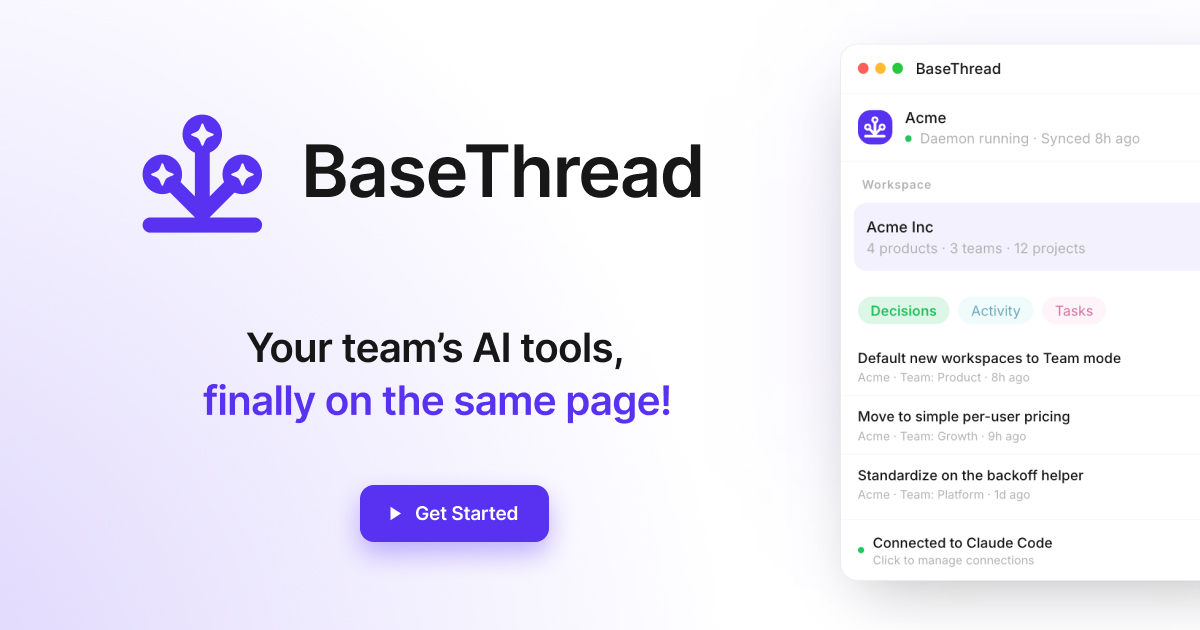
A shared context layer starts from the team. BaseThread holds one curated source, organized by Company, Products, Teams, Projects, and You, that every member's AI tools read over MCP. The context is curated, not scraped, and scoped by role. As work happens, those tools write activity, decisions, and tasks back, harmonized across the team so contributions sharpen the record instead of fragmenting it. A decision you log shows up for the next person's AI, which is exactly the part per-developer memory cannot carry. The deeper structural argument is in AI memory vs shared context.
Which should you pick?
- Want your own developer memory of snippets and context? Pieces is built for that.
- Want your whole team's AI tools to share one curated source plus a record of decisions and activity? That is a shared context layer. See how it works and the full comparison.
Many developers use both: Pieces for personal recall, BaseThread as the shared layer the team's tools read.
The honest summary
Pieces is per-developer memory, local and personal, and good at it. If you wanted your whole team's AI tools to share one curated context and a record of decisions, that is a shared context layer, not personal memory. Different unit, different job.
TL;DR
Pieces remembers context for one developer, locally, and it is good at that. BaseThread is a team-shared, cross-tool context layer: a curated graph organized by your real org that every member's AI tools read over MCP and write activity, decisions, and tasks back to. Per-developer memory does not compound into team knowledge because the unit is one developer. Keep Pieces for yourself; use shared context for the team.
Give your whole team one shared context every AI tool reads and writes back to, not a single-tool memory.
Related reading
Per-user AI memory doesn't compound into team knowledge
Per-user AI memory can't add up to team knowledge. Here is the structural reason ten people's personal memories never become one shared team brain, and what does.
AI memory vs shared context: the difference
AI memory vs shared context: memory is personal and locked to one tool, shared context is team-wide and read by every tool. Here is how to tell them apart.
Why AI agents forget, and how teams fix it
AI agents forget because context is per-session and per-agent, not persistent or shared. Here is the real reason, and the fix that works for a whole team.
AI memory software for teams: what to look for in 2026
Most AI memory software is built for one person. For a team you need shared, cross-tool memory every teammate's AI reads. Here is what to look for and the options.
Frequently asked questions
Is BaseThread a Pieces alternative?
Only if you wanted Pieces for the team, not for yourself. Pieces is per-developer memory: it lives on your machine and recalls the snippets, context, and workflow of one developer. BaseThread is a shared context layer for a whole team's AI tools, read over MCP. If you want your own local recall of code and context, Pieces is built for that. If you want every teammate's AI to share one curated source, BaseThread fits.
What is the difference between Pieces and BaseThread?
Pieces remembers for one developer, locally, inside their own workflow. BaseThread holds a curated context graph for the whole team, organized by your real company structure, that every member's AI tools read and write activity, decisions, and tasks back to. Pieces is your personal memory. BaseThread is the team's shared one.
Can per-developer memory become team knowledge?
Not by itself. Ten developers each running per-developer memory gives you ten private stores, on ten machines, that never merge. There is no mechanism to reconcile them into one shared source. Team knowledge needs the team as the unit from the start, which is what a shared context layer is built for.
Can I use Pieces and BaseThread together?
Yes. Keep Pieces for your own local recall of snippets and context, and use BaseThread as the shared layer your team's AI tools read so everyone is working from the same understanding. Personal memory and team context complement each other.