
AI memory vs shared context
Why AI agents forget, and how teams fix it
AI agents forget because context is per-session and per-agent, not persistent or shared. Here is the real reason, and the fix that works for a whole team.
AI agents forget. You explain the project, the agent does good work, and tomorrow it has no idea what you were doing. The instinct is to blame the model, but forgetting is not a bug in the model. It is structural. Once you see where the context actually goes, the fix for a team is obvious, and it is not a bigger context window.
Definition
Why AI agents forget
An AI agent only knows what is in its context window during a single session. When the session ends or the window fills, that context is gone unless something outside the model persists it. And what one agent holds is invisible to other agents and to teammates. So agents forget across sessions, across tools, and across people.
The three places context leaks out
Forgetting is really three separate leaks, and most fixes only patch one.
Across sessions. A model holds context in its window for the length of a conversation. End the session, and the window resets. Tomorrow's session starts blank unless you re-explain or something stored it. This is the leak people notice first.
Across tools. What Claude Code learned about your project does not show up in Cursor or ChatGPT. Each tool has its own session, its own window, its own memory if it has any. Context does not cross the boundary between tools on its own.
Across people. What your agent figured out is invisible to a teammate's agent. There is no shared place for one person's AI to leave something the next person's AI can pick up. Knowledge that lives in one session, for one person, is lost to the team the moment that session ends.
A bigger context window only touches the first leak, and only barely. It still empties at the end of the session, still belongs to one tool, and still never reaches your teammates.
Why memory features only get you part way
The obvious patch is memory, and tools have added it. ChatGPT, Claude, and Cursor remember some things across your own sessions. Agent-memory systems like Zep and Letta give the agents you build a persistent store. These genuinely help the first leak, and sometimes the second.
But built-in memory is per-user and usually per-tool, so it does not cross to teammates. And agent-memory infrastructure serves one agent you build, not a whole team's tools. We lay this out in Zep and Letta alternative for teams. Memory shortens the gap for one person or one agent. It does not close the team gap, because the team gap is about reaching other people and other tools, which is not what memory is built to do. The fuller version is in AI memory vs shared context.
The fix that actually works for a team
If the problem is that context is trapped in sessions, per agent, per person, the fix is a source outside the session that every tool reads and writes back to.
That is what a shared context layer is. Concretely:
- One curated source. A context graph organized by the company's real structure: Company, Products, Teams, Projects, and You. It is curated, not scraped, so what the agent reads is the version a human stands behind, scoped by role.
- Every tool reads it. Claude Code, Cursor, and ChatGPT read the same source over MCP, through a local Mac bridge or a remote server. The agent starts work already knowing what it needs, instead of starting blank.
- Tools write back. As work happens, those tools record activity, decisions, and tasks back to the shared source. What got done, what the team agreed and why, what is next. So the next session, in any tool, by any teammate, picks up where the last one left off.
- Harmonized across the team. When many people's tools contribute, the record is reconciled, not piled up, so it gets sharper as more work happens, not noisier.
The agent still forgets within a session, because that is how models work. But nothing important lives only in the session anymore. It lives in the shared source, and every tool can read it back. This is the heart of the team-context problem.
So how do you stop your agents forgetting?
- For one person, in one tool: built-in memory helps, and it is on by default.
- For one agent you build: an agent-memory store like Zep or Letta is the right layer.
- For a whole team, across every tool: you need a shared context layer every tool reads and writes back to. That is the only fix that closes all three leaks at once.
See how it works for the read-and-write-back loop, and the comparison for where memory ends and shared context begins.
One line to remember it
Agents forget because context is per-session, per-agent, and per-person. A shared source every tool reads and writes back to is the only fix that reaches across all three.
TL;DR
AI agents forget because their context is per-session and per-agent: the window empties when the session ends, and what one agent holds never reaches other tools or teammates. A bigger context window does not fix it. Memory features help one person or one agent but not a team. The team fix is a shared context layer: a curated source organized by the company's real structure that every tool reads over MCP and writes activity, decisions, and tasks back to, harmonized across the team.
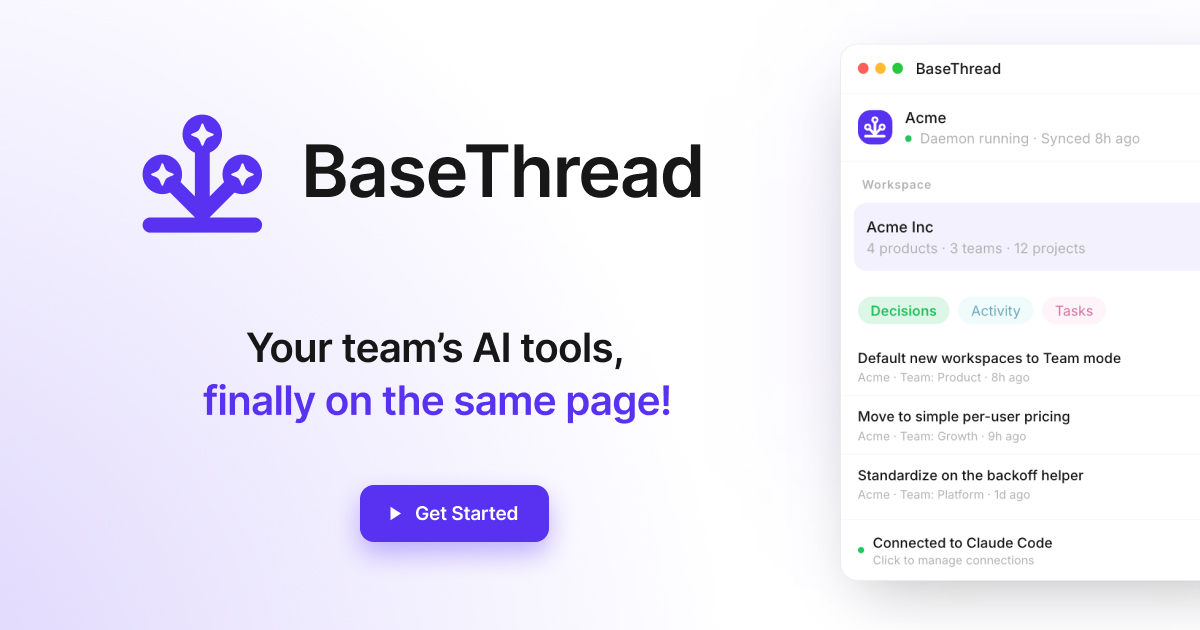
How a shared source keeps every teammate's AI tools from starting blank.
Related reading
AI memory vs shared context: the difference
AI memory vs shared context: memory is personal and locked to one tool, shared context is team-wide and read by every tool. Here is how to tell them apart.
Zep and Letta alternative for teams
Zep and Letta give the agents you build memory. If you want shared context across your whole team's AI tools instead, here is the honest difference.
The team-context problem nobody has solved yet
Every AI tool solves context for one person. The team-context problem, one shared, current context across every tool and teammate, is the gap nobody filled.
AI memory software for teams: what to look for in 2026
Most AI memory software is built for one person. For a team you need shared, cross-tool memory every teammate's AI reads. Here is what to look for and the options.
Frequently asked questions
Why do AI agents forget?
Because their context is per-session and per-agent. A model only knows what is in its context window right now. When the session ends, or the window fills up, that context is gone unless something outside the model persists it. And what one agent remembers is invisible to another agent and to your teammates. So agents forget across sessions, across tools, and across people.
Does a bigger context window fix forgetting?
It helps within one session, but it does not fix the real problem. A bigger window still empties when the session ends, still belongs to one agent, and still does not reach your teammates' tools. The fix is not a bigger window. It is a persistent, shared source the agent reads at the start of work and writes back to as work happens.
How do teams fix AI agents forgetting?
By giving every teammate's AI tools one shared source to read from and write back to. Instead of each agent relying on its own session memory, they all read a curated context graph organized by the company's real structure, and they record activity, decisions, and tasks back to it. Nothing important lives only in a session that is about to end.
Is agent memory the same as shared context?
No. Agent memory makes one agent remember across its own sessions. Shared context makes every teammate's tools understand the team. Memory is per-agent recall. Shared context is a team-wide source every tool reads. They solve different layers of the forgetting problem.