
Context engineering for teams
Semantic, episodic, procedural: the types of AI memory
AI memory comes in three kinds borrowed from cognitive science: semantic, episodic, and procedural. Here is what each one is and why teams need all three.
Ask most people what AI memory is and they will describe a chat assistant remembering their name. That is real, but it is one thin slice of a much older idea. Cognitive scientists have split human long-term memory into three kinds for decades, and the same three map cleanly onto what an AI needs to give good answers.
The three are semantic, episodic, and procedural. Once you see them, you notice that almost every AI memory feature on the market covers the first one shallowly and ignores the other two. That gap is the whole story.
Semantic memory: what is true
Semantic memory is your store of facts and concepts, knowledge detached from when you learned it. You know the capital of France without recalling the moment you learned it. For an AI, semantic memory is the stable structure of your situation.
For a team that means: what the company is, what products it builds, which teams and projects are in flight, who owns what. It is the background that does not change hour to hour. When an AI knows your product is a billing platform and not a social app, that is semantic memory doing its job.
This is the layer most AI memory features gesture at, and even then only for one person. They might remember you prefer TypeScript. They do not hold the shared, structured facts of your whole team.
Episodic memory: what happened
Episodic memory is your record of specific events, tied to time and place. The meeting on Tuesday, the decision you reversed last month, the bug you shipped and fixed. It is autobiographical, ordered, particular.
For an AI, this is the layer almost nothing captures, and it is the one teams miss most. The fact that your product handles billing is semantic. The decision, made three weeks ago, to drop the annual plan is episodic. A good answer often needs both: the standing fact plus the event that changed it.
Without episodic memory, an AI answers from a frozen snapshot. It tells you the plan as it was, not as it is, because nothing recorded what happened in between. It is the same reason AI agents forget the moment a session ends: with no episodic record, every fresh task starts blind to what came before. This is why a running record of activity and decisions matters so much, and why we treat it as core, see AI memory vs shared context.
Procedural memory: how things are done
Procedural memory is skill and habit, the knowledge of how to do something that you do not consciously recite. Riding a bike. Touch typing. For a team, procedural memory is your conventions: how you name branches, how you structure a PR, the review process, the house style, the way decisions get made.
An AI with procedural memory does not just know the facts and the history, it acts the way your team acts. It follows the conventions without being re-told each time. A rules file like a CLAUDE.md is an early, manual stab at procedural memory, one tool, one repo, hand-maintained. It is a start, but it does not travel or stay current.
The three types, side by side
| Type | Answers | Team example | Usually captured? |
|---|---|---|---|
| Semantic | What is true | The company, products, projects, ownership | Partly, per user |
| Episodic | What happened | Decisions made, work shipped, with timing | Rarely |
| Procedural | How it is done | Conventions, process, house style | Manually, per tool |
The pattern jumps out. Single-tool memory gives you a shallow, personal version of semantic memory, skips episodic almost entirely, and leaves procedural to a static rules file. The richest, most valuable layers are the ones it misses.
Why teams need all three, shared
Here is the part that single-tool memory cannot do by design: it is per-user. Your assistant remembering your preferences never becomes your teammate's assistant knowing the same things. We dig into why in per-user AI memory doesn't compound into team knowledge. Even the developer memory frameworks built to store these layers are per-agent and need wiring up, which is why teams reach for a Zep and Letta alternative for teams that ships the shared version instead.
A team needs the three types shared and readable by every tool:
- Shared semantic memory: one structured picture of the company, products, teams, and projects.
- Shared episodic memory: a running record of activity and decisions, so every tool sees what happened, not a stale snapshot.
- Shared procedural memory: the conventions everyone follows, available to every tool, not buried in one repo's rules file.
That combination is shared context for AI tools, and it is what context engineering for teams is really assembling.
How BaseThread maps to the three
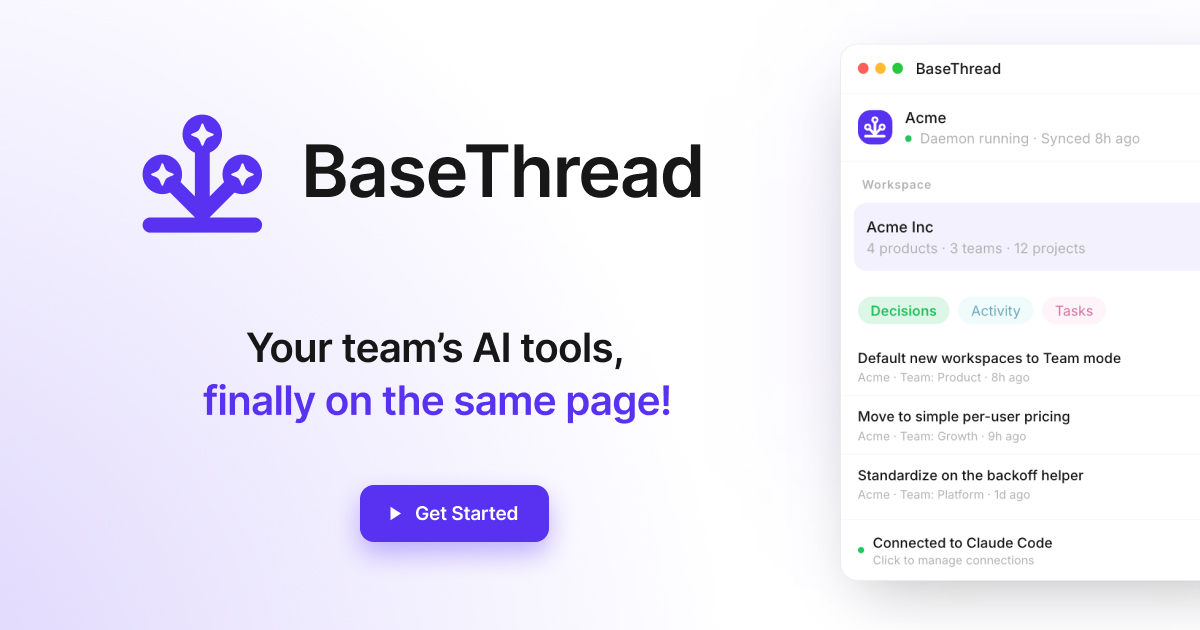
BaseThread is structured around exactly these layers. The context graph, the company, products, teams, projects, and you, is the shared semantic memory: the stable structure of what is true. The activity and decisions streams are the shared episodic memory: a time-ordered record of what happened and what the team settled, with tasks as the forward view. Conventions and preferences carried in that graph and read at session start act as procedural memory, so tools follow the way your team works.
Every AI tool reads the relevant slice over MCP, through the local Mac app or the remote endpoint, and writes activity, decisions, and tasks back as work happens. Integrations distill context from tools like Notion and HubSpot into the graph, the signal, not a dump. Three types of memory, shared across the team, kept current by the work.
The quick audit
Look at your AI memory today. It probably holds a little semantic memory, for you, in one tool. Ask where the episodic record lives, and where the procedural conventions live, shared. Those two gaps are where team knowledge leaks.
TL;DR
AI memory maps to three cognitive-science types: semantic (facts, what is true), episodic (events, what happened and when), and procedural (skills, how things are done). Most AI memory features cover a thin personal slice of semantic memory and skip the rest. Teams need all three shared and readable by every tool: a structured graph (semantic), a running activity and decisions record (episodic), and carried conventions (procedural). BaseThread is built around exactly these layers, read over MCP and kept current by the work.
Structure, record, and conventions, shared across the team and read by every tool.
Related reading
AI memory vs shared context: the difference
AI memory vs shared context: memory is personal and locked to one tool, shared context is team-wide and read by every tool. Here is how to tell them apart.
What is context engineering for teams?
Context engineering is the discipline of getting the right information in front of a model. For teams it means doing it once, shared, so every tool answers well.
Per-user AI memory doesn't compound into team knowledge
Per-user AI memory can't add up to team knowledge. Here is the structural reason ten people's personal memories never become one shared team brain, and what does.
What is shared context for AI tools? (2026 guide)
Shared context for AI tools is the company, project, and decision background every AI reads automatically, so your whole team's tools stop guessing.
Frequently asked questions
What are the three types of AI memory?
Borrowed from cognitive science, they are semantic memory (facts and concepts: what is true), episodic memory (specific events: what happened and when), and procedural memory (skills and conventions: how things are done). Most AI memory features cover the first one shallowly and skip the other two. A complete context system needs all three.
What is the difference between semantic and episodic memory in AI?
Semantic memory holds stable facts, like what your product is or who owns a project. Episodic memory holds time-stamped events, like a decision made on Tuesday or a feature that shipped last sprint. Semantic memory answers what is true; episodic memory answers what happened. A good answer often needs both: the fact plus the event that changed it.
Why do the types of AI memory matter for teams?
Per-user AI memory mostly captures a thin slice of semantic memory for one person, in one tool. Teams need shared semantic memory (the structure of the company), shared episodic memory (the record of activity and decisions), and shared procedural memory (the conventions everyone follows), all readable by every tool. Mapping the three types shows exactly what single-tool memory leaves out.