
Shared context for AI tools
Notion AI and Slack AI vs a layer your tools all read
Notion AI reads your Notion. Slack AI reads your Slack. Here is the honest case for a curated context layer every AI tool reads, across all your apps.
Notion AI and Slack AI are both excellent at the same trick: they make the app you are already in smarter. Ask Notion AI about your docs, it answers from your docs. Ask Slack AI about a thread, it answers from your messages. That ecosystem-native design is exactly why they feel so natural. It is also exactly where they stop. Each one only reads its own app. The moment your work spans tools, and it always does, you feel the wall. That wall is what a shared context layer is for.
What Notion AI and Slack AI do well
Give them their due. Inside their own walls, they are genuinely good.
- Notion AI reads your Notion. Summarize a page, draft from your notes, answer questions across your Notion content, right where your docs live.
- Slack AI reads your Slack. Catch up on a channel, search conversations in natural language, pull the thread you half-remember.
- No new home. Both live inside tools your team already uses every day, so there is nothing extra to adopt.
If your need is "make my Notion smarter" or "make my Slack searchable," these are the right answers and this comparison is academic.
Where ecosystem-native AI stops
The strength is the limit. Each one is native to one ecosystem, which means it is blind to the others.
- Notion AI cannot see your Slack. And Slack AI cannot see your Notion. The decision discussed in Slack and the spec written in Notion never meet.
- Neither feeds your coding tools. Your Claude Code and Cursor still start blank. Notion AI and Slack AI do not reach them at all.
- Context stays trapped per app. Your team's actual context is spread across Notion, Slack, HubSpot, your repo, and more. App-native AI sees only its own slice.
This is the gap we cover in moving from a team wiki to context your AI tools actually read.
A layer all your tools read
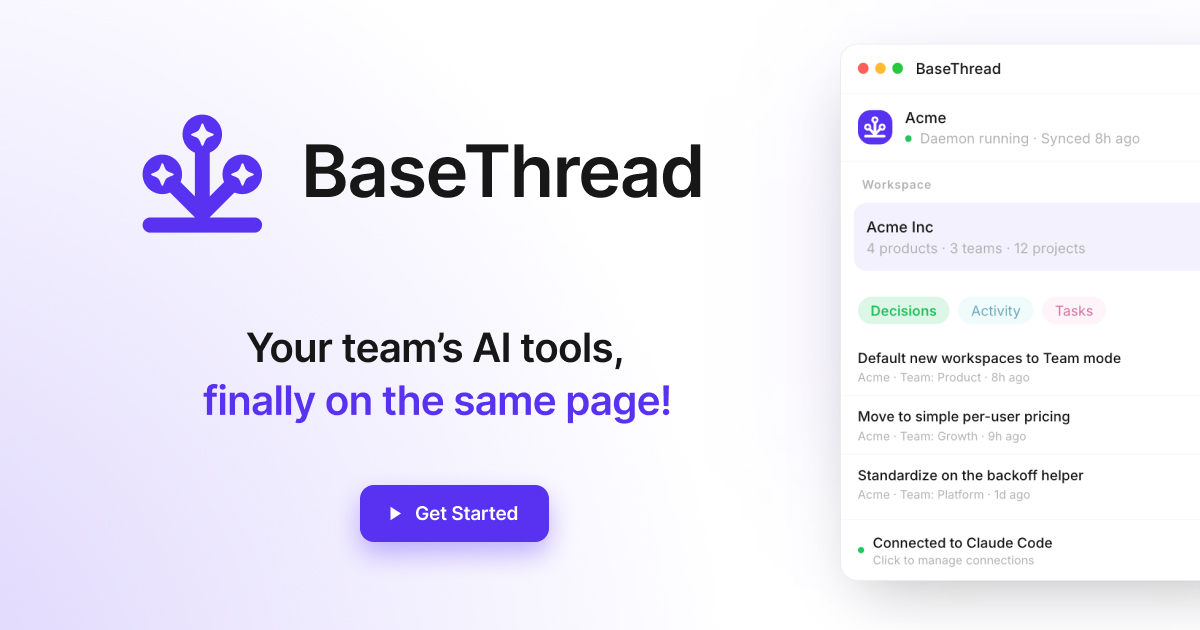
BaseThread takes the cross-tool view that no single-app AI can. It does not live inside one product. It sits across them.
- One curated context, not per-app slices. Your AI writes the signal into a single context graph, structured the way your company works (Company, Products, Teams, Projects, You).
- Read by every AI tool over MCP. Claude Code, Cursor, ChatGPT, and any MCP client read it, local or remote, so the context shows up in whatever tool you are using.
- Your AI is the integration. Your AI already reaches tools like Notion and HubSpot with the access it has; it works with them through your AI and writes what matters into the graph, curated not scraped. BaseThread never connects to or copies your tools. For the Notion case specifically, give every AI tool your Notion context walks the play.
- Decision-aware. Activity, Decisions, and Tasks run through the graph, so the cross-tool context includes what the team agreed, not just what they wrote in one app.
So the spec in Notion and the decision from Slack land in the same curated context, and your coding tools read it too.
Notion AI and Slack AI vs a shared context layer
| Notion AI / Slack AI | BaseThread | |
|---|---|---|
| Reads across all your tools | No, one app each | Yes, your AI writes the signal into one graph |
| Feeds Claude Code / Cursor | No | Yes, over MCP |
| Where the AI works | Inside Notion or Slack | Every AI tool, over MCP |
| Context shape | One app's content | Curated cross-tool graph |
| Captures decisions | No | Yes, Activity, Decisions, Tasks |
| Best for | Smarter Notion or Slack | Every tool sharing your team's context |
Use them together
These are not rivals so much as different layers. Keep Notion AI making your Notion smarter and Slack AI making your Slack searchable. Add a shared context layer for the job neither does: feeding one curated team context to every AI tool, including the ones Notion AI and Slack AI never touch. Many teams run all three for different reasons.
The one-liner
Notion AI reads your Notion. Slack AI reads your Slack. BaseThread is the curated context every AI tool reads, across all your apps, so context stops being trapped in one product.
TL;DR
Notion AI and Slack AI are ecosystem-native: each makes its own app smarter and each only reads that app. Neither reaches across your other tools or feeds your coding tools like Claude Code and Cursor. BaseThread does the cross-tool job: your AI reads your tools with the access it already has and writes the signal into one curated context graph, with Activity, Decisions, and Tasks, and every AI tool reads it back over MCP. Keep the app-native AIs for their apps; add a shared context layer so every tool reads one team context.
Give every AI tool your team uses one shared context, not one app's built-in memory.
Related reading
Notion AI vs BaseThread: a wiki your AI reads vs context your tools read
Notion AI vs BaseThread: Notion AI answers inside your Notion docs. BaseThread feeds your team's context to every AI tool. Here is the honest difference.
What is shared context for AI tools? (2026 guide)
Shared context for AI tools is the company, project, and decision background every AI reads automatically, so your whole team's tools stop guessing.
From a team wiki to context your AI tools actually read
Your wiki is full of knowledge your AI tools never read. Here is how to move from a human-read wiki to shared context every AI tool reads at session start.
How to build a team second brain (step by step)
A team second brain is one curated context every teammate's AI reads. Here is how to build one in five steps, starting small and letting your AI keep it current.
Frequently asked questions
What is the difference between Notion AI, Slack AI, and BaseThread?
Notion AI reads and answers within Notion. Slack AI reads and answers within Slack. Each is ecosystem-native and good at its own app, but neither reaches across your other tools. With BaseThread, your AI reads your tools with the access it already has and writes the signal into one curated context layer that every AI tool you use reads over MCP, so the context is not trapped in a single app.
Is BaseThread a Notion AI or Slack AI alternative?
Not a direct replacement. Notion AI makes your Notion smarter and Slack AI makes your Slack smarter, and many teams keep both. BaseThread does the cross-tool job neither does: it feeds one curated team context to all your AI tools, including Claude Code and Cursor, over MCP. Different problem, often used alongside them.
Why does ecosystem-native AI fall short for cross-tool work?
Because each one only sees its own app. Notion AI cannot answer from your Slack, and Slack AI cannot answer from your Notion, and neither feeds your coding tools. Real work spans tools. A curated context layer that all your AI tools read fixes the part where context is locked inside one product.